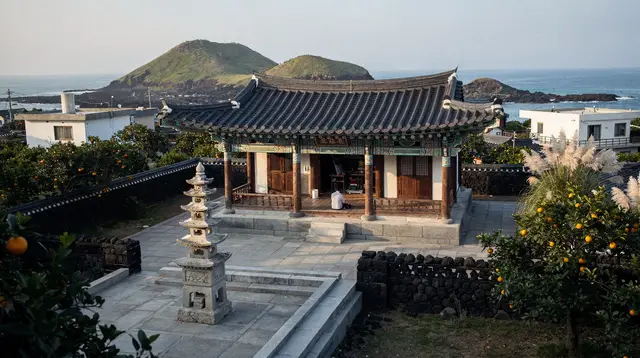
Jeju road trip loop itinerary
Jeju’s coastal ring road (routes 1132 and 1136) traces roughly 180-200km around the island’s perimeter, and driving the full loop rather than darting inland between regions is its own kind of trip — one built around the drive itself as much as the stops along it. This seven-day version circles the island clockwise from Jeju City, with a night in each major region and no single driving leg longer than about 90 minutes.
| Where | Full coastal ring — Jeju City, East Jeju, Seogwipo, Jungmun, West Jeju |
| Duration | 7 days, 6 nights |
| Cost | around ₩1,050,000-1,400,000/person (~US$780-1,035), excl. flights |
| Getting there | CJU airport, rental car (IDP required) |
| Best time | October for visibility; avoid typhoon season (late Aug-Sept) |
The loop at a glance
| Day | Leg | Highlight | Overnight |
|---|---|---|---|
| 1 | Jeju City | Dongmun Market, Yongduam Rock | Jeju City |
| 2 | Clockwise to East Jeju | Manjanggul lava tube | Seongsan |
| 3 | Seongsan sunrise, south | Seongsan Ilchulbong, coastal towns | Seogwipo |
| 4 | Seogwipo’s waterfalls | Cheonjiyeon, Jeongbang, Jusangjeolli | Seogwipo/Jungmun |
| 5 | Long westward leg | Sanbangsan, Osulloc | Aewol/west coast |
| 6 | Aewol’s cafe coast | Handam walk, Hallim Park | Aewol |
| 7 | Final morning | Return leg to CJU | Departure |
Who this road trip suits
This suits self-drive enthusiasts who enjoy the act of driving scenic coastline as much as arriving at a destination, photographers who want flexibility to pull over wherever the light is good, and couples or small groups comfortable splitting a week’s worth of rental car and fuel costs. It’s a mismatch for anyone without an International Driving Permit — legally required to drive on Jeju — or travelers who’d rather have someone else handle navigation; both groups are better served by a guided-tour-based itinerary instead.
Most nationalities — US, EU, UK, Canada, Australia among them — get 30 days visa-free on a direct CJU flight, with the K-ETA exemption for these groups running through December 2026. Book the rental car well ahead if traveling during spring bloom season or the July-August peak, when compact cars sell out days in advance and a longer road trip like this one needs a vehicle reserved for the full week rather than day by day.
Pick-up and return for the Jeju loop
This loop starts around Jeju City and finishes back on the north coast, so the simplest plan is to collect the car at the airport after your CJU flight and hand it back at the same place on the final morning. That makes a one-way fee irrelevant, and it lets you leave straight after landing rather than waiting on a taxi.
Compare the details that matter on a coastal week of driving: how much excess you pay if the car is scratched in a tight cafe car park, whether fuel is returned full, and whether a second driver can be added if a partner will share the long westward leg. Photographers should also check the boot fits camera bags, and you can look at airport pick-ups through DiscoverCars for Jeju airport.
Day 1: Jeju City and the northern approach
Land at CJU, collect a rental car in Yongdam (International Driving Permit required at pickup), and spend the day easing into Jeju City before the loop begins in earnest — Dongmun Traditional Market for lunch, Yongduam Rock for an evening coastal walk. This is also the day to confirm your car’s condition and insurance terms carefully, since you’ll be putting more miles on it this week than on any shorter Jeju itinerary.
Photograph the car from all angles at pickup before leaving the Yongdam lot, and confirm exactly what the collision damage waiver covers — a dispute over a pre-existing scratch is a far more common complaint on week-long rentals than on a two- or three-day booking, simply because there’s more time for something to happen or be misattributed. Overnight in Jeju City, mid-range rooms ₩80,000-120,000/night.
Day 2: Clockwise to East Jeju
Drive east along route 1132 — 50-70 minutes to East Jeju’s main sites — stopping at Manjanggul lava tube (entry ~₩4,000, 40-60 minute walk, constant 11-21°C underground) and Bijarim Forest or Sangumburi Crater (₩3,000-4,000 each) along the way. Jeju: Popular Sightseeing Private Car Charter Tour is worth noting for a later day if driving fatigue sets in and you want a break from being behind the wheel. Overnight in Seongsan, guesthouse rooms ₩60,000-90,000/night.
Day 3: Seongsan sunrise, then continue south
Arrive at Seongsan Ilchulbong 30-45 minutes before sunrise (entry ~₩5,000, 20-40 minute climb on paved steps) — a road trip’s flexible schedule makes an early start easier than on a tour-based itinerary. Afterward, walk Seopjikoji’s headland before continuing the loop south. The coastal road between Seongsan and Seogwipo — about an hour — passes through smaller fishing towns worth a quick photo stop even without a planned attraction at each one; this stretch is part of the loop’s appeal, not just a transit segment.
Settle into Seogwipo by evening for the Maeil Olle Market and an early night. Mid-range rooms run ₩90,000-130,000/night.
Day 4: Seogwipo’s waterfalls and Jungmun
Spend the morning at Cheonjiyeon Waterfall (entry ~₩2,000; see the Cheonjiyeon Waterfall guide) and Jeongbang Waterfall, which drops directly into the ocean. Continue to Jungmun for Jusangjeolli’s columnar basalt cliffs, a short boardwalk walk (entry ~₩2,000-3,000) worth timing for golden hour if your schedule allows. Jeju: Private Car Charter Tour is a reasonable option for this specific day if the previous three days of driving have been tiring and you’d rather be a passenger for once. Overnight in Seogwipo or Jungmun.
Day 5: The long westward leg to Sanbangsan
This is the loop’s longest single driving day — continuing west along the south coast toward Sanbangsan, roughly 45-60 minutes from Jungmun, with several coastal pull-offs worth a stop along the way. Sanbangsan’s grotto temple and the nearby Yongmeori coastal cliffs (entry ~₩2,500) are the day’s main attraction, best visited with tide times checked in advance since the Yongmeori path floods at high tide. Continue north to West Jeju’s Osulloc Tea Museum in the afternoon. Overnight around Aewol, ₩80,000-120,000/night.
Day 6: Aewol’s cafe coast, completing the loop
With most of the driving behind you, use this day for West Jeju’s slower pleasures — Aewol’s ocean-view cafes along the Handam coastal walk, and Hallim Park’s caves and gardens if there’s energy for one more attraction. This is the loop’s natural rest day, built around walking short distances rather than long drives. Overnight in Aewol again or push the final short stretch back toward Jeju City.
Day 7: Final morning and departure
The drive from Aewol back to CJU is one of the shortest transfers of the whole trip — 20-25 minutes — which makes a mid-afternoon flight comfortable even with a leisurely final morning. If time allows, Hamdeok’s Seoubong Beach on the way back offers one last coastal stop before returning the rental car with a full tank in Yongdam. Budget 20-30 minutes for the return process.
If it rains
A road trip’s flexibility is its biggest advantage in bad weather — unlike a fixed-schedule guided tour, you can simply reorder days to chase better conditions. Manjanggul is a reliable underground fallback any day. If the coastal drive itself is the point and visibility is poor, consider delaying a scenic leg by a day rather than driving it in fog or heavy rain purely to stay on schedule; with seven days built in, there’s usually slack to absorb one bad-weather day without losing a planned stop entirely.
East Jeju’s exposed coastline is typically the first to see wind-driven weather worsen, so if the forecast is mixed across the week, front-loading the more sheltered Seogwipo stretch and pushing the east-coast days later can sometimes work in your favor.
Getting around the full loop
Total driving across the full circuit runs approximately 200-230km, with fuel costing ₩35,000-45,000 depending on your car’s efficiency and current fuel prices. Naver Map or Kakao Map are the navigation apps to use — Google Maps has meaningful gaps for driving directions in Korea, particularly on the smaller coastal roads that make up much of this loop’s appeal. Insurance terms vary meaningfully between rental agencies, and disputes over scratches and minor damage are a common complaint among visitors on longer road trips specifically, given the extra mileage — photograph the car from all angles at pickup and confirm exactly what the collision damage waiver covers before signing.
An eSIM or pocket wifi device arranged before landing is worth setting up before leaving the rental counter, since navigation matters more on a loop like this than on a shorter itinerary with fewer unfamiliar roads. Rest stops and gas stations are reasonably frequent along the main coastal road, though become sparser on the smaller inland detours near Osulloc and Sanbangsan — worth topping up fuel before those specific stretches rather than assuming a station will appear when needed.
Budget for a 7-day road trip
Entry fees stay modest throughout the loop: Manjanggul ₩4,000, Seongsan Ilchulbong ₩5,000, Cheonjiyeon ₩2,000, Jusangjeolli ₩2,000-3,000, Sanbangsan ₩2,500. A realistic daily budget for food, entry fees, and incidentals runs ₩90,000-130,000 per person, before lodging and the car. Six nights of mid-range lodging run ₩480,000-650,000 total, and a compact rental car across seven days runs ₩350,000-490,000 in low season, more during spring bloom weekends or the July-August peak.
Rough per-person total for seven days, split between two travelers: ₩1,050,000-1,400,000 (~US$780-1,035), excluding flights to Jeju. Fuel is a smaller line item than most people expect relative to the car rental and lodging costs, typically under 5% of the total trip budget even for this longer driving distance.
Where to stay along the way
This itinerary assumes six moves — a new town roughly every night — which maximizes coverage of the full loop but does mean daily packing and unpacking. A slightly less demanding version pairs nights (two in Seongsan, two in Seogwipo, two on the west coast) at the cost of some backtracking on the days between planned stops, a reasonable trade if the daily hotel changes sound more tiring than the extra driving.
Booking each night individually rather than as a package gives more flexibility to adjust the schedule if a weather day shifts your plans, though it does mean more separate reservations to manage. For travelers who prefer fewer logistics, pre-booking all six nights before departure and simply accepting a fixed schedule removes any need to search for last-minute accommodation while on the road.
What makes a road trip loop different from a standard itinerary
Unlike the standard 7-day itinerary, which treats driving purely as transit between planned stops, this version treats the coastal road itself as part of the experience — deliberately choosing the slower coastal route (1132) over the faster cross-island road wherever the schedule allows, and building in unplanned stops for scenic pull-offs rather than sticking rigidly to a fixed list of attractions. If that flexible, drive-for-the-sake-of-driving approach doesn’t appeal, the standard itinerary or the more focused East Jeju and West Jeju regional itineraries deliver similar sights with less total driving.
What makes a good road trip car for this loop
A compact or midsize sedan handles every road on this route comfortably, including the approaches to Sanbangsan and the smaller inland detours near Osulloc — there’s no need to pay extra for an SUV unless you specifically want the cargo space for luggage or photography gear. Automatic transmission is standard at nearly every rental counter and worth requesting specifically if you’re not comfortable with manual transmission, since Korea’s rental fleet still includes both. A car with reliable navigation integration, or at minimum a solid phone mount, matters more on this itinerary than a shorter trip given how much time you’ll spend following turn-by-turn directions across seven days of varied roads.
Fuel efficiency is a minor consideration given how modest the total driving distance is relative to the trip length — even a larger rental car’s fuel cost for 200-230km stays a small fraction of the overall week’s budget, so choosing a car for comfort and space rather than optimizing purely for fuel economy is a reasonable call for a trip this length.
Coastal pull-offs worth the unplanned stop
Part of the appeal of this itinerary specifically is that it doesn’t need to be followed rigidly — the coastal road between planned stops is full of small harbors, rock formations, and viewpoints with no formal name or entry fee that a faster driving itinerary skips entirely. The Jeju Instagram spots guide and the top 10 photo spots roundup both include several unplanned-stop-friendly locations along this exact route, worth bookmarking before the trip so you recognize a good pull-off when the road passes it rather than driving on and regretting it later. Building 15-20 minutes of slack into each day’s driving estimate specifically for this kind of stop is one of the simplest ways to make a road trip loop feel meaningfully different from a standard point-to-point itinerary.
Avoiding common car rental pitfalls on a week-long loop
A seven-day rental accumulates more miles, more parking situations, and more chances for a disputed charge than a two- or three-day booking, so it’s worth reading the car rental pitfalls guide before pickup rather than after a problem shows up. The car rental and IDP guide covers the International Driving Permit requirement in more depth if there’s any doubt about eligibility, and the driving and road trip tips guide has route-specific notes on the smaller coastal roads this loop deliberately favors over the faster cross-island routes. Photographing the car at pickup and again at drop-off, on every side, takes five minutes and resolves most disputes before they start.
Frequently asked questions about the Jeju road trip loop itinerary
How long does it actually take to drive around Jeju?
The full 180-200km coastal loop takes roughly 5-6 hours of pure driving time without stops, though spreading it across seven days with sightseeing stops is a far more realistic and enjoyable pace than attempting it in one day.
Is the coastal road faster or slower than the cross-island route?
Slower — the coastal roads (1132, 1136) pass through towns and have more traffic lights and turns, while the cross-island roads (97, 1131) cut through the interior more directly. This itinerary favors the coastal route deliberately for the scenery.
Do I need a four-wheel-drive vehicle for this loop?
No — a standard compact or midsize rental car handles the entire route without issue, including the roads near Hallasan and Sanbangsan; four-wheel drive isn’t necessary outside of winter snow conditions in the mountain interior.
What’s the best direction to drive the loop, clockwise or counter-clockwise?
Either works equally well; this itinerary goes clockwise starting east, but reversing the order and starting west works just as smoothly with roughly the same drive times.
How many rest days should I build into a road trip this long?
At least one, which this itinerary places on day six around Aewol — after five days of daily driving and hotel changes, a day built around short walks rather than long drives noticeably improves the second half of the trip.
Is renting a car for all seven days more expensive than mixing in tours?
Usually cheaper if you’re a couple or small group splitting the daily rate, since seven days of guided tours would cost considerably more per person than seven days of a shared rental car plus fuel.
What should I check before returning the rental car at the end?
A full fuel tank to avoid the inflated per-liter refueling penalty most agencies charge, and a final walk-around to photograph the car’s condition against your pickup-day photos in case of any damage dispute.
Is a road trip loop suitable for a family with kids?
It can be, though the daily driving and frequent hotel changes are more tiring for young children than for adults — families often prefer the more downtime-focused Family Jeju itinerary, which builds in fewer moves and more rest stops.
Should I book all seven nights of accommodation before arriving?
Yes, especially Seongsan and the Jungmun/Sanbangsan area, both of which have smaller lodging supply than Jeju City — booking day-by-day risks finding nothing available in the smaller towns during peak periods.
What’s the single most scenic stretch of the whole loop?
Opinions vary, but the coastal road between Seongsan and Seogwipo on day three and the approach to Sanbangsan on day five are two of the more consistently praised stretches for unplanned photo stops along the way.
How does this itinerary compare in cost to the standard 7-day itinerary?
Roughly comparable, since both use a rental car for the full week and cover similar regions — the road trip loop simply prioritizes the coastal route and scenic driving over efficiency, which doesn’t meaningfully change the total budget.
What’s the biggest rental car mistake on a loop this long?
Skipping the pickup and drop-off condition photos — see the car rental pitfalls guide; disputes over scratches and minor damage are a more common complaint on week-long rentals than shorter ones simply because there’s more time and mileage involved.
Are unplanned photo stops worth the extra time on a tight loop?
Yes, if the driving-for-its-own-sake appeal is part of why you chose this itinerary over the standard one — building 15-20 minutes of slack per day for pull-offs is part of what makes this version feel different from a point-to-point trip.
Related guides

Driving around Jeju: road trip tips
Practical driving tips for a Jeju road trip: route lengths, speed enforcement, parking, fuel stops, and when a car charter beats self-driving.

Jeju airport transfers
Comparing every way from Jeju Airport (CJU) to your hotel — limousine bus, city bus, taxi, Kakao T, and private transfer, with real prices.

Best beaches in Jeju
A side-by-side comparison of Jeju's main beaches — Hyeopjae, Hamdeok, Gwakji, Woljeongri, Jungmun, Sinyang, Iho Tewoo — by what each is best for.

Best day tours in Jeju
A roundup of Jeju's main day-tour types — bus loops, private cars, and UNESCO-themed routes — with realistic prices and who each one suits.
Ready to book? Top tours for this guide
We earn a small commission if you book through GetYourGuide — at no extra cost to you. Every tour is hand-picked and verified.
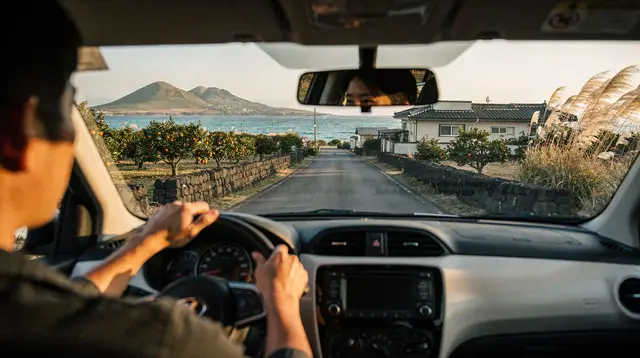
Jeju: UNESCO Day Tour for Cruise Guests
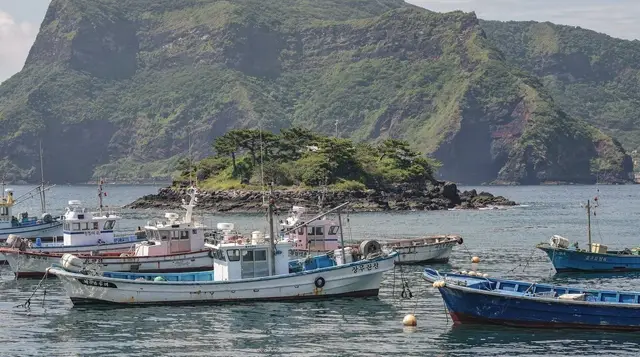
Jeju: Highlights Day Trip (East Course)
Jeju Island: Full Day Tour for Cruise Ship Passengers
Jeju: Small Group UNESCO Highlights Tour for Cruise Guests

Jeju East: Cherry Blossom Early Bird Tour with Hotel Pickup