
Jeju airport transfers
What's the best way to get from Jeju Airport to my hotel?
It depends on your luggage and destination. The limousine bus 600 (₩3,500-4,700) is the most cost-effective option to Jungmun or Seogwipo; a taxi (₩5,000-8,000 to Jeju City center) suits short hops with luggage; and a pre-booked private transfer is worth the extra cost for families, groups, or late-night arrivals who want to skip the logistics entirely.
Landing at CJU puts you within a few minutes’ walk of every ground transport option on the island — the harder part is picking the right one for your situation, since the cheapest option isn’t always the most practical, and the most convenient one isn’t always necessary.
| Where | Jeju International Airport (CJU), arrivals hall exits |
| Cost | ₩1,000 (city bus) to ~₩45,000 (private transfer/taxi to Seogwipo) |
| Time to Seogwipo | 60-80 min depending on option |
| Best for groups | Private transfer, split cost per person |
| Payment | Contactless card, T-money, or app-based (cash rarely needed) |
The decision, in short
A solo traveler with a backpack heading into Jeju City has little reason to spend on a private transfer — the limousine bus or a short taxi ride covers it cheaply and quickly. A family of four with two large suitcases heading to a resort in Jungmun or Seogwipo faces a genuinely different calculation: bus transfers with luggage and small children involve real friction (finding luggage space, managing stops, walking from the bus stop to a hotel entrance), and the cost difference between a bus and a private transfer split across four people often becomes marginal. Neither choice is wrong — they’re suited to different situations, and this guide walks through all of them with real prices so you can match the option to your trip rather than defaulting to whatever’s most familiar.
Limousine bus 600
The 600 is the airport’s dedicated express bus, built specifically for reaching the resort areas on the south side of the island without the stop-heavy routing of a regular city bus. It runs from 6:20am to 9:50pm, departing every 10-15 minutes, with clearly marked stops and luggage racks on board — a meaningfully different experience from a standard city bus.
Fares are ₩3,500 to Jungmun and ₩4,700 to Seogwipo, payable with a contactless card or T-money-compatible transit card at boarding. Total travel time to Seogwipo runs about 70-80 minutes including all intermediate stops, so it’s not fast, but it’s a genuinely comfortable and low-cost way to cover a real distance across the island. This is the standout option for solo travelers and couples without excessive luggage headed toward the resort corridor on the south coast.
Regular city buses (#100-500 series)
Jeju City’s regular bus network also connects to the airport, with routes numbered in the #100-500 series serving destinations across the island at a lower fare — typically ₩1,000-1,500 with a contactless or T-money-compatible card. These buses make considerably more stops than the 600 and have less dedicated luggage space, so they suit travelers heading to Jeju City itself or nearby areas with light bags more than anyone managing large suitcases or a longer cross-island trip. The trade-off against the limousine bus is straightforward: lower fare, slower and less comfortable journey, less luggage accommodation.
Taxi
Taxi stands sit directly outside the arrivals hall, clearly marked and usually with a manageable queue outside the busiest arrival banks. Fares are metered rather than negotiated, which removes one common point of friction for first-time visitors. To Jeju City center, expect roughly ₩5,000-8,000 (about US$4-6) for a 15-20 minute ride; to Seogwipo, roughly ₩35,000-45,000 (about US$26-33) for 60-70 minutes.
A genuine friction point worth flagging honestly: English proficiency among Jeju taxi drivers varies considerably. Many manage basic destination communication fine, particularly with a hotel name or address shown on a phone screen, but a smooth English conversation about routing or stops along the way isn’t guaranteed. Having your destination written in Korean, or pulled up on a map app, smooths this over reliably.
Kakao T ride-hailing
Kakao T is Korea’s dominant ride-hailing app, functioning much like Uber — request a ride, see the fare estimate and driver details upfront, and pay cashlessly in-app rather than handling cash or card at the end of the trip. It has a full English interface and works reliably on Jeju, including directly from the airport, making it a solid alternative to a taxi stand queue, particularly useful for anyone who prefers upfront pricing and app-based booking over hailing on the spot. The Kakao T taxi guide covers app setup and how it compares to a standard taxi in more detail.
Private transfer or car charter
For travelers who’d rather not manage a bus schedule, taxi queue, or app setup right after landing — especially with young children, multiple bags, or a late-night arrival when public transport options thin out — a pre-booked private transfer removes that entire decision. A driver meets you at arrivals (often holding a name sign), takes you directly to your accommodation without intermediate stops, and charges a fixed price agreed in advance rather than a meter running against traffic.
Jeju: Private 1-Way Transfer To/From Jeju Airport (CJU) covers this exact scenario for a single direction, useful if you only need the arrival leg covered and plan to sort out departure transport separately (for instance, using a rental car by then). For a similarly structured option, Jeju Airport (CJU): Private Transfer To/From Jeju Island offers the same one-way private transfer service, worth comparing on price and pickup timing since availability can vary by date. If you’d rather book both directions together in one reservation — a common choice for travelers not renting a car at all — Jeju: Private Transfer – Airport To/From Jeju Island bundles arrival pickup and departure drop-off into a single booking.
Private transfers cost noticeably more than a bus and generally more than a metered taxi for shorter distances, but the calculation changes for groups — split three or four ways, a private transfer’s per-person cost can land close to a taxi’s, while adding the certainty of a fixed price and a driver already briefed on your destination.
Rental car pickup
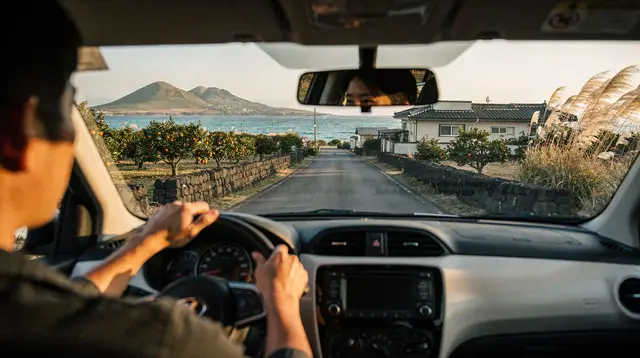
If you’re renting a car for the trip, several counters operate inside or near the terminal, with courtesy shuttles to off-site lots for some providers, adding roughly 10-15 minutes to the pickup process. This isn’t really a “transfer” option in the same sense as the others — you’re driving yourself from the moment you leave the lot — but it’s worth factoring into the decision if a car is part of your plan anyway, since it eliminates the need for any of the above for the initial airport leg. The car rental and IDP guide covers the International Driving Permit requirement and what to check at pickup.
One navigation note that applies here specifically: Google Maps has very limited turn-by-turn driving directions in South Korea, so if you’re picking up a rental car straight from the airport, download Kakao Map or Naver Map before you leave the lot rather than assuming Google Maps will route you reliably to your first stop.
A decision framework by traveler type
Solo traveler or couple, light luggage, heading to Jeju City or the resort corridor — the limousine bus 600 or a regular city bus is the most cost-effective, comfortable-enough option. A taxi is a reasonable upgrade for a short Jeju City hop if you’d rather skip the bus schedule entirely.
Family with children and multiple suitcases, heading to a resort in Jungmun or Seogwipo — a private transfer or taxi generally beats the bus on practicality, since managing young kids, luggage, and bus stops simultaneously is a real source of stress that a fixed-price door-to-door transfer removes entirely.
Group of three or more sharing costs — a private transfer often becomes cost-competitive per person against a taxi, with the added benefit of a single fixed price and a driver who already knows the destination.
Late-night or early-morning arrival outside limousine bus hours (before 6:20am or after 9:50pm) — a taxi, Kakao T, or a pre-booked private transfer are the only realistic options once the 600 has stopped running for the day; a private transfer booked in advance removes any uncertainty about availability at an odd hour.
Renting a car for the whole trip — skip ground transport transfers entirely and go straight to the rental counter, keeping the IDP and paperwork ready.
Payment methods across all options
Contactless card payment (Visa, Mastercard, UnionPay, Apple Pay, Samsung Pay, Google Pay) works on buses and in taxis, alongside T-money-compatible transit cards for anyone who picks one up. Kakao T and pre-booked private transfers are typically settled in-app or prepaid at booking, meaning cash usually isn’t necessary for any of the transfer options covered here — a genuine convenience for visitors arriving without freshly exchanged Korean won.
Hotel shuttles
Some larger resort properties, particularly around Jungmun and Seogwipo, run their own guest shuttles from the airport on a fixed schedule, generally free or low-cost for booked guests. It’s worth checking directly with your accommodation before defaulting to a bus, taxi, or private transfer, since a hotel shuttle can be the simplest option of all when it exists — no booking through a third party, no fare to calculate, and a driver who already knows the property. The catch is that shuttle schedules are usually limited to a handful of departures per day tied to typical flight arrival banks, so they suit travelers whose flight timing lines up with the shuttle rather than anyone landing outside those windows.
Downloading apps before you land
A short but genuinely useful piece of prep: install Kakao T and either Kakao Map or Naver Map before your flight lands, rather than trying to download and set them up on arrival with possibly slow airport WiFi and an unfamiliar interface. Kakao T requires a phone number for verification, which can be set up in advance from home; trying to do this for the first time standing in the arrivals hall adds unnecessary friction to what should be a two-minute process. This matters more than it sounds like it would — a rushed first Kakao T setup at the airport is a common minor frustration for first-time visitors that a few minutes of preparation avoids entirely.
Cost comparison at a glance
To put the numbers side by side for a trip to Seogwipo, roughly 70-80 minutes away: the limousine bus runs ₩4,700 per person, a metered taxi runs roughly ₩35,000-45,000 total regardless of passenger count (so it becomes more cost-competitive per person as a group grows), and a private transfer typically prices similarly to or somewhat above a taxi but with a fixed rate agreed before departure rather than a running meter. For a shorter Jeju City hop, the gap narrows considerably — a taxi at ₩5,000-8,000 is often not much more than the bus fare for one or two people, which is why more travelers default to a taxi for short in-town connections and reserve the bus for longer resort-corridor trips where the fare difference is more meaningful.
Safety and etiquette notes
Jeju’s taxis and buses are generally safe and reliable by any reasonable standard, and tipping is not expected or customary in Korean taxis, buses, or private transfers — the fare or agreed price is the full payment. Seatbelts are required by law in the front and back seats of taxis and private vehicles, and most drivers will wait for you to buckle up before pulling away. If a driver’s fare seems unusually high relative to the ranges above, it’s reasonable to ask for clarification or, for a taxi, to confirm the meter is running rather than a flat rate being quoted verbally — this is uncommon on Jeju but not unheard of, particularly late at night.
Night and early-morning arrivals
Flights landing after the limousine bus’s 9:50pm cutoff, or before its 6:20am start, narrow the options to taxi, Kakao T, or a private transfer booked in advance. Taxi stands remain staffed at CJU for late arrivals, and Kakao T continues to operate, though wait times can run slightly longer overnight as fewer drivers are active. A private transfer booked ahead of a known late-night or early-morning flight removes any uncertainty about availability at an odd hour, which is precisely the scenario where a pre-arranged pickup earns its cost most clearly.
After the transfer: getting around the rest of the island
Once you’re settled at your accommodation, the transfer question shifts to island-wide mobility. The Jeju bus guide covers the public transit network beyond the airport routes, the driving and road trip tips guide is worth reading before a self-drive itinerary, and the Jeju safety guide and money and currency guide round out the practical basics for the rest of the trip.
Comparing transfers to renting a scooter or bike from day one
A small number of travelers skip ground transport transfers altogether by arranging scooter or bike rental delivery to the airport, an option that exists on Jeju but suits a narrow use case — experienced riders comfortable navigating unfamiliar roads immediately after a flight, with minimal luggage. For most visitors, especially first-timers, this isn’t a practical substitute for the transfer options above; it’s mentioned here only because it occasionally comes up as an alternative and is worth ruling out rather than assuming it’s unavailable. A rental car, arranged through the counters described earlier, is the far more common self-drive choice for a first Jeju visit.
Wheelchair-accessible options
Standard taxis at the CJU stand are not uniformly wheelchair-accessible, so travelers who need one should specifically request an accessible taxi through Kakao T’s accessible vehicle option where available, or confirm accessibility directly when booking a private transfer in advance, rather than assuming any car at the taxi stand can accommodate a wheelchair without prior notice. The limousine bus and regular city buses have varying degrees of accessibility depending on the specific vehicle in rotation, so a pre-arranged private transfer is generally the more reliable choice for travelers with mobility equipment.
Currency and cash on arrival
Since most transfer options here accept contactless cards or app-based payment, exchanging a large amount of cash before leaving the arrivals hall usually isn’t necessary just for ground transport. It’s still worth carrying a small amount of Korean won for incidentals on day one — a snack, a vending machine, a market stall that prefers cash — but the transfer itself rarely requires it. The money and currency guide covers exchange counters at the airport and card acceptance more broadly across the island if you want the fuller picture before landing.
Connecting an airport transfer to your first day’s plan
The transfer choice often depends less on the airport leg itself and more on what the rest of day one looks like. Travelers heading straight into sightseeing — a first stop in Jeju City or an afternoon at Dongmun Market — benefit from a fast, simple option like a taxi or Kakao T that gets them moving without extra planning. Travelers checking into a resort for a slower first evening, particularly around Jungmun, can afford the slightly longer limousine bus ride or a scheduled private transfer, since there’s no rush to reach a specific attraction by a set time. If your itinerary has you picking up a rental car and driving directly to your first destination, budget the extra 10-15 minutes for counter processing and shuttle transfer to an off-site lot mentioned above, and see the driving road trip tips guide for what to expect on unfamiliar roads on day one specifically.
Booking a private transfer versus arranging one on arrival
Booking a private transfer in advance rather than arranging one at the arrivals hall matters most in two scenarios: late-night or early-morning flights, when fewer options are available on the spot, and peak travel periods (national holidays, summer weekends) when demand for every ground transport option spikes. A pre-booked transfer locks in a driver, a price, and a pickup time regardless of what’s happening at the arrivals hall that day. For daytime arrivals during quieter periods, the difference matters less — taxis and Kakao T are reliably available without advance planning — but it removes one more variable from a trip that already involves enough logistics on day one. Compare the three private transfer options above on pickup timing and exact drop-off address before booking, since terms can vary slightly between listings even when the service itself is functionally similar.
First-timers: what to expect at the arrivals hall
CJU’s arrivals area is compact and well-signed in English, Korean, Chinese, and Japanese, with ground transport options — limousine bus stop, taxi stand, rental car counters — all reachable within a few minutes’ walk of the exit doors, without needing to navigate between separate terminals. First-time visitors who’ve read the first-time Jeju planning guide beforehand generally find the actual transfer decision straightforward once they land, since the harder work — comparing options and prices — is done in advance rather than under the pressure of a jet-lagged decision at the airport itself. If you’re arriving on a domestic flight from Seoul rather than internationally, the process is effectively identical; see the Seoul to Jeju flights guide for what to expect before landing.
Frequently asked questions about Jeju airport transfers
What’s the cheapest way from Jeju Airport to the city?
A regular city bus (#100-500 series) at ₩1,000-1,500 is the cheapest option, though it makes more stops and has less luggage space than the limousine bus.
Is the limousine bus 600 faster than a taxi?
No, a taxi is faster for most destinations — roughly 60-70 minutes to Seogwipo by taxi versus 70-80 minutes by limousine bus — but the bus costs a fraction of the taxi fare.
Does the limousine bus run all night?
No, it operates from 6:20am to 9:50pm. Outside those hours, a taxi, Kakao T, or a pre-booked private transfer are the practical options.
Can I book a private transfer for just the airport arrival, not the return?
Yes, one-way private transfer options exist specifically for this, useful if you plan to handle your departure differently — for instance, with a rental car return or a different schedule.
Is Kakao T more expensive than a regular taxi?
Generally comparable, since Kakao T pulls from the same taxi fleet in many cases — the main difference is upfront fare visibility and in-app payment rather than a meter and cash or card at the end.
How much luggage space does the limousine bus have?
Reasonable overhead and under-seat space plus a luggage rack near the doors, generally sufficient for one or two suitcases per passenger, though it’s not designed for oversized sports equipment or unusually bulky bags.
Do taxi drivers at Jeju Airport speak English?
It varies. Many manage basic destination communication, especially with an address or hotel name shown on a phone, but fluent conversational English isn’t guaranteed — having your destination written in Korean or displayed on a map app helps.
Related guides

Jeju International Airport (CJU) guide
How Jeju International Airport (CJU) works — terminal layout, ground transport, luggage storage, SIM kiosks, and what to expect on arrival.

Seoul to Jeju flights
How to fly from Seoul to Jeju — Gimpo vs Incheon departure, airlines, flight times, prices, and when a ferry or KTX combo makes more sense.

Busan to Jeju flights
Flying from Busan to Jeju via Gimhae Airport — flight time, airlines, prices, and why routing through Busan can beat Seoul for some itineraries.
Car rental in Jeju and the IDP
How to rent a car in Jeju as a foreign visitor, why the International Driving Permit is mandatory, and what it costs.
Ready to book? Top tours for this guide
We earn a small commission if you book through GetYourGuide — at no extra cost to you. Every tour is hand-picked and verified.
Jeju: Private Car Charter Tour
Jeju: Private Tour with an English Guide and a Vehicle

Private Tour of Jeju Island, by Car, at Your Own Pace

Jeju Island: Seongsan Ilchulbong & Private Transfer

Jeju: Private One Day Car Charter