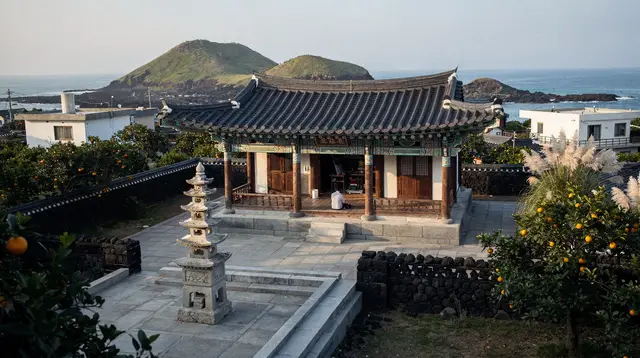
Cheonjiyeon Waterfall
Is Cheonjiyeon Waterfall worth visiting?
Yes — it's the easiest of Seogwipo's three waterfalls to reach, with a short paved walk through subtropical forest to a 22m drop. Entry is around ₩2,000, and it's the only one of the three open for night illumination in high season.
Cheonjiyeon Waterfall is the most visited of Seogwipo’s three named waterfalls, and for a straightforward reason: it’s the easiest to reach, with a short, paved walk through subtropical forest ending at a 22-meter drop into a dark, quiet pool. The name means “Pond of the Sky and the Earth,” and while the marketing language on some tour listings oversells the drama of the falls themselves, the walk through the forest — draped in vines, dense with evergreen broadleaf trees you won’t see much of elsewhere on the Korean peninsula — is genuinely worth the entry fee on its own.
| Where | Old-town Seogwipo, western edge |
| Cost | Around ₩2,000 for adults |
| Time needed | 30-45 minutes |
| Hours | Roughly 7 a.m.-8:30/9 p.m., seasonal |
| Best for | Easiest access of Seogwipo’s three falls |
What you’re actually looking at
Cheonjiyeon sits at the western edge of Seogwipo’s old town, a short taxi ride or a 15-20 minute walk from the harbor and Lee Jung-seob Street. The waterfall itself drops about 22 meters into a pool roughly 20 meters across, framed by a rock overhang and a forest canopy that keeps the whole area noticeably cooler than the open streets of Seogwipo in summer. It’s not the tallest or most dramatic waterfall on the island — Jeongbang, a short drive away, claims the more unusual distinction of falling directly into the ocean — but Cheonjiyeon has the best-developed path and the most reliable access of the three.
The pool below the falls is legally protected as a habitat for several rare species, including a freshwater shrimp found almost nowhere else, which is part of why swimming is prohibited here (it’s also simply not set up for it — the pool is deep and the rocks are slick). A stone bridge, Seonimgyo, crosses the stream just downstream of the falls and makes a decent secondary photo spot if the main platform is crowded.
Entry fee and hours
Entry runs around ₩2,000 for adults, with reduced tickets for teenagers and children — cheap enough that it’s rarely a reason to skip the site, though it’s worth having small bills or a T-money card on hand since the ticket booth doesn’t always handle every card type smoothly. Opening hours run roughly from 7:00 a.m. to somewhere between 8:30 and 9:00 p.m., though the exact closing time shifts by season and is sometimes cut shorter in winter. Cheonjiyeon is also the only one of Seogwipo’s three waterfalls with occasional evening illumination in high season — worth checking if you’re staying in Seogwipo overnight and want to see it after dark, since Jeongbang and Cheonjeyeon close well before sunset year-round.
Note that hours and prices are set by Seogwipo City and do shift from year to year — treat the numbers here as a close, current estimate rather than something to plan a trip around to the exact minute. If precision matters, a quick check of the posted hours at the ticket booth or a local hotel’s front desk the day before resolves any doubt.
Getting there
From central Seogwipo (the harbor, Olle Market, Lee Jung-seob Street), it’s a 15-20 minute walk or a five-minute taxi ride. From CJU airport, driving takes about 50-60 minutes via the Jeju-Seogwipo Expressway or the more scenic 1100 Road, which crosses Hallasan’s southern flank and can close briefly in heavy snow. There’s a paid parking lot at the entrance; it fills up on weekends and during festival periods, so arriving before 10 a.m. avoids the worst of the circling-for-a-spot problem.
Public transit works too: several Seogwipo city buses stop within a short walk of the entrance, though the exact route numbers are worth confirming with Naver Map or a hotel front desk rather than trusting an old printed schedule, since Jeju’s bus network was substantially restructured in recent years. If you’re not renting a car, a guided day tour that bundles Cheonjiyeon with the rest of the southwest circuit removes the routing question entirely — South-West Jeju Essentials: Hallasan & UNESCO Highlights covers Cheonjiyeon alongside Hallasan-area stops and other UNESCO-listed sites in a single nine-hour day.
Best time of day to visit
Tour buses tend to arrive in a wave between 10 a.m. and 2 p.m., so the quietest windows are right at opening (7-8:30 a.m.) or in the last hour or two before closing. Morning light filters through the forest canopy in a way that photographs well without the harsh midday glare that flattens the waterfall’s color in early afternoon shots. If illumination is running in the evening, the falls take on a different character entirely — worth a second visit if you’re staying nearby and have the time.
Photographing the falls
The main viewing platform sits close enough to the pool that a wide-angle lens (16-24mm equivalent) captures the full drop and the surrounding cliff face without needing to back up into the crowd. A polarizing filter cuts glare off the wet rock and water surface, which otherwise tends to blow out in direct sunlight. If the goal is a long-exposure silky-water shot, a small tripod and a neutral density filter help, though tripods can be awkward on the platform when it’s busy — early morning is the practical window for that kind of setup. For a broader look at photographing Jeju’s waterfalls and coastline together, the Jeju photography spots guide covers equipment and timing across the island’s best landscape locations.
The geology behind the falls
Cheonjiyeon, like nearly every waterfall on Jeju, exists because of the island’s volcanic layering. Jeju formed from repeated basaltic and trachyte lava flows over roughly two million years, and where a harder rock layer sits above a softer one, streams erode the soft layer faster, eventually undercutting the hard cap until it collapses into a stepped cliff face. That’s the basic mechanism behind Cheonjiyeon’s drop, and it’s also why the rock face behind the pool has a slightly overhung, shelf-like profile rather than a smooth ramp — you’re looking at differential erosion frozen mid-process. The same basic geology, at a much larger scale, produced the hexagonal columns at Jusangjeolli a short drive west, where lava cooled and contracted into a honeycomb pattern instead of a simple stepped face.
What’s nearby
The immediate entrance area has a small cluster of souvenir stalls and a couple of modest food stands selling hotteok (sweet filled pancakes) and other street snacks — reasonably priced and a fine quick bite, though not destination dining. For an actual meal, old-town Seogwipo’s harbor district, a short taxi ride away, has considerably better and more varied options, including seafood restaurants overlooking the water. Restrooms are available near the entrance and are generally clean and well-maintained, a small but real convenience compared to some of Jeju’s more remote natural sites where facilities are sparse.
There isn’t a dedicated cafe with a waterfall view directly at the site — if that’s the goal, look toward the Jeju Instagram spots guide, which covers cafes designed around a photogenic backdrop, several of them in the Seogwipo area.
Mobile connectivity is reliable throughout the site, so navigation apps and ride-hailing services work normally for visitors arriving without a car. There’s no dedicated bag storage on-site, so this is more practical as a stop mid-day than a first destination straight off a flight with luggage in tow; the harbor area in old-town Seogwipo has a small number of cafes and guesthouses willing to hold bags for guests, worth arranging ahead if it matters to your schedule.
Visiting with kids or limited mobility
The paved main path makes Cheonjiyeon one of the more manageable natural sites on the island for families with strollers or visitors with limited mobility, though it’s not flat — expect a gentle but sustained incline on the way back up. There are a few sets of stairs near the main viewing platform itself, unavoidable if you want the closest vantage point, but the platform is reachable via a side path that avoids the steepest steps for those who need it. Compared to Jeongbang’s more demanding stair descent to the ocean-facing cliff, Cheonjiyeon is the gentler option of the two for a family day.
Common mistakes first-time visitors make
The most common misstep is treating Cheonjiyeon as a five-minute photo stop rather than budgeting time for the actual forest walk, which is arguably the better half of the experience — the tree cover here includes species like the Jeju fig and camphor laurel that don’t grow much further north on the peninsula, and rushing past them to the platform and back misses the point. The second common mistake is visiting in the middle of a dry winter week expecting a dramatic cascade; checking recent rainfall (or simply asking at the ticket booth, since staff are used to the question) sets realistic expectations before paying the entry fee. The third is assuming the night illumination runs year-round — it’s a high-season feature, not a permanent one, so confirm before planning an evening visit specifically to see it lit up.
Comparing Cheonjiyeon to Jeongbang and Cheonjeyeon
All three of Seogwipo’s named waterfalls sit within a 10-15 minute drive of each other, and the honest comparison looks like this: Cheonjiyeon has the easiest path and the best forest walk, but the falls themselves are modest in width. Jeongbang is the only waterfall in Asia that drops directly into the ocean — a genuine point of distinction — but the site involves stairs and offers less shade. Cheonjeyeon is actually three connected falls linked by a scenic trail and the arched Seonimgyo bridge, and it’s arguably the most photogenic of the three when water levels are good, but it’s also the least developed for accessibility.
Most visitors with a half-day to spare see all three in sequence — Cheonjiyeon first since it’s closest to old-town Seogwipo, then Jeongbang, then Cheonjeyeon on the way out, or in reverse depending on where you’re staying. If time is genuinely limited to one waterfall, Cheonjiyeon is the safest single choice for its combination of forest walk, reliable flow, and easy access.
Seasonal flow and the honest caveat
Like every waterfall on Jeju, Cheonjiyeon’s flow depends directly on recent rainfall. Spring, after rain, and the period following typhoon season (late August-September) tend to produce the strongest, most photogenic flow. A dry stretch in winter can reduce the falls to something closer to a heavy trickle — still worth seeing for the forest walk and the pool itself, but not the roaring cascade some marketing photos suggest. If a dramatic waterfall shot is the entire reason for the visit, it’s worth checking recent weather or asking a local guide about flow conditions before committing a half-day to it.
Typhoon season itself (late August through September) can occasionally lead to temporary closures if water levels or debris make the path unsafe — a rare occurrence, but worth building a day of flexibility into a typhoon-season itinerary that centers on this site.
Combining Cheonjiyeon with the rest of Seogwipo
Cheonjiyeon works well as a first stop on a day that also covers old-town Seogwipo’s harbor and market, or as part of a longer loop through the southwest that adds Jusangjeolli Cliff and Sanbangsan. For visitors without a car, Jeju: SouthWest Authentic Tour — Mt Halla, Waterfall, Green Tea bundles a waterfall stop with Hallasan-area scenery and the Osulloc tea fields in a single ten-hour day, which is a reasonable way to see the region’s highlights without renting a car or building your own route.
For a fuller look at the destination this waterfall sits in — including where to stay, budget breakdowns, and a realistic two-day itinerary for the region — see the Seogwipo destination guide. If Hallasan’s trails or the national park’s broader scenery are also on the list, the Hallasan National Park guide covers trailheads and permit rules that connect logically to a southwest Jeju trip.
Where to stay nearby
Old-town Seogwipo, within walking distance of Cheonjiyeon, offers guesthouses and mid-range hotels from roughly ₩60,000-100,000 a night, with the advantage of easy access to all three waterfalls plus the harbor market. The Jungmun resort strip, about 20 minutes west, runs considerably higher (₩150,000-400,000+) but includes full-service hotel amenities. For most travelers prioritizing the waterfall circuit itself, old-town Seogwipo is the more practical and often more atmospheric base — see the Seogwipo destination guide for specific neighborhood recommendations and a fuller budget breakdown across accommodation tiers.
Month-by-month notes
Spring (March-May) brings the strongest post-rain flow of the year alongside cherry blossoms elsewhere on the island, though the forest around Cheonjiyeon itself doesn’t feature cherry trees as a highlight — for that, the western parts of the island are the better target. Summer (June-August) means heat, humidity, and the July monsoon; the forest canopy provides welcome shade, but the entry path and platform can feel crowded and sticky at midday. Autumn (September-November), especially October, is the most comfortable season for the walk, with clear skies and mild temperatures, though early autumn overlaps with the tail end of typhoon season and its risk of short closures. Winter (December-February) brings the thinnest crowds and the highest chance of underwhelming flow after a dry stretch, but also the clearest, coolest walking conditions and — if you’re lucky with recent rain — a striking contrast between green subtropical forest and a crisp winter sky.
Is Cheonjiyeon a tourist trap?
No, not in the sense of being overpriced or misleading — the ₩2,000 entry fee is modest, the site delivers a genuine forest walk and a real waterfall, and there’s no aggressive upselling at the entrance beyond the ordinary souvenir stalls. The closest thing to a caveat is that its status as the most tour-bus-friendly of Seogwipo’s three waterfalls means it can feel more like a managed attraction than a wild natural site during peak midday hours — arriving early sidesteps that entirely. For a broader look at which of Jeju’s popular sites are worth the hype and which lean overrated, the island-wide honest Jeju hub covers tourist traps across every region.
A realistic half-day plan
Arrive at Cheonjiyeon by 8-8:30 a.m. to beat the tour-bus crowds, spend 30-45 minutes on the walk and at the viewing platform, then drive or taxi 10 minutes to Jeongbang for its cliffside ocean-drop view, and finish at Cheonjeyeon’s three-tiered falls and the Seonimgyo bridge by early afternoon. This covers all three waterfalls comfortably before lunch, leaving the afternoon free for old-town Seogwipo or a drive west toward Sanbangsan and the west coast.
Seogwipo’s three waterfalls, side by side
| Cheonjiyeon | Jeongbang | Cheonjeyeon | |
|---|---|---|---|
| Path | Paved, gentle incline | Stairs down to the shore | Mixed paved/natural, uneven in places |
| Typical visit time | 30-45 minutes | 20-30 minutes | 45-60 minutes |
| Crowd level | Busiest of the three | Moderate | Fewer tour buses |
| Signature feature | Forest walk, night illumination in high season | Falls into the ocean | Three connected falls, Seonimgyo bridge |
| Best for | First-timers, easiest access | A genuinely unusual coastal feature | An unhurried forest walk |
Combining Cheonjiyeon with a longer Seogwipo stay
Visitors basing themselves in old-town Seogwipo for two or three nights don’t need to see all three waterfalls on a single rushed day. Splitting the circuit — Cheonjiyeon on an arrival evening if the timing allows for illumination, then Jeongbang and Cheonjeyeon on a fuller day that also includes Jusangjeolli and Sanbangsan further west — spreads the walking out and leaves more room for old-town Seogwipo’s harbor market and restaurants without cramming every sight into one long day.
What if you only have time for one
If a schedule genuinely only allows one waterfall stop, Cheonjiyeon is the safest single choice for most visitors: the forest walk is a real highlight in its own right, the path suits nearly any fitness level or mobility need, and the entry fee is modest. Travelers specifically chasing an unusual sight over convenience should prioritize Jeongbang instead, and those with extra time and a preference for a quieter, longer walk should lean toward Cheonjeyeon.
Related guides

Cheonjeyeon Waterfall
Cheonjeyeon Waterfall is three connected falls linked by a scenic trail and the arched Seonimgyo bridge. Entry fees, hours, and how it compares to Jeju's

Jeongbang Waterfall
Jeongbang Waterfall drops straight into the ocean — a rare feature in Asia. Entry fees, opening hours, the stairs down, and how it compares to Cheonjiyeon.

Jusangjeolli Cliff
Jusangjeolli's hexagonal basalt columns near Jungmun: how they formed, entry fees, best time to visit for waves, and safety on the boardwalk.

Seopjikoji Lighthouse & Cliffs
Seopjikoji's grassy cliffs, lighthouse, and Glass House architecture on Jeju's east coast — free entry, K-drama fame, and how it pairs with Seongsan
Ready to book? Top tours for this guide
We earn a small commission if you book through GetYourGuide — at no extra cost to you. Every tour is hand-picked and verified.
Jeju: UNESCO Day Tour for Cruise Guests
Jeju: Highlights Day Trip (East Course)
Jeju Island: Full Day Tour for Cruise Ship Passengers
Jeju: Small Group UNESCO Highlights Tour for Cruise Guests

Jeju East: Cherry Blossom Early Bird Tour with Hotel Pickup