
Driving around Jeju: road trip tips
How long does it take to drive around Jeju?
The full coast road loop is roughly 180-200 kilometers, taking about 4-5 hours of pure driving without stops. A one-way east-west cross-island drive takes about 1 hour 30 minutes. Neither trip includes stopping time, which realistically doubles or triples the total time for a sightseeing-focused day.
Once you’ve sorted a rental car and the International Driving Permit it requires, the actual experience of driving on Jeju is straightforward for anyone used to rural or coastal roads — but it has its own specific quirks worth knowing before you’re navigating them for the first time at highway speed.
| Coast loop | ~180-200km, 4-5hrs pure driving |
| Cross-island | ~1hr 30min one-way |
| Speed limits | 60-80 km/h open road, 30-50 km/h in towns |
| Fuel | Refuel at a quarter tank in remote areas |
| Navigation | Kakao Map or Naver Map, not Google Maps |
None of what follows should discourage a self-driven trip — for most independent travelers, a rental car remains the single best way to see a representative slice of the island in a limited number of days. The goal here is simply to arrive with realistic expectations about road conditions, enforcement, and the small habits that separate a relaxed road trip from a stressful one.
Driving on the right and adjusting quickly
South Korea drives on the right, which is the default most visitors are already used to, but for travelers from left-hand-traffic countries — the UK, Japan, Australia, and others — the adjustment period deserves a bit of extra caution in the first hour behind the wheel, particularly at intersections and when pulling out of parking lots, where muscle memory can briefly default to the wrong side. Taking the first short drive somewhere low-stakes, like the route from the rental lot toward your first night’s accommodation, rather than heading straight into a complex multi-turn cross-island route, gives that adjustment period somewhere safe to happen.
The two routes that define a Jeju road trip
Nearly every self-driving itinerary on the island revolves around two basic drives. The first is the full coast road loop, tracing the island’s perimeter along a mix of coastal highways, at roughly 180-200 kilometers total — about 4-5 hours of continuous driving with no stops. Almost nobody drives this in one sitting; it’s more useful as a mental model of scale than a single day’s plan, since a genuine full-loop day with even modest stops at a few sites easily runs 8-10 hours door to door.
The second is the east-west cross-island drive, connecting, for example, Jeju City in the north to Seogwipo in the south through the interior, or connecting east Jeju to west Jeju across the island’s waist. This takes roughly 1 hour 30 minutes one-way on the main cross-island routes, passing near Hallasan’s lower slopes and through markedly different scenery than the coast — pasture, forest, and volcanic cones rather than sea views.
Most realistic itineraries mix both: a base in one region with day trips along nearby coast-road stretches, plus one or two cross-island runs to reach attractions on the opposite side of the island.
Road types: no expressways, mostly two lanes
Unlike mainland South Korea’s dense expressway network, Jeju has no true expressways. The coast road and the main cross-island routes are largely two-lane roads — one lane each direction — running through open countryside, small towns, and coastal villages rather than bypassing them via elevated highway. This means your speed is set by the terrain and the towns you pass through as much as by the posted limit, and travel-time estimates in navigation apps generally reflect this realistically rather than assuming expressway-grade average speeds.
Speed limits and camera enforcement: treat every sign as literal
Speed limits on Jeju generally run 60-80 km/h on open roads outside town centers, dropping to 30-50 km/h within towns, near schools, and on some tighter coastal stretches. These aren’t loosely enforced suggestions — Jeju has an extensive network of fixed and mobile speed cameras, and Korean traffic enforcement generally does not offer the same tolerance for modest overages that some drivers may be used to elsewhere.
The mechanism matters for rental drivers specifically: there’s no roadside stop or on-the-spot ticket for a camera-detected violation. Instead, the fine is processed through the vehicle’s registration, which routes to the rental company, which then bills the card on file for your rental — sometimes weeks or months after you’ve returned home, often with an added administrative handling fee on top of the base fine. This delayed, indirect billing is one of the more common unpleasant surprises visitors report after a Jeju rental, and it’s entirely avoidable simply by respecting posted limits, particularly the lower in-town limits that are easy to blow through without noticing the drop from an open-road speed.
Parking: paid at the big sites, limited and free at the small ones
Parking follows a predictable pattern tied to a site’s popularity. Major destinations — Seongsan Ilchulbong, the main Hallasan trailheads, popular beaches in Aewol and Hallim — generally have dedicated paid parking lots charging a modest fee, typically a few thousand won for the day. Smaller or less-visited spots often have limited free parking along the roadside or in a small unpaved lot, which can fill up entirely during midday hours in peak season, particularly around popular cafés and photogenic viewpoints that get featured on social media. Arriving early or late in the day at these smaller sites, or having a backup plan if a lot is full, avoids a frustrating circling search for a spot.
Rest stops and driver fatigue
Even at Jeju’s modest scale, a full day of stop-and-go sightseeing driving is more tiring than the distance numbers suggest — narrow roads, unfamiliar signage, and constant attention to speed limits add mental load that a similar distance on a familiar home commute wouldn’t. Roadside rest areas exist along the busier coastal stretches with parking, restrooms, and often a small café or convenience store, and it’s worth treating them as genuine break points on a long driving day rather than pushing straight through to the next sightseeing stop. This matters more for anyone also adjusting to jet lag in the first day or two of a trip, when fatigue compounds faster than expected.
Fuel stops: plan ahead in remote stretches
Gas stations cluster densely around Jeju City and Seogwipo but thin out noticeably along remote stretches of the east and west coasts and through the central highland roads. Self-service pumping is common and straightforward (look for 셀프 signage), though full-service stations still operate in many areas. The practical habit worth adopting: refuel when the tank drops to around a quarter rather than waiting until it’s nearly empty, particularly before a planned drive through a rural stretch where the next station might be further than expected.
Navigation: Kakao Map or Naver Map, not Google Maps
This point is worth repeating for anyone driving in Korea for the first time: Google Maps has long-standing restrictions on providing detailed turn-by-turn driving directions inside South Korea, tied to data-export regulations that have never been fully lifted. It’s not a Jeju-specific quirk — it applies across the whole country — but it catches visitors off guard because Google Maps otherwise works fine for browsing points of interest and reading reviews. For actual driving navigation, Kakao Map or Naver Map are the apps that work reliably, both with usable English-language interfaces and real-time traffic and rerouting.
Stone walls and rural sightlines
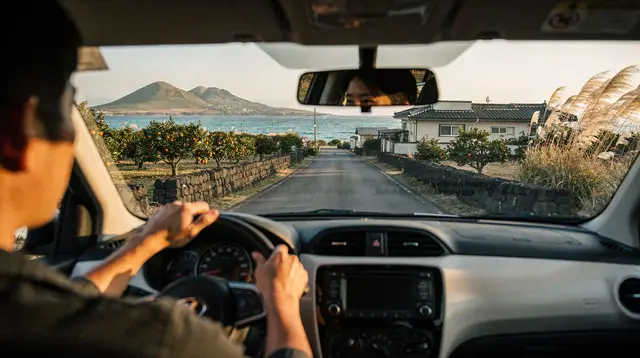
One hazard that surprises visitors more than expected: many of Jeju’s rural roads are lined with low, dry-stacked black basalt stone walls, a traditional feature of the island’s agricultural landscape and genuinely part of its charm — but they restrict sightlines at intersections, driveways, and blind curves more than a similar road without walls would. Combined with narrow road widths on some rural stretches, this means slowing down through unfamiliar rural sections, particularly ones without a painted center line, is a sensible habit rather than overcaution. Local drivers navigate these roads at speed because they know exactly which curves hide a crossing tractor or a slow-moving scooter; a first-time visitor doesn’t have that local knowledge yet.
Driving with a hired driver: the car-charter alternative
Self-driving isn’t the only way to get a private vehicle’s flexibility on Jeju. Private car charter services — an English-capable driver paired with a vehicle for a half or full day — sidestep the entire self-driving equation: no International Driving Permit requirement, no unfamiliar-road anxiety, no speed-camera risk landing on your credit card months later, and no need to split attention between driving and navigating on your own.
Jeju: Private Car Charter Tour puts a driver and vehicle at your disposal for a custom day built around whichever sites you want to see, at your own pace rather than a fixed group-tour schedule — a practical middle ground between renting a car yourself and joining a scheduled bus tour. For visitors who’d rather follow an established route covering the island’s best-known sights without planning the day themselves, Jeju: Popular Sightseeing Private Car Charter Tour combines the same private-vehicle comfort with a pre-built itinerary hitting the island’s most visited highlights.
Both options cost more per day than a self-driven rental plus fuel, but the calculation changes for travelers without a valid IDP, those uncomfortable driving on unfamiliar right-hand-traffic roads for the first time, or groups who’d simply rather relax and look out the window than watch for speed-camera signage and stone-wall blind corners themselves. Splitting a full-day charter’s cost across a group of three or four often brings the per-person price close enough to a self-driven rental’s total daily cost (rental, insurance upgrade, and fuel combined) that the decision comes down mainly to whether anyone in the group actually wants to drive, rather than a strict budget calculation.
A realistic driving day: combining a loop segment with stops
A typical self-driven day might cover a coast-road segment of 60-80 kilometers with three or four stops — roughly 90 minutes to two hours of actual driving, plus however long you spend at each site. Building in generous stop time (an hour at a major site like Seongsan Ilchulbong, 20-30 minutes at smaller spots) and accounting for the parking search at busier locations gives a more realistic total than simply dividing distance by speed limit. For a full-day cross-island itinerary — say, starting in Jeju City, crossing to Seogwipo, and returning via the coast — figure on 3-4 hours of total driving time woven around whatever sightseeing fills the rest of the day.
Roundabouts and intersection habits
Korea has installed a growing number of roundabouts on Jeju in recent years, replacing some traffic-light intersections, particularly in less dense rural and suburban areas. The basic rule mirrors most countries with right-hand traffic: yield to vehicles already circulating in the roundabout before entering, signal your exit, and don’t stop inside the circle unless genuinely forced to. Visitors from countries without much roundabout exposure sometimes hesitate too long at the entry point, which is more disruptive to local traffic flow than a smooth, confident entry once a gap appears.
Night driving on rural roads
Once you’re off the main coast road and its town centers, street lighting on Jeju’s rural roads thins out considerably, and combined with the stone-wall sightline issue described above, night driving through unfamiliar countryside carries meaningfully more risk than the same route in daylight. Slower speeds, high beams where no oncoming traffic is present, and extra caution around unmarked intersections and pedestrians or cyclists without reflective gear are all sensible habits. If your itinerary includes a night activity in a remote area — stargazing away from light pollution is a genuine Jeju draw — plan the return drive conservatively rather than rushing it.
Winter driving and road closures
Jeju’s coastal roads rarely see serious winter weather, but the higher elevations around Hallasan and some of the interior cross-island routes can see snow and icy conditions in winter months, occasionally leading to temporary road closures or chain requirements on the higher sections. If you’re driving the cross-island route in winter, check current road conditions before setting out, and don’t assume the mild coastal weather at sea level reflects conditions a few hundred meters higher inland.
Ferries and driving don’t mix directly
If your road trip plan includes a stop at Seongsan Harbor or Moseulpo Port for a ferry to Udo, Gapado, or Marado, remember that your rental car stays on Jeju proper — none of these ferries carry passenger vehicles for tourists in the way some inter-island ferries elsewhere do. Park at or near the port (parking is generally available, sometimes paid) and treat the islet portion of your day as a walking or e-bike segment, then resume driving once you’re back on Jeju.
Whether you end up behind the wheel yourself or hand the driving to someone else for a day, the core planning logic for a Jeju road trip stays the same: respect the posted speed limits given how consistently they’re enforced, budget realistic time for both driving and stopping rather than one or the other, and lean on Kakao Map or Naver Map rather than habit from home.
Toll roads and payment on Jeju
Unlike mainland Korea’s expressway network, Jeju has no toll roads to plan around — every route on the island, coastal or cross-island, is free to drive with no electronic toll transponder or cash toll booth to worry about. The only recurring on-road payments a self-driven visitor encounters are parking fees at the busier attractions covered above, and neither of these requires anything beyond cash or a card at a standard payment machine, considerably simpler than the toll-heavy expressway systems some visitors may be used to from mainland driving elsewhere.
Insurance and what a speed-camera fine actually costs
Most rental agreements bundle a basic insurance tier, but it’s worth confirming what excess or deductible applies before you drive off the lot, since Jeju’s narrow rural roads and stone-wall blind corners do produce a meaningfully higher minor-scrape rate than a typical mainland rental. Speed-camera fines themselves are generally modest per incident — often in the tens of thousands of won range plus an administrative fee from the rental company — but they add up if multiple violations occur across a multi-day trip, which is one more reason treating posted limits as firm rather than advisory pays off financially, not just in avoiding risk.
Self-drive versus car charter: a direct cost comparison
| Self-drive rental | Private car charter | |
|---|---|---|
| Cost basis | Rental + insurance + fuel | Flat daily rate |
| Best for | Solo/pairs comfortable driving | Groups of 3-4, non-drivers |
| Flexibility | Full control, own pace | Full control, no driving effort |
| Requirement | Valid IDP | None |
| Speed-camera risk | Yes | No |
Splitting a full-day charter’s cost across three or four people often lands close to a self-driven rental’s total daily cost once insurance and fuel are counted, which is why the decision usually comes down to whether anyone in the group wants to drive rather than a strict budget calculation.
Frequently asked questions about driving around Jeju
Are there expressways on Jeju?
No. Jeju has no expressways in the mainland Korean sense — the coast road and cross-island routes are mostly two-lane roads passing through towns, farmland, and coastal villages, with posted speeds well below expressway standards.
What are the speed limits on Jeju roads?
Generally 60-80 km/h on open roads outside towns and 30-50 km/h within town limits and near schools, with variation by specific road. Limits are strictly enforced by an extensive speed-camera network, so treat posted signs as firm rather than advisory.
What happens if a speed camera catches my rental car?
The fine is mailed to the rental company weeks or months after your trip, and the company then bills the amount (often plus an administrative fee) to the card on file for the rental — sometimes well after you’ve returned home. There’s no on-the-spot ticket to contest; the charge simply appears later.
Is parking free at Jeju’s tourist attractions?
It varies. Major, high-traffic sites like Seongsan Ilchulbong and Hallasan’s main trailheads have paid parking lots (typically a few thousand won), while smaller or less-visited attractions often have limited free parking that fills up during peak hours, especially midday in high season.
Do I need to worry about running out of fuel in rural Jeju?
It’s worth planning around. Gas stations are plentiful near Jeju City and Seogwipo but noticeably sparser along remote stretches of the east and west coasts and in the central highlands, so refuel before a tank drops below a quarter rather than assuming a station will appear when needed.
What’s the biggest hazard on Jeju’s rural roads?
Low stone walls lining many rural roads restrict sightlines at intersections and blind curves more than visitors expect, especially combined with narrow road width. Slowing down through unfamiliar rural stretches, particularly ones without painted center lines, is a reasonable habit to build.
Can I hire a driver instead of driving myself around Jeju?
Yes. Private car charter services pair an English-capable driver with a vehicle for a half or full day, giving you a private vehicle’s flexibility and route control without the IDP requirement, unfamiliar-road stress, or speed-camera risk of self-driving.
Which navigation app should I use while driving in Jeju?
Kakao Map or Naver Map — Google Maps has long-standing restrictions on providing turn-by-turn driving directions inside South Korea, so it won’t reliably route you on Jeju’s roads.
How much does a typical speed-camera fine cost on Jeju?
Individual fines are generally modest, often in the tens of thousands of won range, but the rental company typically adds an administrative handling fee on top when billing your card weeks or months later. Multiple violations across a trip add up, which is why respecting posted limits matters financially, not just for safety.
Is a private car charter cheaper than self-driving for a group?
It can be, once split across three or four people — a charter’s flat daily rate divided by group size often lands close to a self-driven rental’s total cost (rental, insurance, fuel) combined, making the choice come down to whether anyone wants to drive rather than pure budget.
Related guides
Car rental in Jeju and the IDP
How to rent a car in Jeju as a foreign visitor, why the International Driving Permit is mandatory, and what it costs.

Jeju airport transfers
Comparing every way from Jeju Airport (CJU) to your hotel — limousine bus, city bus, taxi, Kakao T, and private transfer, with real prices.

Jeju International Airport (CJU) guide
How Jeju International Airport (CJU) works — terminal layout, ground transport, luggage storage, SIM kiosks, and what to expect on arrival.

Seoul to Jeju flights
How to fly from Seoul to Jeju — Gimpo vs Incheon departure, airlines, flight times, prices, and when a ferry or KTX combo makes more sense.
Ready to book? Top tours for this guide
We earn a small commission if you book through GetYourGuide — at no extra cost to you. Every tour is hand-picked and verified.
Jeju: Private Car Charter Tour
Jeju: Private Tour with an English Guide and a Vehicle

Private Tour of Jeju Island, by Car, at Your Own Pace
Jeju Island: Seongsan Ilchulbong & Private Transfer

Jeju: Private One Day Car Charter