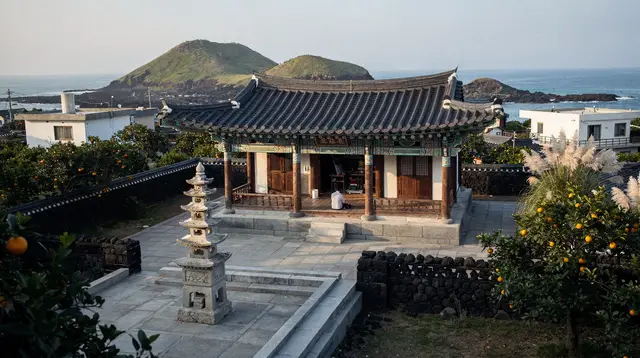
4 days in Jeju itinerary
Four days is the sweet spot for a first proper look at Jeju: enough time to circle roughly three-quarters of the island’s coastline — Jeju City, the east coast’s UNESCO trio, Seogwipo’s waterfalls, and West Jeju’s tea fields and coastal cliffs — without the rushed one-sight-per-stop feeling that a three-day version forces. It works as a counter-clockwise loop with three overnight changes, or a slightly slower version with only two changes if you’re willing to add drive time on the busiest day.
| Where | Jeju City, East Jeju, Seogwipo, West Jeju |
| Duration | 4 days, 3 nights |
| Cost | around ₩650,000-850,000/person (~US$480-630), excl. flights |
| Getting there | CJU airport, rental car (IDP required) |
| Best time | October for clear skies; late March-May for cherry blossoms and canola |
The four days at a glance
| Day | Region | Highlight | Overnight |
|---|---|---|---|
| 1 | Jeju City → East Jeju | Manjanggul lava tube | Seongsan |
| 2 | Seongsan → Seogwipo | Sunrise at Seongsan Ilchulbong, Cheonjiyeon Waterfall | Seogwipo |
| 3 | Seogwipo → West Jeju | Jusangjeolli cliffs, Sanbangsan | Aewol/west coast |
| 4 | West Jeju → CJU | Osulloc tea fields, Aewol cafes | Departure |
Who this four-day version suits
This length suits first-time visitors who want to actually see the island rather than sample it, couples who don’t mind a new hotel every night or two, and photographers who want daylight flexibility at more than one region’s golden hour. It’s tight for anyone wanting to add Hallasan’s summit trail — that’s an 8-9 hour commitment on its own — or a full-day islet trip to Udo; both are better suited to the 5-day or 7-day versions of this itinerary.
Most visitors from the US, EU, UK, Canada, and Australia fly in visa-free for up to 30 days on a direct CJU flight, with the K-ETA exemption for these same passport groups running through December 2026 — worth confirming against current rules before booking, but generally a non-issue for a trip this length. The bigger planning task is locking in a rental car and Seongsan accommodation early if your dates overlap spring bloom season or the July-August peak.
Day 1: Jeju City to the east coast
Land at CJU, pick up a rental car in Yongdam (bring an International Driving Permit — it’s legally required), and spend the first couple of hours in Jeju City: Dongmun Traditional Market for lunch, then Yongduam Rock for a short coastal walk if timing allows. By early afternoon, drive east — 50-70 minutes depending on the exact destination — toward Manjanggul lava tube. Entry is about ₩4,000, the walk through the public section takes 40-60 minutes, and it’s a constant 11-21°C underground regardless of the season outside, so a light jacket is worth packing even in August.
Jeju: Private Transfer to Manjanggul Cave and Ticket is a useful add-on if you’d rather not deal with parking logistics on your first driving day on unfamiliar roads. Overnight in Seongsan town, where guesthouse rooms run ₩60,000-90,000/night (~US$45-67) and put you in position for an early sunrise the next morning.
For dinner, Seongsan’s harbor-facing restaurants specialize in jeonbokjuk (abalone porridge) and same-day sashimi, a noticeably different scene from the black-pork restaurants that dominate Jeju City. Expect ₩15,000-25,000 per person for a proper sit-down meal. If you land later than planned, most guesthouses can direct you to a convenience store for a fallback dinner — common enough after a long travel day that no one will think twice about it.
Day 2: Seongsan sunrise, Seopjikoji, and south to Seogwipo
Arrive at Seongsan Ilchulbong 30-45 minutes before sunrise — the only reliable way to beat the crowd on the crater-rim path. The climb takes 20-40 minutes on paved steps (entry ~₩5,000), and exact gate times shift seasonally, so check the current sunrise time the night before. Afterward, walk or drive to nearby Seopjikoji for the grassy headland and lighthouse, which is genuinely quieter once the sunrise crowd disperses.
Mid-morning, decide between two inland detours before heading south: Bijarim Forest’s 800-year-old nutmeg-yew grove (entry ~₩3,000, flat well-marked trails) or Sangumburi’s rare flat “maar” crater reached by boardwalk (entry ~₩4,000). Both are quieter alternatives to the coastal crowds and take roughly an hour each including the drive. By early afternoon, drive south to Seogwipo — about an hour — for a late lunch at the Maeil Olle Market and an afternoon at Cheonjiyeon Waterfall (entry ~₩2,000; full details in the Cheonjiyeon Waterfall guide). Overnight in Seogwipo, where mid-range rooms run ₩90,000-130,000/night.
If the driving on day one and two feels like more than you want to handle solo, Jeju Island: Customized Private Full-Day Van Tour can cover the east-coast portion with a driver instead, and you can pick up a rental car in Seogwipo for the western half of the trip.
Day 3: Seogwipo’s coast to West Jeju
Start with Jeongbang Waterfall, one of the few in Asia that drops directly into the ocean — a short walk with minimal elevation change, easily done before checkout. From there, drive toward Jusangjeolli, the columnar basalt cliffs near Jungmun, formed by cooling lava that cracked into hexagonal pillars; the boardwalk viewing area takes 20-30 minutes and entry runs about ₩2,000-3,000. Jungmun itself is Seogwipo’s resort district if you want a nicer lunch stop with ocean views.
By mid-afternoon, drive west along the coast toward West Jeju — roughly 45-60 minutes depending on your exact route and stops. Sanbangsan, a bell-shaped lava dome with a grotto temple partway up, and the nearby Yongmeori coastal cliffs are the region’s signature sights; both are outdoor, low-cost stops (Sanbangsan entry ~₩2,500) that work well in the day’s remaining light. Overnight around Aewol or elsewhere along the west coast, where ocean-view guesthouses and small hotels run ₩80,000-120,000/night.
Jeju: Private Car Charter Tour is worth considering for this specific day if you’d rather have a driver handle the longer south-to-west transfer while you focus on photos along the way.
Day 4: West Jeju cafes and tea fields, then depart
Spend the morning at Osulloc Tea Museum’s green tea fields — free to walk the grounds, with tea tastings and a shop if you want to bring hallabong or green-tea souvenirs home — followed by a slower stretch along Aewol’s cafe coast, where ocean-view coffee shops line the Handam coastal walk. This is a good morning to simply wander rather than sightsee on a schedule; Aewol rewards an unhurried pace more than a checklist.
By early afternoon, it’s a 20-25 minute drive from Aewol back to CJU airport — one of the shortest transfers in this whole itinerary, which makes a mid-afternoon flight comfortable. Return the rental car with a full tank to avoid the inflated per-liter refueling penalty most agencies charge, and budget 20-30 minutes for the return process itself.
If your flight isn’t until evening, Hamdeok makes a worthwhile last stop on the way back — its Seoubong Beach has an unusually turquoise shallow-water color for a Korean beach, and the hill overlooking it is an easy 15-minute walk for a final coastal view before heading to the airport.
If it rains during the trip
Manjanggul on day one is a solid rainy-day fallback since it’s fully underground regardless of surface weather. If sunrise is rained out on day two, Seongsan Ilchulbong stays open and worth climbing later in the morning — the view holds up without the sunrise colors. Cheonjiyeon and Cheonjeyeon waterfalls on day three actually look better after rain, since spring runoff visibly increases their flow. Osulloc’s tea fields on day four are one of the least weather-dependent stops in the itinerary, since much of the visit is under cover.
Getting around over four days
A rental car remains the practical choice for this length of loop — roughly 180-200km of driving across the four days, close to a full circuit of the island. Fuel runs about ₩30,000-40,000 total for that distance. If you’d rather not drive the whole way, a hybrid approach works: rent for the east-to-south leg (days one and two) and swap to a guided day tour or bus-plus-taxi combination for the west-coast portion, or vice versa.
Naver Map or Kakao Map are the navigation apps to use — Google Maps has significant gaps for driving directions in Korea. Both have workable English-language modes for point-to-point navigation. An eSIM or pocket wifi rental at the airport is worth arranging before landing so navigation works from the moment you leave the car rental counter, rather than scrambling to set it up at the first parking lot.
Rental pickup and drop-off both happen in Yongdam, the neighborhood immediately around CJU airport — agency counters and shuttle stops are within a five-minute walk of arrivals, and English-language service is standard at the larger chains. Bring a home driver’s license plus an International Driving Permit; Korea does not accept a foreign license alone, and this is checked at pickup without exception.
Budget for four days
A realistic mid-range daily budget runs ₩100,000-140,000 per person (~US$74-104) for food, entry fees, and local transport, before lodging and the car. Entry fees stay modest throughout: Manjanggul ₩4,000, Seongsan Ilchulbong ₩5,000, Bijarim or Sangumburi ₩3,000-4,000, Cheonjiyeon ₩2,000, Jusangjeolli ₩2,000-3,000, Sanbangsan ₩2,500. The bigger line items are three nights of mid-range lodging (₩240,000-350,000 total) and a compact rental car across four days (roughly ₩200,000-280,000 in low season, more in peak periods).
Rough per-person total for four days, mid-range style and split between two travelers: ₩650,000-850,000 (~US$480-630), excluding flights to Jeju. Traveling solo raises the car-rental share meaningfully, which is where Jeju Island: Customized Private Full-Day Van Tour or a similar guided day can sometimes work out comparably once fuel, parking, and insurance are factored in.
Where to stay each night
This itinerary assumes three moves — Seongsan, then Seogwipo, then somewhere along the west coast — which avoids backtracking but does mean packing and unpacking daily. If that sounds tiring, a two-base version works: stay in Seogwipo for nights one and two (accepting a longer early-morning drive to Seongsan for sunrise on day two), then move west for night three. Either way, book Seongsan’s guesthouses further ahead than the others — its lodging supply is the smallest of the four stops.
Seogwipo has the widest range of lodging on this route, from ₩30,000 dorm beds to full resort rooms in nearby Jungmun at ₩250,000+/night, which makes it a flexible choice if your budget shifts partway through planning. The west coast around Aewol leans smaller and more boutique — expect independent guesthouses and small ocean-view hotels rather than international chains, which suits travelers who value character over amenities on their last night.
Eating your way around the loop
Each region on this route has its own food identity worth building meals around rather than defaulting to whatever’s closest. Jeju City’s Dongmun Market and its surrounding “black pork street” are the place for heukdwaeji (Jeju’s smaller, marbled-meat pig breed) grilled tableside. The east coast, especially around Seongsan’s harbor, leans toward abalone and same-day seafood. Seogwipo’s Maeil Olle Market mixes both traditions with a stronger night-market feel after dark. West Jeju, particularly around Aewol and the Osulloc tea fields, is where the island’s cafe culture concentrates — worth a slower coffee stop rather than a rushed one between sights.
Momguk (a seaweed-and-pork soup unique to Jeju) and galchijorim (braised beltfish) are two dishes worth actively seeking out on this loop if black pork alone gets repetitive by day three — most local restaurants in any of the four regions serve at least one of them.
What to skip on a four-day trip
Hallasan’s summit trails (Seongpanak or Gwaneumsa) don’t fit this itinerary — both need a dedicated 8-9 hour day with an advance reservation, and squeezing a summit attempt into an already-full loop usually means arriving too late in the day to be granted trail access at all. An Udo Island day trip is similarly better saved for a longer visit; the ferry crossing and return-sailing wait alone can consume half a day. Both fit naturally into the 7-day itinerary if you’re planning a return trip.
Also worth skipping: trying to add a second west-coast stop beyond Sanbangsan and Aewol, such as Hallim Park’s caves. It’s a fine attraction on its own, but on a four-day loop it tends to push day three’s departure from Seogwipo later than is comfortable, which then compresses the sunset window at Sanbangsan — one of the better golden-hour spots on this entire route and not worth rushing through.
Jeju’s tea culture beyond Osulloc
Osulloc gets the fourth day’s morning above, but it’s worth knowing it’s one stop in a wider tea landscape rather than the only one. The green tea fields around West Jeju stretch well beyond Osulloc’s grounds, and the region’s volcanic soil is part of why the tea and the island’s famous hallabong citrus both do so well here. If tea specifically is the draw rather than just a pretty photo stop, the Jeju tea culture and Osulloc guide covers tasting etiquette and the quieter fields nearby, and the dedicated Osulloc tea fields guide has current opening hours. Pairing the tea stop with a quick look at hallabong citrus — sold at nearly every farm stand along this stretch of coast — rounds out West Jeju’s agricultural side without adding real driving time to day four.
Timing this loop around blossom season
Late March through May adds two blooms to this exact route that aren’t visible the rest of the year: cherry blossoms, concentrated on the roads near Jeju City and the west coast, and canola fields, which turn parts of West Jeju genuinely golden-yellow for a few weeks. Both are worth checking timing for before locking in dates, since the windows are short and shift year to year — the cherry blossom season guide and the more specific 2026 cherry blossom timing guide cover expected dates, and the canola flower season guide does the same for the yellow fields that cluster near this itinerary’s day-three and day-four route. Traveling outside these windows doesn’t hurt the itinerary — the sights above stand on their own — but travelers who specifically want the blooms should build the trip dates around the flowers rather than the reverse.
Slowing down day three if the pace feels rushed
Day three is the busiest single day in this itinerary — Jeongbang Waterfall, Jusangjeolli, and Sanbangsan all in one afternoon-to-evening stretch, with a region change from Seogwipo to the west coast on top. If that feels like too much once you’re actually mapping it out, the cleanest fix is dropping Jusangjeolli rather than either waterfall or Sanbangsan — its columnar basalt cliffs are striking but the boardwalk viewing area is the shortest stop of the three, and skipping it buys back 45-60 minutes without losing one of the day’s headline sights. Jungmun, right where Jusangjeolli sits, is also a reasonable lunch stop to keep even if the cliffs themselves get cut.
Frequently asked questions about the 4-day Jeju itinerary
Is four days better than three for a first visit?
Yes, if your schedule allows it — the extra day adds West Jeju’s tea fields and coastal cliffs, which the 3-day version has to skip entirely, without making any single day feel rushed.
Do I need to move hotels every night?
Not strictly — a two-base version (Seogwipo for two nights, then the west coast) works with slightly more driving on the sunrise morning, if you’d rather not repack daily.
Is a rental car necessary for this loop?
Strongly recommended given the distance covered (180-200km over four days). A hybrid of rental-plus-guided-tour works if you’d rather not drive the entire route yourself.
Can I fit Hallasan into this four-day trip?
Not realistically. A Hallasan summit hike needs its own full day with an advance reservation — trying to combine it with this itinerary’s east-to-west loop usually means missing the trail’s cutoff time.
What’s the best season for this specific route?
October gives the clearest skies island-wide. Late March through May adds cherry blossoms and canola fields to the west-coast portion, though with more variable rain.
How much does gas cost for the whole loop?
Roughly ₩30,000-40,000 total for the full 180-200km circuit, assuming a standard compact rental car.
Should I book accommodation for all four nights in advance?
Yes, especially Seongsan — its guesthouse supply is the smallest of the four stops and fills up fastest around weekends and bloom-season weeks.
What if I only want the east or west coast, not both?
The dedicated East Jeju itinerary and West Jeju itinerary both go deeper into a single region if a full-island loop isn’t the goal.
Is this itinerary suitable for a family with young children?
It’s workable but ambitious for young kids given the daily driving and hotel changes — families often prefer the dedicated Family Jeju itinerary, which builds in more downtime and family-oriented stops like Aqua Planet.
Can I do this route in reverse, starting west instead of east?
Yes — the loop works equally well counter-clockwise, starting toward West Jeju first and finishing on the east coast before returning to CJU. Reverse the day order above and the drive times stay roughly the same.
When exactly should I book this trip for cherry blossoms or canola fields?
Late March into April for cherry blossoms and April into early May for canola, though both windows shift by a week or two year to year — check the cherry blossom timing guide closer to your travel dates rather than assuming a fixed calendar date.
Is Osulloc the only tea stop worth visiting on day four?
It’s the most convenient, but not the only option — the Jeju tea culture guide covers a few quieter fields nearby if Osulloc’s crowds during peak season aren’t appealing.
Related guides

Cheonjiyeon Waterfall
Cheonjiyeon Waterfall in Seogwipo: a 22m drop through subtropical forest, entry fees, opening hours, night illumination, and how it compares to Jeju's

Scuba diving in Jeju
Jeju is South Korea's best scuba diving destination, with soft coral reefs at Munseom and beginner-friendly dives near Seongsan Ilchulbong.

Bonte Museum
Bonte Museum near Andeok explained — the contemporary art collection, architecture-forward design, and whether it fits a family day near Jungmun.

Cheonjeyeon Waterfall
Cheonjeyeon Waterfall is three connected falls linked by a scenic trail and the arched Seonimgyo bridge. Entry fees, hours, and how it compares to Jeju's
Ready to book? Top tours for this guide
We earn a small commission if you book through GetYourGuide — at no extra cost to you. Every tour is hand-picked and verified.
Jeju: UNESCO Day Tour for Cruise Guests
Jeju: Highlights Day Trip (East Course)
Jeju Island: Full Day Tour for Cruise Ship Passengers
Jeju: Small Group UNESCO Highlights Tour for Cruise Guests

Jeju East: Cherry Blossom Early Bird Tour with Hotel Pickup