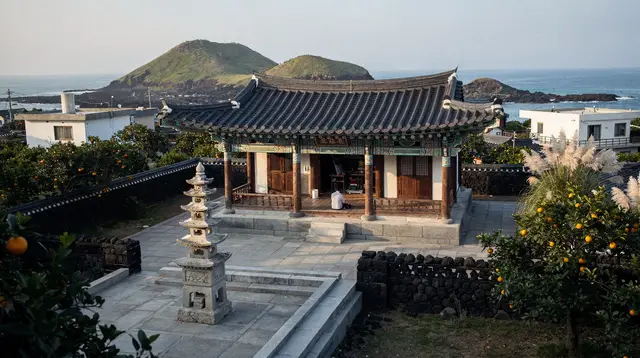
Cheonjeyeon Waterfall
What makes Cheonjeyeon different from Cheonjiyeon?
Cheonjeyeon is actually three connected waterfalls — not one — linked by a scenic trail and the arched Seonimgyo bridge, sometimes decorated with carved nymph figures. It's quieter than Cheonjiyeon and, when water levels are good, arguably the most scenic of Seogwipo's three falls.
Cheonjeyeon Waterfall is the least straightforward of Seogwipo’s three named falls to describe in a single sentence, because it isn’t really one waterfall — it’s three, connected along the same stream by a wooded walking trail and crossed by an arched stone bridge, Seonimgyo, that has become one of the most photographed single structures on this stretch of coast. The name means roughly “God’s Pond,” a reference to a legend involving seven nymphs said to have descended from the sky to bathe here, a story the bridge itself commemorates with carved relief figures.
| Where | Seogwipo, western part of the waterfall circuit |
| Cost | Around ₩2,000-2,500 for adults |
| Time needed | 45-60 minutes for the full three-fall loop |
| Hours | Roughly 9 a.m.-6 p.m., seasonal |
| Best time | Spring for flow, weekday mornings for quiet |
The layout: three falls, not one
The first fall, closest to the entrance, is the most visited and most consistently full — a broad curtain of water into a green pool, reachable via a short, well-maintained path. The second and third falls sit further along the trail, smaller and more seasonally dependent on flow, and see considerably fewer visitors simply because reaching them takes more time and effort than the first. Most tour groups stop at the first fall and the bridge and turn back; independent travelers with an extra 20-30 minutes can walk the full loop to see all three, and the quieter upper sections are, for many visitors, the more rewarding part of the visit precisely because they see so much less foot traffic.
The Seonimgyo bridge and the nymph legend
Seonimgyo arches over the stream between the falls, decorated with carved figures representing seven nymphs (seonnyeo) who, according to local legend, descended nightly from the sky to bathe in the pool below before returning to the heavens. It’s a genuinely striking piece of architecture in its own right — worth the detour even if you’re not particularly invested in the legend — and it functions as the de facto signature photo of the site, appearing on more tour listings and postcards than either of the actual waterfalls.
Entry fee and hours
Entry runs around ₩2,000-2,500 for adults, comparable to Cheonjiyeon and Jeongbang, with reduced tickets for children and teenagers. Hours generally run from about 9 a.m. to 6 p.m., though this shifts somewhat by season — there’s no night illumination here, unlike Cheonjiyeon’s occasional evening opening in high season. As with the other waterfalls in this circuit, treat these numbers as close estimates rather than fixed facts; Seogwipo City periodically adjusts pricing and hours, and the ticket booth can confirm the current figures on the day.
Getting there
Cheonjeyeon sits a short drive (10-15 minutes) from both Cheonjiyeon and Jeongbang, making it a natural third stop on a Seogwipo waterfall circuit, and it’s roughly 15-20 minutes from old-town Seogwipo’s harbor district. From CJU airport, the drive takes 50-60 minutes via the Jeju-Seogwipo Expressway or the scenic 1100 Road. There’s paid parking near the entrance; it’s generally less crowded than Cheonjiyeon’s lot since fewer tour buses prioritize this stop, which is itself a point in favor of visiting if crowd avoidance matters to your trip.
Public buses reach the general area, though as with the other waterfalls, confirming current routes via Naver Map or a hotel front desk beats relying on an old printed schedule. For visitors without a car, Jeju: SouthWest Authentic Tour — Mt Halla, Waterfall, Green Tea covers a waterfall stop in this region as part of a broader ten-hour day that also takes in Hallasan-area scenery and the Osulloc tea fields, a practical option if building your own multi-stop route isn’t appealing.
Best time to visit
Because Cheonjeyeon draws fewer tour groups than Cheonjiyeon, the crowd-avoidance calculus is less urgent here — but arriving before 10 a.m. or after 3 p.m. still produces a noticeably quieter walk, particularly around the first fall and the bridge, which remain the most-photographed spots. Morning light filtering through the forest canopy along the upper trail sections photographs especially well, and the relative quiet of this site compared to its neighbors makes it a better candidate for an unhurried, exploratory visit than a quick tick-box stop.
Photography notes
Cheonjeyeon offers the most compositional variety of Seogwipo’s three waterfalls: the first fall and its pool for a classic waterfall shot, the Seonimgyo bridge for an architectural frame (often shot from below, looking up at the arch against the sky or forest canopy), and the quieter upper trail for forest-and-stream compositions without another visitor in frame. A mid-range zoom (24-70mm equivalent) covers most of these; a slightly longer lens helps isolate the bridge’s carved details from a distance. For a fuller roundup of Jeju’s landscape photography locations and gear recommendations, see the Jeju photography spots guide.
Where the “God’s Pond” name comes from
Cheonjeyeon translates roughly to “Pond of the Emperor of Heaven,” a name tied directly to the nymph legend commemorated on the Seonimgyo bridge — the pool below the first fall was said to be where the seven celestial nymphs bathed before returning to the sky each dawn. Whether or not the legend holds any weight as history, it’s a genuinely appealing bit of context that most guided tours mention while standing at the bridge, and it explains why the carved figures decorating the arch specifically depict seven female forms rather than a generic decorative motif. Local sources sometimes also connect the site’s name to the wider “Samseonghyeol” mythology cluster tied to Jeju’s founding legends, though that connection is looser and worth treating as folklore rather than settled etymology.
Common mistakes visitors make
The most frequent misstep is treating Cheonjeyeon like Cheonjiyeon — a quick five-to-ten-minute stop for a single photo — and missing the point of the site entirely, which is the walk itself and the bridge, not a single dramatic overlook. A second common mistake is skipping the second and third falls because they’re not visible from the entrance, without realizing the extra ten to fifteen minutes of walking involved is genuinely modest for what it adds. A third is visiting during a dry winter week expecting the same lush, full-flow photos seen in spring marketing images — as covered above, the upper falls in particular are highly rain-dependent, and a realistic expectation avoids disappointment.
Is Cheonjeyeon a tourist trap?
No — if anything, it’s somewhat underrated relative to Cheonjiyeon, precisely because its three-part layout doesn’t lend itself to the same five-minute tour-bus stop. Entry fees are modest and comparable to the other two waterfalls, there’s no aggressive upselling, and the site rewards visitors willing to spend closer to an hour than fifteen minutes. For a broader look at which of Jeju’s marketed attractions live up to their reputation and which don’t, see the island-wide honest Jeju hub.
Accessibility in more detail
The path to the first fall and the Seonimgyo bridge involves a mix of paved sections and natural-surface trail with some uneven footing — manageable for most visitors in normal footwear, but genuinely more demanding than Cheonjiyeon’s smooth path for anyone using a wheelchair or a standard stroller. Sturdy, closed-toe shoes are worth the small effort, particularly after rain when the trail surface can be slick in places. The second and third falls require additional walking on less developed sections of trail, and visitors with significant mobility constraints should treat the first fall and bridge as the realistic full visit rather than attempting the entire loop.
Comparing Cheonjeyeon to Cheonjiyeon and Jeongbang
If ease and reliability matter most, Cheonjiyeon’s flat path and consistently full pool make it the safest single choice. If a genuinely unusual geographic feature is the draw, Jeongbang’s ocean-falling cascade is unmatched. If the goal is the most scenic walk and the richest set of photo opportunities — at the cost of a bit more walking and a less dramatic single viewpoint — Cheonjeyeon is arguably the pick. Most visitors with a half-day simply see all three in sequence, since they sit within a 10-15 minute drive of each other.
Seasonal flow
Like its neighbors, Cheonjeyeon’s flow depends on recent rainfall, with spring rain and the aftermath of typhoon season (late August-September) producing the fullest cascades across all three tiers. In a dry winter stretch, the second and third falls in particular can slow to a trickle or nearly stop, while the first fall — fed by a larger catchment — tends to maintain at least a modest flow year-round. If seeing all three falls at genuinely full volume is the goal, timing a visit for spring or shortly after a rain event gives the best odds.
Visiting with kids or limited mobility
The main trail to the first fall and the Seonimgyo bridge is moderately graded — gentler than Jeongbang’s stairs, but with more uneven, natural-surface sections than Cheonjiyeon’s paved path. It’s manageable for most families with older children, though a stroller will need to be carried over some sections, and reaching the second and third falls involves further walking on less developed trail. For visitors prioritizing full accessibility, Cheonjiyeon remains the easier of the three sites.
What’s nearby
The entrance area has a small cluster of food stalls and souvenir vendors, more modest than Cheonjiyeon’s. For a proper meal, either backtrack toward old-town Seogwipo’s harbor district or continue toward Jungmun, which has a wider range of restaurants geared toward the resort crowd. Restrooms are available near the entrance. The Osulloc green tea fields, a scenic and genuinely photogenic stop in their own right, sit a further 20-30 minutes west and pair naturally with a Cheonjeyeon visit on a day heading toward the west coast.
Combining Cheonjeyeon with the rest of the region
Cheonjeyeon works as the natural final stop on a Seogwipo waterfall circuit that starts at Cheonjiyeon and continues through Jeongbang, or as an early stop on a longer day heading toward Jusangjeolli’s basalt columns and the Osulloc tea fields further west. For the full destination picture, including where to stay and a realistic multi-day plan for the region, see the Seogwipo destination guide.
Month-by-month notes
Spring (March-May) brings the strongest, most consistent flow across all three tiers, alongside comfortable walking temperatures — arguably the best season for this specific site given how much its appeal depends on genuinely flowing water across all three falls. Summer (June-August) brings heat and the July monsoon; the forest canopy along the trail offers welcome shade, though humidity makes the walk to the upper falls more of a workout. Autumn (September-November), especially October, combines comfortable temperatures with generally reliable flow after the tail end of typhoon season passes. Winter (December-February) brings the thinnest crowds of the year, but also the highest chance that the upper two falls will be reduced to a trickle after weeks without significant rain.
Nearby: Cheonjeyeon Bridge and the coastal walk
Beyond the waterfall trail itself, a separate pedestrian suspension bridge — distinct from Seonimgyo, and sometimes confused with it in older travel write-ups — crosses a section of coastline nearby, offering ocean views back toward the Seogwipo coast. It’s a minor add-on rather than a destination in its own right, but worth the extra ten minutes if you’re already in the area and want an ocean vista to complement the forest-and-waterfall scenery of the main trail. Combined with the Osulloc tea fields further west, this stretch of coastline offers a reasonably full afternoon of scenery without needing to backtrack toward old-town Seogwipo.
What locals and repeat visitors say
Ask a Seogwipo resident which of the three waterfalls they’d send an out-of-town friend to, and Cheonjeyeon comes up more often than the guidebook rankings would suggest — not because it’s more impressive at a glance than Cheonjiyeon, but because the longer walk and quieter upper falls feel less like a managed attraction and more like an actual forest outing. Repeat visitors to Jeju who’ve already ticked off Cheonjiyeon on a previous trip often name Cheonjeyeon as the more rewarding return visit, precisely for the reasons that make it slightly less convenient for a first-timer on a tight schedule: it takes longer, and it asks more of you than a single overlook does.
Weather-dependent closures
Beyond the general seasonal flow variation covered above, Cheonjeyeon’s trail can close in specific weather conditions — heavy rain that raises stream levels dangerously along the walking path, or, less commonly, the tail end of a typhoon when fallen branches or slick trail surfaces make the upper sections temporarily unsafe. These closures tend to be short (a day or two at most) and are more common in the late-August to September typhoon window than at any other point in the year. If a rainy-season visit is unavoidable, checking conditions the morning of — via a hotel front desk or the Seogwipo tourism office — avoids arriving to a closed gate after the drive out.
Budget notes
A visit to Cheonjeyeon alone costs little beyond the ₩2,000-2,500 entry fee and parking, which is typically free or nominal at the site’s own lot. Combined with Cheonjiyeon and Jeongbang, a full waterfall-circuit morning runs under ₩10,000 in entry fees total for an adult — modest by almost any standard, and one of the better value blocks of sightseeing on the island relative to the time and scenery involved. Food at the entrance stalls runs ₩3,000-6,000 for a snack; a proper meal is better sought in old-town Seogwipo or, if heading west, near the Osulloc tea fields, both of which offer considerably more variety than the waterfall-adjacent food stands.
Frequently overlooked: the second and third falls in detail
The second fall sits roughly ten minutes further along the trail from the first, smaller and often reduced to a narrow ribbon of water even in moderate flow conditions, framed by a rockier, less manicured setting than the main viewing area. The third fall, another five to ten minutes beyond that, is the smallest of the three and the most dependent on recent rain — in a dry stretch it can all but disappear, leaving little more than a damp rock face. Neither is essential viewing if time is tight, but together they turn a fifteen-minute stop into a genuine forty-five-minute walk through some of the quietest, least-photographed corners of the entire Seogwipo waterfall circuit, which is arguably the point for visitors who’ve already seen the more famous single-overlook falls elsewhere on the island.
A realistic half-day plan
Visit Cheonjiyeon first for the easier walk, then Jeongbang for the ocean-drop view, and finish at Cheonjeyeon — budgeting 45-60 minutes here rather than the 30 minutes that suffices at the other two, since the full three-fall loop and the bridge genuinely reward unhurried exploration. This sequence covers the entire Seogwipo waterfall circuit at a comfortable pace in a single morning, leaving the afternoon free for old-town Seogwipo, the Osulloc tea fields, or a drive further west toward Sanbangsan and the west coast.
Jeju: Southwest Essentials — Hallasan & UNESCO Highlights Day Tour is a practical option for covering this waterfall circuit alongside the region’s other UNESCO-listed sights without renting a car.
Seogwipo’s three waterfalls, side by side
| Cheonjeyeon | Cheonjiyeon | Jeongbang | |
|---|---|---|---|
| Layout | Three connected falls plus a bridge | One main fall and pool | Single fall dropping into the ocean |
| Path | Mixed paved/natural, some uneven ground | Flat, easiest of the three | Stairs down to the shore |
| Typical visit time | 45-60 minutes | 20-30 minutes | 20-30 minutes |
| Crowd level | Fewer tour buses | Busiest of the three | Moderate |
| Best for | An unhurried forest walk | Easy access, reliable flow | A genuinely unusual coastal feature |
Amenities and practical details
Restrooms sit near the entrance, alongside the modest cluster of food and souvenir stalls mentioned above. There’s no on-site water refill station, so bring a bottle, particularly in summer humidity when the walk to the upper falls becomes a genuine workout. Cash and card are both generally accepted at the ticket booth, though carrying some won in small denominations is a reasonable habit across all of Jeju’s paid attractions in case a card reader is temporarily down.
Discounted combined tickets covering all three Seogwipo waterfalls aren’t consistently available, so budget the individual entry fees separately rather than assuming a bundle price. Free short-term luggage storage isn’t available on-site, so this is better treated as a stop along a driving day than a first destination straight from the airport with bags in tow. Mobile signal is generally reliable throughout the trail, including the quieter upper sections, so navigation apps and ride-hailing services work normally if you’re arriving without your own car.
Combining Cheonjeyeon with a Hallasan day
For visitors building a fuller southwest-Jeju day, Cheonjeyeon pairs naturally with a morning or afternoon on Hallasan’s southern trails, both reachable within a similar drive time from Seogwipo. A common structure: an early Hallasan trail before the afternoon heat and crowds build, followed by the comparatively gentle, shaded walk at Cheonjeyeon in the afternoon — a pairing that balances a genuinely strenuous morning with a relaxed, low-effort second half of the day. Drivers doing this pairing should budget realistic transition time between the two: Hallasan’s trailheads sit inland and higher up, while Cheonjeyeon is closer to the coast, so the drive between them is closer to 30-40 minutes than a quick hop, and finishing a long hike with tired legs makes the walking pace at Cheonjeyeon noticeably slower than it would be fresh.
Fitting Cheonjeyeon into a wider Seogwipo plan
Cheonjeyeon is easiest to enjoy when it is one calm chapter in a day that has some variety. After the forest walk, the old town is a natural next step: the Seogwipo walking tour gives the town a cultural frame, and the Seogwipo restaurant guide helps with a proper meal once the trail is behind you. If you would rather stay in the Jungmun direction, the Jungmun area culture walk is a gentle companion to a morning among waterfalls.
Travelers who like to plan the whole trip around days like this one will find the first-time Jeju planning guide useful for deciding how much of the south to cover, and the Jeju 3-day itinerary shows how a waterfall morning can sit beside coastal and cultural stops. Anyone building a slower trip around Olle walks can look at the Olle trail overview to see how the southern coast connects.
If you prefer a guide to handle the driving, a day tour of the southern UNESCO-listed spots is one way to cover this side of the island without managing parking and routes yourself, and the private versus group day tours guide explains how to choose between formats.
Related guides

Cheonjiyeon Waterfall
Cheonjiyeon Waterfall in Seogwipo: a 22m drop through subtropical forest, entry fees, opening hours, night illumination, and how it compares to Jeju's

Jeongbang Waterfall
Jeongbang Waterfall drops straight into the ocean — a rare feature in Asia. Entry fees, opening hours, the stairs down, and how it compares to Cheonjiyeon.

Jusangjeolli Cliff
Jusangjeolli's hexagonal basalt columns near Jungmun: how they formed, entry fees, best time to visit for waves, and safety on the boardwalk.

Seopjikoji Lighthouse & Cliffs
Seopjikoji's grassy cliffs, lighthouse, and Glass House architecture on Jeju's east coast — free entry, K-drama fame, and how it pairs with Seongsan
Ready to book? Top tours for this guide
We earn a small commission if you book through GetYourGuide — at no extra cost to you. Every tour is hand-picked and verified.
Jeju: UNESCO Day Tour for Cruise Guests
Jeju: Highlights Day Trip (East Course)
Jeju Island: Full Day Tour for Cruise Ship Passengers
Jeju: Small Group UNESCO Highlights Tour for Cruise Guests

Jeju East: Cherry Blossom Early Bird Tour with Hotel Pickup