
Hiking and adventure Jeju itinerary
Jeju rewards hikers with more variety than its reputation as a beach-and-cafe island suggests: a genuine mountain summit at Hallasan, a scatter of smaller volcanic cones (oreums) climbable in a couple of hours each, and coastal Olle Trail sections that mix walking with sea views rather than forest. This five-day itinerary is built around three consecutive demanding days plus recovery time, rather than trying to spread hiking evenly across a full sightseeing trip. The Hallasan hiking guide and oreum hiking guide are useful companions for broader trail background beyond this specific five-day plan.
| Where | Hallasan National Park, East Jeju, Udo Island |
| Cost | ₩750,000-1,000,000/person for 5 days, excluding flights |
| Getting around | Rental car, IDP required |
| Best for | Fit, experienced hikers; active travelers |
| Book ahead | Hallasan summit trail reservation (mandatory, no walk-up) |
Who this itinerary suits
This suits fit, experienced hikers who want Hallasan’s summit as a centerpiece rather than an afterthought, active travelers who’d rather move under their own power than sit in a rental car all day, and photographers chasing crater-rim and coastal-cliff shots that aren’t accessible from a parking lot. It’s a poor fit for casual walkers or anyone with limited hiking experience — Hallasan’s summit trails alone are an 8-9 hour, 17-19km round trip with real elevation gain, and this itinerary stacks that alongside two more active days.
Both Hallasan summit trails require an advance online reservation with a daily hiker quota — book as soon as your dates are fixed, since popular days fill within days of the booking window opening. There’s no walk-up option, and gate cutoff times are enforced strictly at the trailhead checkpoint regardless of how far you’ve already traveled that morning.
Day-by-day summary
| Day | Focus | Key activity | Overnight |
|---|---|---|---|
| 1 | Warm-up | Geumun-oreum crater loop | East Jeju/Hallasan area |
| 2 | Sunrise climb | Seongsan Ilchulbong, active recovery | Near Hallasan trailheads |
| 3 | Summit day | Hallasan (Seongpanak or Gwaneumsa) | Near Hallasan/Seogwipo |
| 4 | Recovery | Yeongsil trail or coastal walk | Near Hallasan/Seongsan |
| 5 | Final active day | Udo Island e-bike loop, depart | — |
Day 1: Arrival and an oreum warm-up
Land at CJU, collect a rental car in Yongdam (an International Driving Permit is required), and use the afternoon for an easier warm-up climb rather than diving straight into Hallasan jetlagged. Geumun-oreum, a volcanic crater near East Jeju, is a good choice — a moderate 1.5-2 hour loop through forest to a crater viewpoint, without Hallasan’s altitude or distance; the Geumun-oreum crater hike guide covers the trailhead and current access details. Jeju: Geumun-oreum Volcanic Crater Hiking covers this hike with a guide if you’d rather have local trail knowledge on day one.
Overnight near East Jeju or Hallasan’s access towns — guesthouse rooms in this area run ₩60,000-90,000/night (~US$45-67).
Day 2: Seongsan Ilchulbong sunrise climb
A different kind of climb from Hallasan: shorter (20-40 minutes on paved steps) but genuinely worth doing at sunrise rather than midday. Arrive at Seongsan Ilchulbong 30-45 minutes before sunrise to beat the crowd on the crater-rim path — entry runs about ₩5,000, and exact gate times shift seasonally, so check the current sunrise time the night before. The full Seongsan Ilchulbong guide has month-by-month gate times and an honest read on how crowded it actually gets.
Treat the rest of day two as an active-recovery day — a walk along the Seopjikoji headland, or a shorter oreum if energy allows — since day three is the trip’s most demanding. Overnight positioned within reasonable driving distance of Hallasan’s trailheads (30-45 minutes from either Jeju City or Seogwipo).
Day 3: Hallasan summit
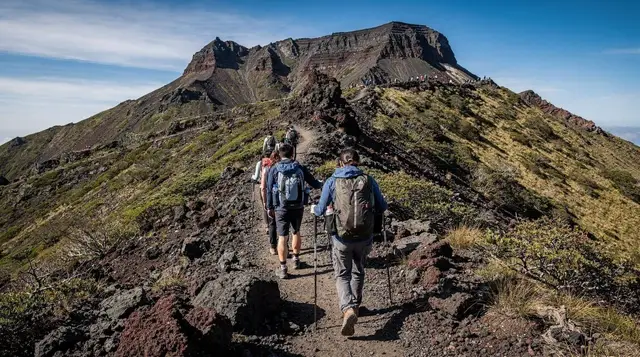
The centerpiece of the trip. The Seongpanak trail (9.6km one way, gentler average grade, 8-9 hours round trip) and the Gwaneumsa trail (8.7km one way, steeper with rockier upper sections, 7.5-9 hours round trip) are the only two routes reaching the crater rim at Baengnokdam. Full comparisons, current conditions, and reservation details are in the Seongpanak Trail guide and Gwaneumsa Trail guide. Start at first light — the gate cutoff time matters more here than on any other hike in this itinerary, and rangers do enforce it without exception.
Jeju: Hiking Mt. Hallasan, South Korea’s Highest Mountain is worth considering if you’d rather have a guide manage pacing and reservation logistics on the most demanding day of the trip. Pack more water than feels necessary, proper hiking shoes (not trail runners if conditions are wet), layers for summit wind, and trail snacks — the mountain’s huts sell limited food at a markup. Stay near Hallasan or in Seogwipo again tonight; you’ll want an easy dinner and an early night.
Day 4: Deliberate recovery, then Yeongsil or a coastal walk
Build in genuine rest after Hallasan rather than another demanding climb the next morning. If legs are still willing, the Yeongsil trail — climbing to Witse Oreum below the crater rim, about 3.7km one way with no reservation needed — offers dramatic rock scenery at a fraction of the previous day’s effort; see the Yeongsil Trail guide. If a full rest day feels more appropriate, a flatter coastal walk along an Olle Trail section near Seogwipo or Seongsan is a gentler alternative that still counts as movement without taxing already-tired legs.
Jeju: Sunset Tour Olle Trail Walking Tour with Hotel Pickup is a low-effort way to close this day with a guided coastal walk rather than more solo route-finding.
Day 5: Udo Island cycling, then depart
For a final active day that’s easier on the legs than another climb, cross by ferry to Udo Island and cover its roughly 17km perimeter road by e-bike — genuinely good exercise without Hallasan-level exertion. Jeju: Udo Island E-Bike, Seongsan Ilchulbong & Speed Boat bundles the ferry crossing with e-bike rental. Ferries cancel outright in rough seas, so check the morning sailing schedule before committing to this as your final activity. Return to the mainland coast by early afternoon and drive back to East Jeju or Jeju City for the flight home, roughly 50-70 minutes depending on your exact route.
Booking the Hallasan reservation
Since 2019, both summit trails require an advance online reservation through the national park’s booking system, with a daily hiker quota and an assigned starting-time window. Popular dates — weekends, holidays, peak October foliage weeks — can fill within days of the booking window opening, so reserve as soon as your travel dates are confirmed. Confirm the current gate cutoff time for your specific date when you book; it varies seasonally and is enforced strictly at the trailhead checkpoint, with rangers turning back hikers who arrive late regardless of how far they’ve traveled that morning.
If this trip is built specifically around summiting Hallasan, consider whether your dates have any flexibility at all — a single reserved day with no backup leaves the whole itinerary’s centerpiece exposed to one weather forecast. Booking two adjacent possible summit days if your schedule allows, and treating whichever one has the better forecast as the actual attempt, is a reasonable hedge for hikers who can’t afford to lose the whole trip’s centerpiece to one bad weather day.
Oreum climbing beyond Geumun-oreum
Jeju has hundreds of oreums (small volcanic cones) scattered across the island, and most are free to climb with no reservation system — a useful contrast to Hallasan’s more regulated trails. Beyond Geumun-oreum on day one, East Jeju and the interior near Hallasan both have oreums rising directly from farmland, typically a 30-60 minute round trip climb to a crater-rim or summit viewpoint — Saebyeol-oreum is a popular sunrise-and-sunset option worth considering if a scheduled day runs short. The oreum hiking guide has a fuller list of options across the island. If any of the scheduled days above run short on time, substituting a nearby oreum for a planned rest stretch is a reasonable way to add movement without significant extra driving.
Adding an Olle Trail section instead of another oreum
If a lower-elevation, sea-level alternative appeals more than another oreum climb on day four, several of Jeju’s 21 numbered Olle Trail routes hug the coast rather than climbing inland — a genuinely different hiking texture from Hallasan’s forest-and-summit terrain. The Olle Trail overview covers the full network, and Course 7 near Seogwipo or Course 10 near Sanbangsan are both reasonable half-day sections that fit this itinerary’s recovery day without much extra driving. Hikers wanting to build an entire trip around the coastal trail network specifically should look at the dedicated Olle Trail multi-day itinerary instead of trying to layer it onto this Hallasan-centered one.
If it rains or Hallasan closes
Hallasan’s summit trails close outright in high wind or heavy rain, enforced at the gate regardless of your reservation, with no easy rebooking. If your scheduled day is affected, the Yeongsil trail is sometimes a viable lower-elevation alternative depending on conditions, but confirm current trail status before driving out. Geumun-oreum and Udo’s e-bike loop are both more resilient to light rain than the exposed summit trails, making them reasonable swaps if the forecast shifts mid-trip.
Getting around for a hiking-focused trip
A rental car is essential for reaching trailheads efficiently — Hallasan’s two trailheads sit 30-45 minutes from Jeju City or Seogwipo, and public transport to them runs infrequently enough to risk missing the reservation window. Total driving across the five days runs roughly 150-180km, with fuel costing ₩25,000-35,000. Naver Map or Kakao Map are the navigation apps to use; Google Maps has meaningful gaps for driving directions on Jeju’s mountain access roads specifically.
Budget for five days of hiking
Trail access itself is largely free once reserved — Hallasan’s trails have no entry fee, and most oreum climbs cost nothing or a nominal parking fee. The paid stops are Seongsan Ilchulbong (₩5,000), Geumun-oreum guided hikes if booked, and Udo’s ferry (₩8,500-10,500 round trip) plus e-bike rental (₩15,000-25,000). A realistic daily budget for food, minor entry fees, and local transport runs ₩70,000-100,000 per person (~US$52-74), before lodging and the car.
This is one of the cheaper Jeju itineraries by design — hiking and trail access cost far less than a schedule built around paid attractions or resort stays, and the main expenses are the rental car and lodging rather than entry fees. Travelers on a tighter budget who still want an active trip can trim this itinerary’s cost meaningfully by skipping Udo on day five and using that day for a free oreum climb instead.
The one place worth spending more rather than less is footwear and basic trail gear — cutting costs on shoes that don’t fit properly or lack adequate grip is a false economy on a trip built around three consecutive demanding hiking days, where a preventable blister or ankle roll can end the trip’s centerpiece before it starts.
Gear matters more on this itinerary than most — proper hiking shoes, a headlamp for pre-dawn starts, and trekking poles if you use them at home are all worth packing rather than buying locally, since Jeju’s outdoor-gear shops are limited compared to mainland Korea; the Jeju hiking gear and safety guide has a fuller packing list and safety notes specific to Hallasan’s terrain and weather. Rough per-person total for five days, split between two travelers: ₩750,000-1,000,000 (~US$555-740), excluding flights to Jeju.
Where to stay
Basing near Hallasan’s access towns (either Jeju City-side via the 1131 road, or Seogwipo-side) for days two through four minimizes the drive to trailheads on the itinerary’s most demanding days. Moving to Seongsan for day one and day five’s Udo crossing bookends the trip with the east coast’s easier logistics. Guesthouse and small-hotel supply near the trailheads themselves is limited, so book Hallasan-adjacent nights earliest.
What to skip on a hiking-focused trip
Don’t try to combine both Hallasan summit trails into one trip — pick one based on your fitness level and preference for a longer, gentler climb (Seongpanak) versus a shorter, steeper one (Gwaneumsa), and save the other for a return visit. Resist adding West Jeju’s cafes or a full-island sightseeing loop to this itinerary; the daily hiking demands leave little energy for additional driving and sightseeing, and trying to combine both usually shortchanges the hiking.
Also worth skipping: scheduling a long dinner drive or another physical activity for the evening after the Hallasan day. Coming down from a 17-19km round trip with real elevation gain leaves most hikers wanting food, a shower, and sleep in roughly that order — planning anything more ambitious than a nearby restaurant tends to backfire.
Frequently asked questions about the hiking and adventure itinerary
How fit do I need to be for this itinerary?
Genuinely fit and experienced with long hikes — three demanding active days in five, including an 8-9 hour Hallasan summit attempt, isn’t suitable for casual walkers or complete hiking beginners.
Can I do this itinerary without summiting Hallasan?
Yes — substitute the Yeongsil trail (about 3.7km one way, no reservation needed) for a lower-commitment version that still delivers dramatic mountain scenery without the full summit’s time and elevation demands.
What happens if my Hallasan reservation is cancelled for weather?
The reservation is void for that specific date with no automatic rebooking. This is why a dedicated hiking trip needs either flexible dates or acceptance that the summit attempt might not happen.
Which Hallasan trail should hikers on this itinerary choose?
Seongpanak is longer (9.6km one way) with a gentler grade; Gwaneumsa is shorter (8.7km) but steeper with rockier sections. Total effort ends up similar — choose based on whether you prefer distance or steepness.
Is Udo cycling a good way to end a hiking trip?
Yes — it’s genuinely active without the elevation demands of the earlier days, making it a reasonable way to stay engaged on the last day without over-taxing legs that are still recovering from Hallasan.
What gear should I bring specifically for this trip?
Proper broken-in hiking shoes, layers for summit wind and temperature swings, a headlamp for pre-dawn starts, more water than feels necessary, and trekking poles if you use them regularly at home.
Is this itinerary safe to do solo?
Both Hallasan trails are well-marked and busy enough with other hikers that solo hiking is common and reasonably safe, though telling someone your planned route and expected return time is standard practice regardless.
What’s the best season for this itinerary?
May-June and September-October offer the clearest Hallasan summit weather. Winter adds snow and ice requiring crampons on the upper trail sections; summer brings monsoon rain and higher cancellation risk.
Are there guided options if I don’t want to navigate trailhead logistics myself?
Yes — guided tours exist for both the Hallasan trails and smaller oreum hikes, useful if you’d rather have someone else manage the reservation system and pacing, particularly for the summit day where the gate cutoff adds real time pressure.
How crowded is Hallasan compared to Seongsan Ilchulbong?
Both get busy on clear-weather weekends, but Hallasan’s daily hiker quota caps numbers on the trail itself, while Seongsan has no such cap — arriving early matters more for beating crowds at Seongsan than at Hallasan.
Should I train before this trip?
If you don’t hike regularly, some preparation is worth it — an 8-9 hour, 17-19km round trip with genuine elevation gain is demanding even for people who consider themselves generally fit but don’t hike often.
How does Hallasan compare to other well-known peaks for difficulty?
It’s a long-distance endurance hike more than a technical climb — no ropes or scrambling are required on either summit trail, but the sheer distance and duration make it comparable in overall effort to many well-known day hikes elsewhere in the world that are shorter but steeper.
What if I’ve never used trekking poles before — should I start on this trip?
It’s better to practice with poles on a shorter local hike beforehand if you plan to use them, since unfamiliar gear on an already demanding trail adds friction rather than help. If in doubt, skip poles entirely rather than trying them for the first time on Hallasan.
Is the Olle Trail a good substitute if Hallasan’s reservation falls through?
Yes, to an extent — coastal Olle Trail sections like Course 7 don’t replace a mountain summit experience, but they’re a genuinely good full-day hiking alternative that doesn’t depend on any reservation system if a Hallasan date is unavailable or gets weathered out.
Should I buy hiking gear locally or bring it from home?
Bring it from home if possible — Jeju’s outdoor-gear shops are limited compared to mainland Korea, and the hiking gear and safety guide has a packing list worth checking before you fly rather than assuming you can buy anything missing on arrival.
Related guides
Hiking Hallasan: Complete Guide
Compare all four Hallasan trails — Seongpanak, Gwaneumsa, Yeongsil, Eorimok — by distance, difficulty, reservation rules, and what each one delivers.

Hallasan: Seongpanak Trail
Seongpanak is the longer but gentler of Hallasan's two summit trails — 9.6km one way, reservation required, 8-9 hours round trip.

Best Oreums to Hike in Jeju
Jeju has over 360 oreums (volcanic cones). Here's how to pick which ones to climb, from 20-minute grassy hills to longer forested craters.

Geumun-oreum Volcanic Crater Hike
Geumun-oreum is a forested UNESCO Geopark crater near Gujwa — longer and more ecologically protected than most oreum hikes on Jeju.