
Hallasan: Gwaneumsa Trail
Is the Gwaneumsa Trail harder than Seongpanak?
Yes, in terms of grade — Gwaneumsa is about 900m shorter one way (8.7km) but climbs more steeply, with rockier, more technical sections in the upper third. Total time and effort end up similar to Seongpanak once the extra steepness is factored in.
Gwaneumsa is the second of Hallasan’s two summit trails, and the one hikers choose when they want a shorter distance and don’t mind a steeper, more technical climb in exchange. At 8.7km one way — roughly 900m shorter than the Seongpanak alternative — it sounds like the easier option on paper, but the grade is noticeably steeper and the upper third involves rockier, more scramble-like terrain that evens out the total effort.
| Distance | 8.7km one way / 17.4km round trip |
| Time | 7.5–9 hours |
| Reaches summit? | Yes — Baengnokdam crater rim |
| Reservation | Required, same system as Seongpanak |
| Trailhead | Near Gwaneumsa Temple, ~25–30 min from Jeju City |
The route, section by section
The trail begins near Gwaneumsa Temple at around 620m elevation, lower than the Seongpanak trailhead, which means slightly more total elevation gain packed into a shorter distance. The first stretch climbs through dense forest along a stream valley — genuinely pleasant walking, with several small waterfalls in wetter months. Around the 4km mark the trail reaches Yongjin-gak shelter, a rest point with toilets, and the grade begins to steepen noticeably.
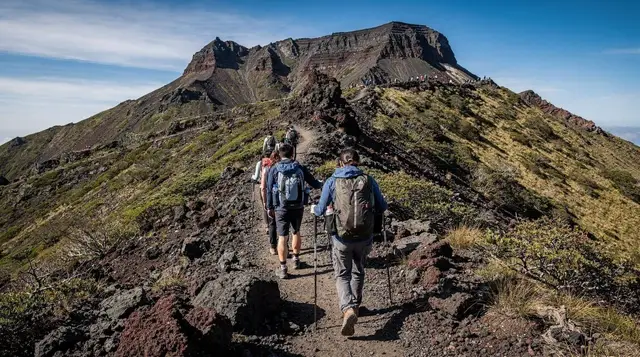
Past Yongjin-gak, the trail enters its most demanding section: a series of switchbacks and rocky steps climbing toward Samgakbong, a distinctive triangular peak visible from much of the upper trail, where the only overnight shelter on either summit route sits (bookable in advance for a rare two-day summit hike). From Samgakbong to the crater rim, the terrain is loose volcanic rock with sections requiring hands-on scrambling in a few spots — this is the part of Gwaneumsa that earns its “harder trail” reputation.
Reservations and the gate system
The same reservation system covers both summit trails: an online booking with a capped daily quota and an assigned starting window, enforced at checkpoints along the route. Gwaneumsa’s quota and cutoff times track Seongpanak’s seasonal pattern — tighter windows in shorter-daylight months, more flexibility in summer. Because Gwaneumsa is somewhat less well known to first-time visitors than Seongpanak, its daily quota sometimes fills slightly slower, which can make it the easier trail to book on short notice during peak weekends — worth checking if Seongpanak shows no availability.
How long it actually takes
Budget 7.5-9 hours round trip, including a break at the summit. The shorter distance saves some time compared to Seongpanak, but the steeper, rockier terrain — particularly on the descent, where loose rock demands more caution — closes most of that gap. Hikers with knee sensitivity often find Gwaneumsa’s descent harder than Seongpanak’s, despite the shorter distance, because of the technical footing.
If the reservation system and trail-finding feel like too much to manage independently, Jeju Island: Hallasan Mountain Winter Scenery Guided Tour covers the winter season with a guide handling permits and gear, and general summit-hiking tours like Jeju: Hiking Mt. Hallasan, South Korea’s Highest Mountain typically use whichever summit trail has availability on the day, which is often Gwaneumsa when Seongpanak is fully booked.
Winter conditions
Snow and ice cover the upper section from roughly December through March, and the already-technical rocky terrain becomes considerably more hazardous under ice — crampons are essential, not optional, and available to rent near the trailhead. Gwaneumsa is more prone to full-day closure than Seongpanak after significant snowfall, given the steeper grade’s higher risk profile, so check trail status the morning of a planned winter hike rather than assuming it’s open.
What to bring
Sturdy, ankle-supportive hiking shoes matter even more here than on Seongpanak, given the scrambling sections in the upper third. Trekking poles help considerably on the steep switchbacks near Samgakbong, both ascending and descending. There’s a shelter with toilets at Yongjin-gak but no food service on the trail, so carry everything you need for a full day. The Jeju hiking gear and safety guide has a complete seasonal packing list.
Gwaneumsa vs the other three trails
Gwaneumsa and Seongpanak are the only trails reaching the summit crater rim; Yeongsil and Eorimok stop at Witse Oreum below the crater and don’t require a reservation. Choose Gwaneumsa over Seongpanak if you’d rather trade a longer distance for a steeper, more technical climb, or if it simply has the better availability on your travel dates. The complete Hallasan hiking guide weighs all four options together.
Getting to the trailhead
The Gwaneumsa trailhead is roughly 25-30 minutes from Jeju City, making it the most centrally located of Hallasan’s four trailheads relative to the capital. It’s less convenient from Seogwipo, adding roughly 15-20 minutes compared to Seongpanak. A rental car or taxi is the most reliable way to hit your reservation window, since public bus coverage to this trailhead is limited. See the Hallasan National Park destination guide for a wider overview.
Cost of a Gwaneumsa hike
Like Seongpanak, the trail itself is free and the reservation carries no separate fee. A taxi from Jeju City to the trailhead is comparatively cheap given the short distance — roughly ₩15,000-20,000 (about $11-14) one way — making Gwaneumsa one of the more affordable summit trails to reach without a rental car. Winter crampon rental near the trailhead runs a similar ₩5,000-10,000 (about $4-7) as at Seongpanak. Guided hiking tours that use this trail cost more than independent transport plus gear, but remove the reservation and navigation burden — worth it for visitors unfamiliar with the booking system or uneasy navigating the steeper, rockier sections alone.
Gwaneumsa Temple at the trailhead
The trail’s namesake temple sits directly at the starting point, and it’s worth 15-20 minutes of your time before or after the hike even if temple visits aren’t normally on your itinerary. Gwaneumsa is a working Buddhist temple, not a museum, so keep noise to a minimum and dress reasonably modestly if you walk through the grounds. It provides a genuinely different opening (or closing) note to the hike than a plain parking-lot trailhead would — a quiet architectural counterpoint before or after several hours of physical exertion on the mountain.
Notable features along the route
Samgakbong, the triangular peak visible for much of the upper trail, is Gwaneumsa’s most recognizable landmark and a natural point to pause and take in how far you’ve climbed. The overnight shelter near Samgakbong is the only one of its kind on either summit trail, and even hikers not staying overnight often stop briefly at the shelter area for the views and a breather before the final push to the crater rim. The stream valley in the lower section, with its small waterfalls in wetter months, is a pleasant early contrast to the increasingly stark, rocky terrain higher up — worth slowing down for rather than rushing through on the way to the “real” scenery above.
Common mistakes on this trail
Underestimating the technical difficulty of the upper third is the single biggest misstep — hikers who’ve done Seongpanak before and assume Gwaneumsa will feel similar because it’s shorter are often surprised by how much more the rocky scrambling sections slow them down. Poor footwear choices matter even more here than on Seongpanak; sneakers that were merely uncomfortable on Seongpanak’s smoother sections can become genuinely hazardous on Gwaneumsa’s loose rock. Finally, some hikers push toward the summit too late in the day assuming the shorter distance buys more flexibility with the gate cutoff — it doesn’t, since the steeper grade often takes as long as Seongpanak’s greater distance.
Seasonal conditions month by month
Spring on Gwaneumsa follows a similar pattern to the rest of Hallasan — mild lower-trail temperatures with lingering cold and wind at elevation, and the stream valley near the trailhead running fuller with snowmelt and spring rain, which adds to the scenery but also means damper, occasionally slicker footing on the lower rocky sections. Summer’s monsoon rains (July) create genuine hazard on Gwaneumsa’s already rockier terrain, since wet volcanic rock is considerably more slippery than dry, and this trail’s technical sections amplify that risk more than Seongpanak’s gentler grade does.
Typhoon season (August into September) carries the same cancellation risk as elsewhere on the mountain. Autumn, especially October, brings the best hiking conditions and the heaviest reservation demand, with the added visual bonus of foliage color along the forested lower stretch near the stream. Winter (December through March) is Gwaneumsa’s most demanding season by a clear margin — the combination of steep terrain and ice makes this trail meaningfully more hazardous than Seongpanak under the same conditions, and cautious hikers sometimes choose Seongpanak specifically for winter attempts even if they’d otherwise prefer Gwaneumsa’s shorter distance.
Why some hikers prefer Gwaneumsa over Seongpanak
Beyond simple availability when Seongpanak’s reservation quota is full, some experienced hikers genuinely prefer Gwaneumsa’s character — the more varied terrain, the stream valley scenery, the sense of a “real” mountain trail rather than a longer but more uniform climb. If you’ve hiked technical trails before and find a steady, unchanging grade more tedious than physically demanding rocky terrain, Gwaneumsa’s shorter distance and more varied technical character may suit your preferences better than Seongpanak, despite the added difficulty. This is a legitimate, common reason to choose Gwaneumsa deliberately rather than only as a fallback.
Accessibility considerations
Gwaneumsa is generally considered less accessible than Seongpanak given its steeper grade and rockier upper terrain, and it’s not the trail typically recommended for hikers with limited mobility, young children, or those attempting their first Hallasan summit without previous rougher-trail hiking experience. The overnight shelter option near Samgakbong, while a genuine feature for experienced multi-day hikers, requires its own advance booking and isn’t relevant for the large majority of single-day visitors. If in doubt about which trail suits your fitness and experience level better, Seongpanak remains the safer default choice for a first attempt.
Trail traffic and timing
Gwaneumsa generally sees less foot traffic than Seongpanak, given the latter’s stronger reputation as the default first-time recommendation, which can make Gwaneumsa a genuinely quieter option even during peak reservation season. That said, “quieter” doesn’t mean empty, and popular weekend windows still fill with a meaningful number of hikers. Starting at the earliest point in your assigned reservation window generally means better trail conditions in the technical upper sections, where passing other hikers on narrow, rocky footing is more awkward than on Seongpanak’s broader path.
Descending Gwaneumsa safely
The descent on Gwaneumsa deserves particular attention given the trail’s rockier character — loose volcanic rock that felt manageable on the way up, when legs are fresh and attention is sharp, becomes a genuinely different proposition on tired legs during the descent. Take the steep switchback sections near Samgakbong slowly, use trekking poles if you have them, and resist the temptation to rush simply because you’re eager to finish; a twisted ankle or fall on this section is the most common minor injury reported on this specific trail, and nearly all of it is avoidable with a deliberately unhurried pace on the way down.
Photography opportunities specific to Gwaneumsa
The stream valley near the trailhead offers some of the most classically scenic, waterfall-adjacent photography on any Hallasan trail, particularly after rain when water flow increases. Samgakbong’s distinctive triangular silhouette makes for a strong compositional anchor in wider shots of the upper trail, and the more rugged, technical terrain higher up photographs with a rawer, more dramatic character than Seongpanak’s steadier, more uniform ascent — worth keeping your camera accessible rather than packed away given how much the scenery shifts across the trail’s shorter but more varied length.
A final planning checklist
Before heading to the Gwaneumsa trailhead, confirm your reservation window, check the mountain forecast specifically rather than the coastal one, and pack for both the stream-valley humidity of the lower trail and the drier, windier conditions higher up. Broken-in hiking shoes with real ankle support matter more here than on any other Hallasan trail given the rockier upper terrain, and trekking poles are worth carrying if you have them, particularly for the steep switchbacks near Samgakbong. Give yourself a realistic time buffer to reach the trailhead — the reservation system enforces starting windows strictly, and arriving late isn’t a minor inconvenience but a real risk of losing your slot entirely.
Who should choose Gwaneumsa deliberately
Beyond hikers simply taking whichever summit trail has reservation availability, Gwaneumsa is worth choosing on purpose if you specifically want a shorter overall distance and don’t mind trading that for steeper, more technical terrain, if you’re drawn to the stream-valley scenery and Samgakbong’s distinctive silhouette, or if you’re interested in the rare overnight shelter option for a two-day summit approach. It’s also a reasonable pick for hikers who’ve already completed Seongpanak on a previous visit and want a genuinely different experience of the same mountain on a return trip, rather than repeating the same route.
How Gwaneumsa’s difficulty is often misjudged
Because the trail is shorter on paper than Seongpanak, some hikers assume it will simply be an easier, quicker version of the same hike, and that assumption is the root of most difficulty complaints reported after the fact. Comparing the two honestly: Gwaneumsa asks for more per kilometer in terms of grade and technical footing, and treating the two trails as directly comparable in difficulty just because one number (distance) is smaller is a genuine planning mistake. Approach Gwaneumsa expecting a demanding, technical mountain trail rather than a shortcut version of Seongpanak, and the actual experience will match your expectations far better.
Rest and recovery afterward
After a demanding descent, many hikers use the rest of the day for lighter activity — a soak at a nearby jjimjilbang or spa, or simply an easy evening exploring Jeju City given the trailhead’s proximity. If a winter attempt left you managing rented crampons and gear, returning them promptly near the trailhead before heading back into town is one less thing to remember later in the day.
One last consideration before you commit
If you’re torn between Gwaneumsa and Seongpanak right up to the morning of your hike, default to whichever trail your current reservation actually covers rather than trying to switch at the trailhead — same-day changes generally aren’t accommodated within the reservation system, and showing up at the wrong trailhead wastes valuable early-morning time you can’t easily recover.
Gwaneumsa vs. Seongpanak, side by side
| Gwaneumsa | Seongpanak | |
|---|---|---|
| Distance one way | 8.7km | 9.6km |
| Grade | Steeper, rockier upper third | Steadier, more forgiving |
| Trailhead access | ~25–30 min from Jeju City | ~30–40 min from Jeju City or Seogwipo |
| Overnight shelter | Yes (Samgakbong, by reservation) | No |
| Best for | Experienced hikers, shorter distance | First-time summit attempts |
Gwaneumsa within the wider Hallasan picture
Gwaneumsa is one of four established Hallasan routes, and the complete Hallasan hiking guide lines up all four — Gwaneumsa, Seongpanak, Yeongsil, and Eorimok — side by side by distance, difficulty, and reservation rules, useful if you’re comparing this trail against the non-summit options rather than only against Seongpanak.
Frequently asked questions about the Gwaneumsa Trail
How long is the Gwaneumsa Trail?
8.7km one way to the summit crater rim, 17.4km round trip. Plan 7.5-9 hours including a summit break, slightly less than Seongpanak but the steeper grade makes it feel comparable.
Is Gwaneumsa suitable for beginners?
It’s more demanding than Seongpanak due to rockier, steeper terrain in the final third — reasonably fit beginners can manage it with good shoes and an early start, but Seongpanak is the gentler choice for a first Hallasan summit.
Does Gwaneumsa require a reservation?
Yes, the same online reservation system that applies to Seongpanak covers Gwaneumsa, with a daily hiker quota and assigned starting-time window enforced at trailside checkpoints.
Where does the Gwaneumsa trailhead start?
Near Gwaneumsa Temple on Hallasan’s northern slope, about 25-30 minutes from Jeju City — closer to the city than the Seongpanak trailhead.
Is there camping on the Gwaneumsa Trail?
Yes — Gwaneumsa is the only summit trail with an overnight shelter (Samgakbong shelter) available by advance reservation, allowing a rare two-day summit approach with sunrise timed at the crater rim.
What’s the elevation gain on Gwaneumsa?
Roughly 1,400m of gain from the trailhead (around 620m) to the 1,947m summit — slightly more cumulative elevation gain per kilometer than Seongpanak given the shorter distance.
Can I combine Gwaneumsa with Gwaneumsa Temple?
Yes — the temple sits right at the trailhead and is worth 15-20 minutes before or after the hike; it’s a working temple, not a museum, so keep noise down and dress modestly if visiting the grounds.
Related guides
Hiking Hallasan: Complete Guide
Compare all four Hallasan trails — Seongpanak, Gwaneumsa, Yeongsil, Eorimok — by distance, difficulty, reservation rules, and what each one delivers.

Hallasan: Seongpanak Trail
Seongpanak is the longer but gentler of Hallasan's two summit trails — 9.6km one way, reservation required, 8-9 hours round trip.

Hallasan: Eorimok Trail
Eorimok is the gentlest of Hallasan's four trails, climbing toward Witse Oreum from the west — no reservation, roughly 4.7km one way.

Hallasan: Yeongsil Trail
Yeongsil climbs to Witse Oreum below Hallasan's crater rim — no summit reservation needed, dramatic rock formations, roughly 3.7km one way.
Ready to book? Top tours for this guide
We earn a small commission if you book through GetYourGuide — at no extra cost to you. Every tour is hand-picked and verified.
Jeju: Hiking Mt. Hallasan, South Korea's Highest Mountain
Jeju Island: Hallasan Mountain Winter Scenery Guided Tour
Jeju: Mt. Hallasan Small-Group Nature Hike & Lunch
Jeju: UNESCO Sites & Sunrise Peak Hiking Small Group Tour
Jeju South: Small Group Healing Tour w/Mt.Halla & Olle Trail
