
Jeju public bus guide
Is Jeju's bus system good enough for a car-free trip?
It works well for travel between Jeju City and Seogwipo and to a handful of major single sites, but rural coastal and inland attractions in east and west Jeju are poorly served, often requiring long waits or a final 20-30 minute walk from the nearest stop. Budget travelers sticking to city-based itineraries can rely on buses; anyone wanting to cover multiple scattered sites in a day should rent a car or use Kakao T taxis for the gaps.
Jeju’s bus network underwent a significant overhaul in 2017, restructuring what had been a patchwork of overlapping local routes into a clearer trunk-and-branch system with color-coded route types. It’s a genuine improvement over the old system, and for visitors basing themselves in Jeju City or Seogwipo, it can realistically replace a rental car. For anyone chasing the island’s more scattered rural attractions, though, the gaps in coverage are still real enough to plan around.
| Base fare | around ₩1,000-1,500 |
| Best for | Jeju City / Seogwipo corridor + major hub sites |
| Weak spot | rural east/west Jeju, oreums, back-road cafés |
| Payment | T-money compatible card recommended; cash accepted |
| Planning app | Kakao Map or Naver Map (not Google Maps) |
Buses are worth taking seriously as a primary transport option rather than dismissing them as a fallback for people who couldn’t rent a car. A meaningful share of budget and solo travelers to Jeju build entire trips around the bus network combined with occasional taxis, and for the right itinerary — one centered on the island’s main hub towns and a handful of well-connected marquee sites — it’s a genuinely comfortable and inexpensive way to see the island without ever dealing with an International Driving Permit, insurance paperwork, or unfamiliar roads.
How the trunk-and-branch system works
The 2017 restructuring split Jeju’s buses into a small number of route categories, each marked by number range and, informally, color on maps and at bus stops. Trunk routes (often called intercity or express buses) run along the island’s main arteries — the coast road and the cross-island highways — connecting Jeju City, Seogwipo, Seongsan, and other hub towns with relatively few stops and higher average speeds. Branch and local routes then fan out from those trunk corridors into neighborhoods, smaller towns, and some (not all) rural attractions, with more frequent stops and slower overall travel times.
In practice, a typical visitor journey to a rural site — say, from Jeju City to Bijarim Forest in east Jeju — often means catching a trunk-route bus toward the general area, then either transferring to a branch route or walking the final stretch, since not every attraction sits directly on a bus line. This isn’t a flaw unique to Jeju; it’s the standard structure of hub-and-spoke transit anywhere, but it’s worth understanding before assuming a single bus will take you door-to-door.
Fares and how to pay
Base fares on Jeju run roughly ₩1,000-1,500 for a standard ride, with the higher end applying to longer intercity and express routes where fares scale with distance traveled. A short hop within Jeju City sits at the lower end; a full cross-island trunk-route ride toward Seongsan or the Hallasan trailheads costs more.
Cash is accepted on all routes, but a contactless transit card is the practical choice for nearly everyone. T-money-compatible cards — the same standard used across Korea’s national transit system — work seamlessly on Jeju buses, and can be purchased or topped up at CU, GS25, and 7-Eleven convenience stores island-wide, including locations near CJU airport. Tapping a card in and out (where applicable) also unlocks a transfer discount within a set time window, typically making a connecting bus ride free or heavily discounted if boarded within that window — a saving that adds up quickly if your route requires switching buses partway.
Paying cash works fine for occasional single rides but becomes a hassle if you’re making several trips a day, since drivers don’t reliably carry much change and fumbling for exact fare slows down boarding for everyone else on the bus.
Route types in practical terms
For sightseeing purposes, the routes that matter most to visitors fall into two broad categories. Intercity/express routes link the island’s major population centers and tourist hubs with minimal stops — useful for getting from Jeju City to Seogwipo, or out toward Seongsan, in one relatively fast ride. Local routes serve neighborhoods and smaller towns with dense stop spacing, which is what you’ll typically need for the final leg to a specific attraction, beach, or trailhead once the trunk route drops you near the general area.
There are also dedicated tourist-oriented routes in some areas that loop past a cluster of nearby attractions, though these tend to run less frequently than the main trunk lines and are worth checking specifically rather than assuming they match trunk-route frequency.
Planning a route: use Kakao Map or Naver Map, not Google Maps
South Korea’s long-standing restriction on exporting detailed mapping data affects public transit routing as much as driving directions — Google Maps’ public transit function is unreliable or simply absent for much of South Korea, Jeju included. Kakao Map and Naver Map both have functional public transit trip planners that show real-time bus arrival estimates, walking segments to and from stops, and transfer instructions, with Kakao Map offering a usable English-language toggle for visitors. Download one of these apps before your trip rather than relying on your usual mapping habit — this is one of the most common points of confusion for first-time visitors to Korea generally, not just Jeju.
Where the coverage genuinely falls short
This is the section worth reading carefully before committing to a car-free Jeju trip. Buses cover the island’s main population corridor — Jeju City to Seogwipo along the interior highways, plus the coast road connecting major towns — reasonably well, with departures every 10-20 minutes at peak times on the busiest trunk routes. Once you move away from that spine, coverage thins fast.
Rural attractions in east Jeju and west Jeju — smaller oreums, back-road cafés, certain beaches, and some of the less-visited waterfalls and gardens — are frequently served by a single local route running once every 30-60 minutes, with the nearest stop often a 15-30 minute walk from the actual site entrance. Missing a bus back from one of these stops can mean a genuinely long wait, and last departures from rural stops tend to be earlier in the evening than visitors expect, sometimes well before sunset in shoulder seasons.
This coverage pattern makes bus-only itineraries workable for travelers whose plans center on a handful of well-connected major sites — Seongsan Ilchulbong, Manjanggul, the main Hallasan trailheads, central Seogwipo’s waterfalls — but genuinely difficult for anyone trying to string together three or four scattered rural stops in a single day.
Who buses actually work well for
Buses suit a specific kind of traveler well: budget-conscious visitors basing themselves in Jeju City or Seogwipo, planning day trips built around one or two major, well-served destinations rather than a packed multi-stop loop, and comfortable supplementing bus travel with the occasional Kakao T taxi ride to bridge a gap. For this profile, a Jeju trip without a rental car is entirely feasible and meaningfully cheaper — a day of bus fares rarely exceeds a few thousand won per person, against the daily cost of a rental car plus insurance and fuel.
Who should rent a car instead
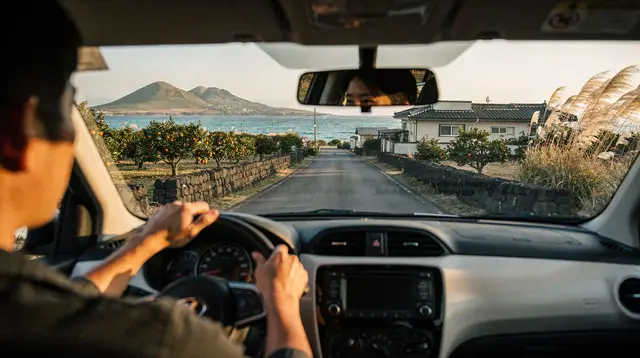
If your itinerary involves chasing sunrise at a specific spot, visiting several rural attractions across different regions in a single day, or exploring at a pace that depends on spontaneous stops — a roadside stone wall photo, an unplanned detour to a quiet beach — a bus schedule will fight you at every turn. The honest recommendation for most first-time visitors trying to see a representative slice of the island in under a week is a rental car, which removes the waiting and walking that bus travel to rural sites requires. Travelers who want a private vehicle’s flexibility without personally driving also have the option of a hired car and driver, covered in the road trip planning guide.
Reading bus stop signage and shelters
Bus stops on Jeju’s main routes typically display the route numbers that serve that stop, a basic schedule, and — at busier stops, particularly in Jeju City and Seogwipo — an electronic arrival board showing real-time countdowns for the next few buses. Smaller rural stops may have only a signpost with route numbers and no shelter or digital display at all, which makes checking your route on Kakao Map or Naver Map beforehand more important than relying on stop signage alone once you’re out in the countryside. Stop names are generally posted in both Korean script and romanized English on major routes, though smaller local stops are more likely to be Korean-only.
Traveling with luggage
Visitors arriving at CJU airport and heading straight into town by bus should know that Jeju’s buses don’t have dedicated luggage racks or storage areas the way some airport shuttle services do — larger suitcases go in the aisle or on your lap, which is manageable on a short ride into Jeju City but becomes uncomfortable on a longer intercity leg, especially if the bus is crowded. For a longer first-day journey with full luggage, a Kakao T taxi or a pre-arranged transfer is often the more comfortable choice, saving the bus network for lighter day-to-day sightseeing once you’ve dropped bags at your accommodation.
Weekday, weekend, and seasonal schedule differences
Bus frequency on Jeju’s trunk routes generally holds steady across the week, unlike some cities where weekend service drops noticeably, though rural local routes can run a reduced schedule on Sundays and public holidays. Seasonal demand also shifts real-world crowding rather than posted schedules — buses to Seongsan and other high-traffic tourist corridors run fuller during peak cherry blossom season (spring) and October’s peak hiking season, occasionally leaving standing room only during midday departures. This doesn’t usually mean getting left behind, since buses aren’t capacity-capped the way some transit systems are, but it does mean less comfort on an already longer ride.
A realistic bus-based day: Jeju City to Seongsan and back
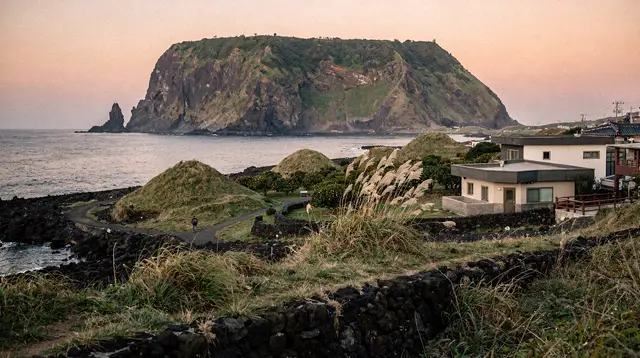
To illustrate the coverage pattern concretely: an intercity bus from central Jeju City to Seongsan takes roughly 60-90 minutes depending on the specific route and time of day, running at a base fare toward the higher end of the ₩1,000-1,500 range given the distance. From the Seongsan bus terminal, it’s a walkable 10-15 minutes to Seongsan Ilchulbong’s entrance, but reaching Manjanggul or Bijarim Forest from there typically requires either a local connecting bus with a longer wait or a short Kakao T taxi ride. Round-trip bus fare for this kind of day comes to roughly ₩4,000-6,000 per person before any taxi supplement — a fraction of a rental car’s daily cost, at the expense of losing an hour or two to transfers and walking that a car would eliminate.
Practical tips for first-time bus riders
Board at the front and pay or tap as you enter; on most routes you exit from a rear door, sometimes requiring a second tap-out for transfer tracking. Stop announcements are typically bilingual (Korean and English) on newer buses serving major tourist routes, though older local buses may announce in Korean only — this is where having your route pulled up on Kakao Map or Naver Map, tracking your position in real time, saves you from missing your stop. Buses can run a few minutes early or late relative to posted schedules, particularly on routes through town centers with traffic signals, so build a small buffer if you’re catching a connecting bus or a ferry with a fixed departure time, such as those covered in the Udo, Gapado, and Marado ferry guide.
Combining buses with other transport for a full day
Buses work best as one piece of a mixed-mode day rather than the sole method of getting around. A common and sensible pattern for budget travelers: take an intercity bus for the long leg between hub towns, then switch to walking or a short Kakao T taxi ride for the final approach to a specific attraction that sits off the main route. This hybrid approach captures most of the cost savings of bus travel while avoiding the worst of the coverage gaps described above, and it’s how many budget-conscious visitors handle Jeju without ever touching a rental car.
Buses and the islet ferries
If a day trip to Udo, Gapado, or Marado is part of your plan, buses can get you to Seongsan Harbor for the Udo ferry reasonably well, since it sits on the same intercity corridor serving Seongsan Ilchulbong. Moseulpo Port, the departure point for both Gapado and Marado, is less convenient by bus — coverage there is thinner, and a Kakao T taxi or rental car from nearby Sanbangsan or Daejeong is the more practical connection for most visitors trying to catch an early sailing without a long, uncertain bus transfer beforehand.
Comparing the true cost against a rental car
A useful way to frame the bus-versus-car decision is total daily cost rather than the sticker price of either option. A day of intercity and local bus fares for one person, even with several transfers, rarely exceeds ₩5,000-8,000. A rental car, once you add the daily rate, insurance upgrade, and fuel, typically runs ₩60,000-100,000 or more per day depending on vehicle class and season. For a solo traveler or budget-focused couple sticking to well-served corridors, that gap is significant enough to make buses the financially sensible default — the calculation shifts mainly when a group splits the car cost across more people, or when the itinerary genuinely requires reaching sites buses can’t practically serve.
Bus etiquette and small cultural notes
Korean bus etiquette is fairly relaxed compared to some countries, but a few habits are worth adopting. Priority seating near the front is reserved for elderly passengers, pregnant travelers, and those with disabilities — visitors should avoid these seats even when the bus looks empty, since a passenger who needs one may board at the next stop. Loud phone conversations are mildly frowned upon, and most locals keep phones on silent. Drivers generally don’t wait for stragglers running toward the stop, so it’s worth being at the stop a couple of minutes early rather than assuming a grace period. None of this is strict or unforgiving toward visitors — Korean bus drivers and fellow passengers are generally patient with tourists who are clearly trying — but a little awareness goes a long way toward a smoother ride.
Connecting bus travel to your wider itinerary
Bus coverage is one input among several when deciding how to structure a Jeju trip. The first-time Jeju planning guide and how many days in Jeju guide both factor in transport mode when suggesting realistic day-by-day plans, and it’s worth reading one of those before committing to a bus-only itinerary, since the right transport mix depends heavily on how many regions you’re trying to cover and how many days you have to do it in.
Bus versus taxi versus rental car: a quick comparison
| Bus | Kakao T taxi | Rental car | |
|---|---|---|---|
| Typical daily cost (1 person) | ₩4,000-8,000 | varies, ₩10,000-20,000 for short hops | ₩60,000-100,000+ incl. fuel |
| Best for | hub-to-hub travel, major sites | last-mile gaps, late returns | scattered rural sites, sunrise timing |
| Flexibility | lowest — fixed schedules | high for point-to-point | highest |
| Needs an IDP? | no | no | yes |
Most cost-conscious visitors don’t pick just one column — the practical pattern is buses for the long hub-to-hub legs, with a taxi filling the gap on the final stretch to a specific attraction, as covered above.
Buses to the airport and major transfer points
CJU airport sits close enough to central Jeju City that intercity and local buses reach it frequently, making a bus-only arrival genuinely practical for budget travelers with light luggage. The airport transfers guide compares the bus option against Kakao T taxis and pre-booked private transfers for the airport leg specifically, which matters more on arrival day than on any other day of the trip, since you’re often tired and unfamiliar with the signage.
Jeju airport private transfer, pickup or drop-offWhen a hybrid bus-plus-tour day makes sense
For travelers who want the savings of buses but don’t want to manage transfers to a cluster of rural east-coast sights in a single day, a small-group day tour covering Seongsan, Manjanggul, and nearby stops removes the coverage gaps described above entirely for that one day, while keeping bus travel for the simpler city-to-city legs of the trip. This hybrid approach — buses for hub-to-hub travel, a tour or taxi for scattered rural clusters — is how many cost-conscious visitors handle Jeju’s east side without renting a car for the whole trip.
Jeju eastern UNESCO must-see spots day tourFrequently asked questions about Jeju’s bus system
How much does a Jeju bus ride cost?
Base fares run roughly ₩1,000-1,500 depending on route type, with intercity and express routes at the higher end and local city routes cheaper. Fares are distance-based on longer intercity routes, so a full cross-island ride costs more than a short hop within Jeju City.
Can I pay with cash on Jeju buses?
Yes, cash is accepted, but exact change or small bills work best since drivers don’t always carry much change. A contactless transit card is strongly preferable — it’s faster to board with, qualifies for transfer discounts, and avoids the fumbling-for-coins delay that holds up the whole bus.
Does T-money work on Jeju buses?
Yes. T-money and other nationally compatible transit cards work on Jeju’s bus network the same way they do in Seoul and other Korean cities. You can buy and top up a card at convenience stores (CU, GS25, 7-Eleven) across the island, including near CJU airport.
Which app should I use to plan a bus route in Jeju?
Kakao Map or Naver Map. Both have built-in bus route planning with real-time arrival estimates, similar to how Google Maps handles transit in most countries. Google Maps itself has limited public transit routing in South Korea, so it’s not a reliable planning tool here.
Are Jeju buses reliable for reaching Seongsan or Hallasan?
Reasonably reliable for the fact that direct routes exist, but frequency thins outside peak hours — often to one bus every 30-60 minutes — and the closest stop to some trailheads or coastal viewpoints still leaves a walk of 15-30 minutes. Build in buffer time and check the last return bus of the day before you commit to a route.
What’s the difference between intercity and local buses on Jeju?
Intercity (also called trunk or express) routes connect major hubs like Jeju City, Seogwipo, and Seongsan with fewer stops and higher speeds, while local routes wind through neighborhoods and smaller towns with frequent stops. Intercity routes are what most visitors use for point-to-point sightseeing; local routes fill in the last mile.
Do buses run late at night on Jeju?
Most routes stop by around 10-11 p.m., with some intercity routes running slightly later. There’s no genuine night-bus network comparable to major mainland cities, so plan your return trip before dark if you’re relying on a bus back from a rural site, or budget for a Kakao T taxi as a backup.
Related guides

Jeju airport transfers
Comparing every way from Jeju Airport (CJU) to your hotel — limousine bus, city bus, taxi, Kakao T, and private transfer, with real prices.

Jeju International Airport (CJU) guide
How Jeju International Airport (CJU) works — terminal layout, ground transport, luggage storage, SIM kiosks, and what to expect on arrival.

Seoul to Jeju flights
How to fly from Seoul to Jeju — Gimpo vs Incheon departure, airlines, flight times, prices, and when a ferry or KTX combo makes more sense.

Busan to Jeju flights
Flying from Busan to Jeju via Gimhae Airport — flight time, airlines, prices, and why routing through Busan can beat Seoul for some itineraries.
Ready to book? Top tours for this guide
We earn a small commission if you book through GetYourGuide — at no extra cost to you. Every tour is hand-picked and verified.
Jeju: Private Car Charter Tour
Jeju: Private Tour with an English Guide and a Vehicle

Private Tour of Jeju Island, by Car, at Your Own Pace
Jeju Island: Seongsan Ilchulbong & Private Transfer

Jeju: Private One Day Car Charter