
Busan to Jeju flights
How long is the flight from Busan to Jeju?
About 55 minutes from Gimhae International Airport (PUS) to Jeju, with multiple daily departures across several airlines. It's shorter than the Gimpo-Jeju route and a practical option for anyone already in southeast Korea.
| Where | Gimhae International Airport (PUS), Busan |
| Flight time | About 55 minutes to Jeju (CJU) |
| Cost | Around ₩40,000-70,000 one-way, LCC, booked ahead |
| Getting to Gimhae | 30-40 min by taxi or light rail (BGL) from central Busan |
| Best booked | 2-4 weeks ahead outside Korean holidays |
Busan doesn’t get nearly the same attention as Seoul when people plan how to reach Jeju, but Gimhae International Airport (PUS) runs a solid, practical connection to the island — about 55 minutes in the air, with multiple daily departures — that’s worth considering seriously if Busan features anywhere in your Korea itinerary.
The flight itself is short even by domestic Korean standards: roughly 55 minutes gate to gate, a few minutes shorter than the Gimpo-Jeju hop, since Busan sits somewhat closer to Jeju geographically than Seoul does. It won’t match the sheer frequency of the world’s busiest domestic route, but it doesn’t need to — Busan-Jeju has enough daily departures across several airlines to build a workable itinerary around without much friction.
Why route through Busan at all
For travelers building a Korea itinerary that already includes the southeast of the country — Busan itself, Gyeongju, or a broader “southern coast” loop sometimes associated with Korean drama filming locations and regional food tourism — flying onward to Jeju from Gimhae avoids backtracking to Seoul entirely. That’s the real case for this route: not that it’s dramatically cheaper or faster than flying from Seoul, but that it fits naturally into a specific trip shape without wasting a day or more on unnecessary travel back north.
It’s also a sensible option for travelers who fly internationally into Busan directly (Gimhae has a modest but real international arrivals schedule) and want to add Jeju to the trip without ever routing through Seoul at all. And for anyone doing a broader Korea loop — Seoul, then south through Busan, then Jeju, then flying home from CJU or looping back — Busan-Jeju is the connecting leg that makes that shape work without doubling back.
Airlines on the Busan-Jeju route
Six carriers operate this corridor to varying degrees:
- Korean Air — full-service, generally the higher end of the fare range.
- Asiana — the other full-service carrier on this route.
- Jeju Air — a frequent low-cost operator here, often among the cheaper fares.
- Jin Air — Korean Air’s LCC subsidiary, a regular presence on this corridor.
- T’way — competitive LCC pricing, decent schedule density.
- Air Busan — based in Busan itself, so unsurprisingly a strong presence on flights out of its home airport, including this route.
As with the Seoul route, the LCCs (Jeju Air, Jin Air, T’way, Air Busan) are generally the better bet for price-conscious travelers, while Korean Air and Asiana offer more schedule flexibility and slightly more generous baggage allowances at a higher base fare.
With six carriers flying out of Busan, the fare gap usually comes down to baggage and flexibility, so check what the ticket includes before you pay. A low-cost fare can lose its edge once a checked bag is added, while Korean Air or Asiana may cost less overall if you need the larger allowance. To line up every carrier’s Busan to Jeju times and totals, search flights on Aviasales for your dates.
What it costs and how far ahead to book
Pricing on Busan-Jeju tracks fairly closely with the Seoul-Jeju route — driven mainly by how far ahead you book and whether travel dates overlap a Korean holiday period, rather than by the specific mainland departure city. Booked a few weeks ahead on an ordinary weekday, one-way LCC fares often fall in a similar ₩40,000-70,000 range (roughly US$30-50); full-service fares and last-minute bookings run meaningfully higher. Seollal, Chuseok, and peak summer weekends push prices up sharply across all carriers on this route too, since Jeju’s domestic tourism demand isn’t specific to Seoul travelers.
Two to four weeks of lead time on a normal week is generally enough to find a reasonable fare; booking within a few days of a major Korean holiday is the scenario most likely to mean either a high price or limited seat availability, exactly as with the Gimpo route.
The ferry question — and why it doesn’t apply here
It’s worth being direct about this, because it comes up often: there is no practical direct ferry service from Busan to Jeju for tourists. Ferries to Jeju exist from mainland Korea, but they depart from ports further west and south — Mokpo, Wando, and similar southern coastal towns — not from Busan itself. A traveler hoping to skip flying and take a scenic sea crossing from Busan specifically will not find a workable regularly scheduled passenger option; flying via Gimhae is, in practice, the only realistic way to make this connection. If a ferry crossing to Jeju is something you specifically want as part of the trip, it needs to be built around one of the western/southern mainland ports instead, which typically means routing the ferry leg through a different city than Busan.
Building a Korea itinerary around this route
A common trip shape that makes the Busan-Jeju leg genuinely useful looks like this: fly internationally into Seoul, spend several days in the capital, take the KTX south to Busan (about 2.5-3 hours from Seoul Station), spend a few days exploring Busan and possibly Gyeongju nearby, then fly the short Gimhae-Jeju hop to close out the trip on the island before flying home from CJU — which does have a modest international schedule of its own, or a final short domestic hop back to Seoul or Busan for an international departure. This loop avoids backtracking through Seoul twice and uses each leg of transport for what it’s actually good at: KTX for the fast, scenic Seoul-Busan rail corridor, and a short flight for the water crossing to Jeju that no train or road route can cover.
A reverse version works just as well for travelers who want Jeju first: fly directly into CJU (potentially qualifying for Jeju’s visa-free entry rules on a direct international flight, worth checking against the K-ETA guide), spend the island portion of the trip first, then fly Jeju-Gimhae onward into the rest of Korea rather than returning to Seoul immediately.
Booking platforms and what to check
As with the Seoul route, Korean domestic booking platforms and the airlines’ own sites and apps generally show the fullest and most accurate fare set for Busan-Jeju, since some international flight search engines don’t fully index Korean LCC inventory. Before booking, check whether checked baggage is included in the fare (LCC basic fares often exclude it), whether the ticket allows free changes given Jeju’s occasional weather disruptions, and whether seat selection is bundled or a separate charge — the same three checks that matter on the Seoul route apply equally here.
Weather and disruption on this route
Jeju’s exposure to wind, typhoons (a real risk from late August through September), and occasional winter weather affects the Busan route just as it does the Seoul route. Because Busan-Jeju runs less frequently than the Gimpo shuttle, a cancelled flight here is more disruptive than the same scenario on the world’s busiest domestic route — there may not be another seat available for several hours or until the next day during a weather event, rather than within the hour. Travelers with a tight connecting schedule (an international flight out of Busan or elsewhere shortly after landing from Jeju, for instance) should build in a buffer during typhoon season specifically, rather than scheduling back-to-back connections with no slack.
Family and group travel notes
For families or larger groups, the same logic that applies to the Seoul route holds here: a full-service carrier’s larger baggage allowance and more predictable seating can be worth the higher headline fare once you’re managing multiple checked bags, car seats, or strollers across several travelers, while the LCCs remain a solid choice for individuals and couples with lighter luggage prioritizing price over flexibility.
Using this route for a Jeju day trip from Busan
Because the flight is under an hour each way, a very early departure and a late return flight can technically support a long day trip to Jeju from Busan, though this is a demanding way to see the island — most of a day would go to transit and airport logistics rather than sightseeing, and Jeju’s attractions are spread widely enough (a full loop of the island runs roughly 200km) that a single day barely scratches the surface. It’s mentioned here for completeness rather than as a genuine recommendation; an overnight stay of at least two or three nights is a far more practical way to use this route.
Gimhae Airport itself
Gimhae is a dual-purpose airport handling both domestic and a modest international schedule, considerably smaller than Incheon but with a straightforward layout. Getting there from central Busan takes roughly 30-40 minutes by taxi or the Busan-Gimhae Light Rail Transit (BGL), which connects to Busan’s main subway network — a comparable distance and travel time to the Gimpo-to-central-Seoul connection, if slightly less frequent in terms of transit options.
Arrival at CJU and getting onward
However you arrive — from Busan, Seoul, or elsewhere — you’ll land at the same single-terminal Jeju International Airport (CJU), straightforward to navigate regardless of which domestic city you flew in from. From arrivals, the Jeju airport transfers guide covers every practical way to reach your accommodation, from the limousine bus and regular city buses to taxis, Kakao T, and private transfers.
What flying from Busan feels like in practice
Gimhae’s domestic schedule is noticeably quieter than Gimpo’s shuttle-paced departures, which has a practical upside: check-in and security queues tend to be shorter and less rushed, even though the airport still handles meaningful volume as Korea’s second-busiest overall (across domestic and international combined). Boarding calls come with a bit more breathing room than the tightly packed Gimpo schedule, since Gimhae isn’t turning gates over every 15-30 minutes for a single destination the way Gimpo is for Jeju. Arriving 40-60 minutes ahead of a domestic departure is still the sensible baseline, but the margin for a slightly late arrival is a little more forgiving here than on the busiest Gimpo departure banks.
Domestic versus international sides at Gimhae
Gimhae operates a genuinely separate domestic and international terminal, connected by a short walk or shuttle. Flights to Jeju depart from the domestic side, which is the smaller and simpler of the two to navigate — useful to know if you’re researching the airport and mostly finding information about its international operations, which serve destinations across Japan, China, and Southeast Asia rather than the Jeju route itself.
Regional alternatives to Busan and Seoul
Busan and Seoul aren’t the only mainland gateways to Jeju — Daegu, Daejeon, Gwangju, Cheongju, and Gangneung all have direct flights to CJU as well, though with considerably less frequency than either the Gimpo shuttle or the Busan route. For travelers based in or near one of these cities, checking direct flight availability before assuming a detour through Seoul or Busan is necessary can save a genuine amount of backtracking, even though schedules on these secondary routes are thin enough that flexibility matters more than on the two higher-volume options.
Comparing Busan and Seoul as your Jeju gateway
Neither route is objectively “better” — it depends entirely on the shape of the broader trip. The Seoul to Jeju flights guide covers the Gimpo route in full, including why it’s the higher-frequency option overall (a genuine advantage if your dates are flexible and you want maximum schedule options) versus Busan’s role as the more natural fit for a southeast Korea-inclusive itinerary. Price-wise the two routes are close enough that schedule fit and overall trip routing should drive the decision more than fare comparison alone.
Pre-booking a ride and a first day on the island
If you land tired after a morning of Busan sightseeing and would rather not work out buses or taxis on arrival, a pre-arranged driver is the simplest way to start the Jeju leg: a private transfer from the airport to your accommodation means someone is waiting for you at arrivals, which is especially handy with children, heavy bags, or a late flight. It is one option among several, and the Kakao T taxi guide and the Jeju bus guide cover the cheaper alternatives.
If your Jeju stay is short, it also helps to settle your first full day before you fly. A guided option such as a day tour of the eastern UNESCO sites removes the need to rent a car on day one, which suits travelers coming from Busan’s subway-and-train rhythm. To compare guided days against driving yourself, read the best day tours guide, the private versus group tours guide, and the car rental and IDP guide.
Once you know how long you are staying, the 3-day itinerary, the first-timer itinerary, and the Jeju safety guide help you shape the days after landing, and the Jeju packing tips are worth a skim before you fill your bags at Gimhae.
Connecting to your first stop on the island
Whichever airport you land at on Jeju, having a plan for the next leg matters as much as the flight itself. The SIM and eSIM guide and money and currency guide are worth sorting out before or shortly after landing, and if children are part of the trip, the Jeju with kids planning guide covers family-specific logistics that apply regardless of which mainland city you flew in from.
Currency, payment, and last practicalities at Gimhae
Contactless card payment works throughout Gimhae Airport for food, shopping, and the light rail connection into Busan, so arriving without freshly exchanged Korean won isn’t a significant obstacle. Currency exchange counters are available if you’d rather carry some cash, and the domestic terminal has a reasonable range of cafés and a food court for a meal before or after the flight, though — as with CJU — it’s not a dining destination in its own right so much as a functional stop between two legs of a trip.
Planning the Jeju leg of a Korea trip
If Jeju is one stop within a longer Korea itinerary rather than a standalone trip, working out how many days it deserves relative to Seoul, Busan, or Gyeongju is worth doing before locking in flights either direction — the how many days in Jeju guide and first-time Jeju planning guide are useful starting points for that broader trip-shape decision. Once you’ve settled on dates, the Jeju budget guide and where to stay guide help translate a rough itinerary into a realistic spending plan and a base to book from, and the K-ETA and visa guide is worth checking if any leg of your trip involves a direct international flight into Jeju rather than routing entirely through mainland Korea.
Baggage policies to check before booking
Baggage allowances vary meaningfully by carrier and fare class on this route, exactly as they do on the Seoul corridor. Basic LCC fares on Jeju Air, Jin Air, T’way, and Air Busan typically include only a small cabin bag, with checked luggage priced as an add-on that can range from a modest fee to a surprisingly large one if purchased at the airport rather than during booking. Korean Air and Asiana generally bundle a more generous checked baggage allowance into their standard fares. For a short domestic hop like this, it’s worth adding up the true total cost — base fare plus any checked bag fee — before assuming the cheapest-looking headline price is actually the cheapest way to travel with luggage.
Mileage and loyalty programs on this route
As with the Seoul route, Korean Air and Asiana domestic Busan-Jeju flights earn or redeem within their respective loyalty programs (SKYPASS and Asiana Club), which can tip the balance toward a full-service booking for travelers already active in one of those programs, even against a cheaper LCC fare. For a single short domestic hop booked in isolation, though, the LCCs generally remain the better value unless loyalty points specifically factor into your broader travel plans with that airline.
Combining this route with Gyeongju
Gyeongju, roughly an hour from Busan by train or bus, is a common add-on for travelers already routing through the southeast — a former Silla-dynasty capital with a genuinely different historical character than Busan’s port-city energy or Jeju’s volcanic landscape. Slotting a day or two in Gyeongju between Busan and the Gimhae-Jeju flight extends the southeast Korea portion of a trip without adding meaningful backtracking, since Gyeongju connects easily back to Busan by the same rail or bus options used to arrive.
What to do in the first hour after landing at CJU from Gimhae
Regardless of which mainland city you flew from, the first hour on Jeju follows the same pattern: clear the single-terminal arrivals area, decide on ground transport, and get moving toward your first stop. Travelers arriving from Busan specifically sometimes underestimate how different Jeju’s driving and transit patterns feel compared to Busan’s dense urban subway network — Jeju has no rail system at all, so the airport transfers guide is worth a quick read before landing if Busan is the only other Korean city you’ve navigated so far on the trip. Renting a car directly at CJU is a common choice for travelers coming from a rail-and-subway-heavy Busan stay, since it’s often the first time on the trip a rental car becomes the practical default rather than one option among several.
A note on connecting flights versus separate one-way tickets
Some travelers book the Busan-Jeju leg as a genuinely separate one-way ticket rather than a connecting itinerary through their original international carrier, which is usually the more flexible and often cheaper approach for a domestic Korean hop like this one. Booking separately means more control over exact departure times and carrier choice on the Busan-Jeju leg specifically, though it also means handling baggage transfer yourself between the international and domestic legs rather than relying on a single through-checked itinerary — worth factoring into the total time budget at Gimhae if your international arrival and the Busan-Jeju departure aren’t on the same day.
Seasonal timing: pairing Busan’s schedule with Jeju’s own calendar
Busan and Jeju sit at different points on Korea’s south coast, but their weather patterns broadly overlap, which matters for anyone timing a combined trip. If cherry blossom season, the canola flower bloom, or autumn foliage is part of the reason for the Jeju leg, checking the Jeju month-by-month guide before finalizing Gimhae-Jeju dates avoids arriving on the island a week or two outside the specific seasonal window you’re chasing. Typhoon season (late August-September) is the other calendar factor worth cross-checking against a Busan itinerary specifically, since a storm affecting Jeju’s flights often affects Busan’s coastal weather at the same time, occasionally disrupting both legs of a combined trip rather than just the island portion.
Comparing total trip time: Busan routing versus flying straight into Jeju
For travelers without a specific reason to see Busan, flying directly into CJU from home (where a direct international route exists) or via Seoul’s Incheon remains the faster way to reach Jeju in isolation — routing through Busan only makes sense once Busan itself, or a broader southeast Korea loop, is genuinely part of the plan. Added end to end, a Seoul-Busan-Jeju loop by KTX and short flight typically adds one to two extra travel days compared to flying directly into Jeju from an international gateway, time that’s well spent if Busan and Gyeongju interest you, but unnecessary if Jeju is the sole destination.
Frequently asked questions about flying from Busan to Jeju
How long does the Busan to Jeju flight take?
About 55 minutes in the air from Gimhae International Airport (PUS), slightly shorter than the Gimpo-Jeju route.
Is there a direct ferry from Busan to Jeju?
No, not a practical one for tourists. Ferries to Jeju depart from mainland ports further west and south, such as Mokpo and Wando — flying is effectively the only realistic option from Busan.
Which is cheaper, flying from Busan or from Seoul?
Prices are generally comparable between the two routes. The bigger factors are how far ahead you book and whether travel dates fall near a Korean public holiday, not which mainland city you depart from.
How many airlines fly Busan to Jeju?
Six: Korean Air, Asiana, Jeju Air, Jin Air, T’way, and Air Busan, though not all operate every day — check current schedules when booking.
Does Gimhae Airport have international flights?
Yes, a modest international schedule exists alongside its larger domestic operation, making it a viable entry point for travelers who want to skip Seoul entirely on a Busan-then-Jeju trip.
Is Busan worth visiting on the way to Jeju?
That depends on your interests and time budget rather than anything specific to the flight route itself — Busan is a major Korean city in its own right, and the short Gimhae-Jeju hop makes combining the two straightforward if it fits your itinerary.
How far ahead should I book a Busan to Jeju flight?
Two to four weeks ahead on an ordinary week usually finds a reasonable fare; avoid booking close to Seollal, Chuseok, or peak summer weekends if price matters, since demand spikes sharply during those periods.
Related guides

Seoul to Jeju flights
How to fly from Seoul to Jeju — Gimpo vs Incheon departure, airlines, flight times, prices, and when a ferry or KTX combo makes more sense.

Jeju airport transfers
Comparing every way from Jeju Airport (CJU) to your hotel — limousine bus, city bus, taxi, Kakao T, and private transfer, with real prices.

Jeju International Airport (CJU) guide
How Jeju International Airport (CJU) works — terminal layout, ground transport, luggage storage, SIM kiosks, and what to expect on arrival.
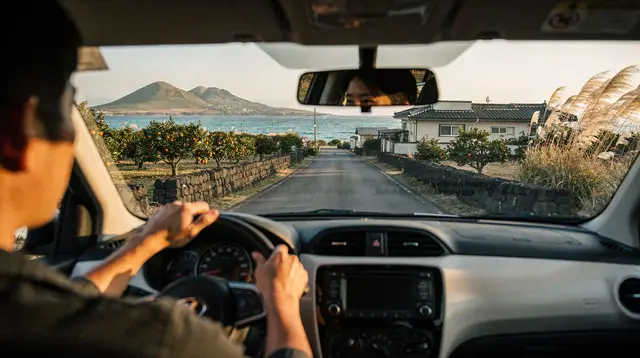
Car rental in Jeju and the IDP
How to rent a car in Jeju as a foreign visitor, why the International Driving Permit is mandatory, and what it costs.
Ready to book? Top tours for this guide
We earn a small commission if you book through GetYourGuide — at no extra cost to you. Every tour is hand-picked and verified.
Jeju: Private Car Charter Tour
Jeju: Private Tour with an English Guide and a Vehicle

Private Tour of Jeju Island, by Car, at Your Own Pace

Jeju Island: Seongsan Ilchulbong & Private Transfer

Jeju: Private One Day Car Charter