
Jeju International Airport (CJU) guide
What is Jeju International Airport (CJU) like to navigate?
CJU has a single passenger terminal with a small international wing attached to a much larger domestic side. It's compact by international standards — most connections between arrivals, ground transport, and check-in take 5-15 minutes on foot, with clear English signage throughout.
Jeju International Airport, usually written by its code CJU, is South Korea’s second-busiest airport and the single entry point most visitors use to reach the island. It sits on the northern coast, a short distance from Jeju City, and its scale is driven almost entirely by one route: Gimpo-Jeju, connecting the island to Seoul’s domestic airport, is the world’s busiest domestic air corridor, with flights departing every 15-30 minutes for most of the day.
| Location | Northern coast, 15-20 min from Jeju City |
| Terminals | One building, domestic + international wing |
| Arrive by | 40-60 minutes before a domestic flight |
| Luggage storage | Coin lockers + staffed counter, arrivals area |
| Navigation | Kakao Map or Naver Map, not Google Maps |
Why CJU feels different from a typical international airport
Most travelers picture an international airport as the sprawling, multi-terminal kind — think Incheon. CJU is not that. It has one terminal building split into a large domestic section and a much smaller international wing, and despite ranking among Korea’s busiest airports by passenger count, the walking distances inside it are short. Domestic arrivals to baggage claim is typically a 3-5 minute walk; the international arrivals hall, immigration, and baggage claim for the smaller international side takes slightly longer given the added immigration step. The airport’s real complexity isn’t its layout — it’s the sheer volume of people moving through a compact building, especially around peak domestic departure banks in the morning and early evening.
Terminal layout
The terminal is arranged on a few levels: departures on the upper floor, arrivals below. Domestic check-in counters occupy most of the departures level, since domestic traffic vastly outnumbers international traffic here — this is the airport built around the Gimpo shuttle, not around long-haul connections. The international section, used for flights to and from cities like Shanghai, Beijing, Osaka, Fukuoka, and Hong Kong, sits at one end of the building with its own check-in row, security screening, and — for arrivals — immigration and customs.
Signage is in Korean and English throughout, with additional Chinese and Japanese on major wayfinding boards given the mix of international traffic. Security screening for domestic flights tends to move quickly outside of Korean public holiday weekends (Seollal, Chuseok), when domestic volume spikes sharply as Jeju is a popular getaway for mainland Korean travelers as well as foreign tourists.
Arrivals: what actually happens when you land
For a domestic arrival from Gimpo, Busan, or another Korean city, there’s no immigration step — you walk from the gate to baggage claim, typically 5-10 minutes including any connecting corridor. Baggage usually starts appearing within 15-20 minutes of the aircraft parking, though this varies with how full the flight was.
For an international arrival, the sequence is immigration first, then baggage claim, then customs. Immigration lines vary with how many international flights have landed close together — during quieter parts of the day this can take 10-15 minutes; during a cluster of arrivals it can stretch to 30-45 minutes. Foreign visitors on Jeju’s visa-free entry (see the note on that below) go through the same immigration counters as anyone else; there’s no separate fast lane for visa-exempt travelers.
Once through baggage claim, both domestic and international arrivals exit into the same general arrivals hall, where ground transport counters, SIM kiosks, and the taxi and bus stands are all reachable within a short walk.
Ground transport options — the overview
Every practical way of leaving the airport originates from the arrivals level, generally within 2-5 minutes’ walk of the terminal doors:
- Limousine bus route 600 — a direct, luggage-friendly coach service running to Jungmun and Seogwipo, departing roughly every 10-15 minutes between 6:20am and 9:50pm.
- Regular city buses — the #100-500 series routes serve Jeju City and other destinations at a lower fare but with more stops and less predictable timing.
- Taxi stands — clearly marked outside the arrivals hall, metered, with fairly short queues outside peak arrival banks.
- Kakao T ride-hailing — bookable from the moment you land, useful for avoiding a taxi queue or getting an upfront fare estimate.
- Rental car counters and shuttles — most major rental companies have counters inside or near the terminal, with courtesy shuttles to off-site lots for some providers.
- Private transfer / car charter — pre-booked door-to-door service, useful for groups, families with heavy luggage, or anyone who prefers not to navigate ground transport logistics after a flight.
The full breakdown of prices, timings, and which option suits which traveler is in the Jeju airport transfers guide. If a pre-booked pickup sounds simpler than sorting out a queue on arrival, Jeju: Airport (CJU) Transfer Pick-up & Sending Service covers both directions — arrival pickup and departure drop-off — with a driver meeting you at the gate area rather than at a taxi rank.
Ground transport options, compared
| Option | Cost | Best for |
|---|---|---|
| Limousine bus 600 | Low, flat fare | Jungmun/Seogwipo, luggage-friendly |
| Regular city bus | Lowest | Budget travelers, more stops |
| Taxi | Moderate, metered | Short hops, no pre-booking needed |
| Kakao T | Moderate, upfront fare | Avoiding a taxi queue |
| Rental car | Varies by season | Multi-day, scattered-site itineraries |
| Private transfer | Highest, fixed price | Groups, families, late-night arrivals |
Rental car pickup
Jeju’s rental market is large relative to the island’s size, since a car is the most practical way to see sights spread across a roughly 200km coastal loop. Some rental counters operate directly inside the terminal building; others require a short shuttle ride to an off-airport lot, which adds 10-15 minutes to the pickup process. Bring an International Driving Permit — Korea does not accept a home country license alone for most foreign visitors — the car rental and IDP guide covers the paperwork and what to check before signing.
Luggage storage
Coin lockers and a staffed luggage storage counter are available in the arrivals area, a genuinely useful option if your accommodation check-in time doesn’t line up with your flight — dropping bags for a few hours to start sightseeing immediately, or storing them before a late evening departure flight after checkout. Prices are modest, typically a few thousand won per hour or a flat daily rate depending on locker size, paid at the machine with cash or card.
WiFi and connectivity
Free WiFi is available throughout the terminal without a lengthy registration process — connecting on arrival is straightforward and one of the easier “first five minutes in Korea” tasks. For connectivity beyond the airport, several telecom kiosks near the domestic arrivals hall sell prepaid SIM cards and can activate eSIMs for phones that support them, though most travelers find it faster and cheaper to buy an eSIM online in advance and simply activate it once landed rather than queuing at a counter. Full details on providers and pricing are in the SIM and eSIM guide.
Food and shopping
The terminal has a mix of Korean chain cafés, a food court with Korean staples (bibimbap, noodle dishes, kimbap), and convenience stores for snacks and drinks before a flight. It’s not a dining destination in itself — most visitors either eat before arriving or wait until they reach their first meal on the island proper — but there’s enough on offer for a reasonable meal between a landing and a ground transport connection. A small duty-free and souvenir retail area covers last-minute gifts, concentrated mostly on the departures level.
Currency and payment at the airport
Currency exchange counters operate in the arrivals hall for travelers who want cash on hand, though contactless card payment (Visa, Mastercard, UnionPay, Apple Pay, Samsung Pay, Google Pay) works at the vast majority of airport shops, cafés, taxis, and buses — cash isn’t strictly necessary just to get from the airport into the city. The money and currency guide covers where cash still matters once you’re off-airport (some smaller local markets and older taxis).
Visa-free entry, briefly
Most nationalities — including US, EU, UK, Canadian, and Australian passport holders — get 30-day visa-free entry when flying directly into Jeju on an international flight, without a mainland Korea stopover. This is a Jeju-specific rule, distinct from the entry requirements for flying into Seoul. K-ETA exemption for many of these same nationalities is currently extended through December 31, 2026. Rules like this shift, so verify current requirements before booking, especially for travel planned after that date — the K-ETA and visa guide has the detail.
Navigation tip that catches almost everyone off guard
Google Maps has very limited turn-by-turn driving directions inside South Korea, a long-standing data restriction that surprises most first-time visitors who assume it will work the way it does everywhere else. It’s fine for basic searches and walking directions, but not reliable for driving navigation once you’re behind the wheel of a rental car leaving the airport. Kakao Map or Naver Map — both available in English — are what locals and informed visitors actually use, and downloading one before landing (or at least before picking up a rental car) saves real frustration on your first drive out of the airport lot.
A private transfer, if you’d rather skip the logistics
For travelers who’d rather not manage bus schedules, taxi queues, or Kakao T app setup right after a flight — particularly with young children, heavy luggage, or a late-night arrival — Jeju: Private 1-Way Transfer To/From Jeju Airport (CJU) books a driver in advance for a fixed price, with meet-and-greet at arrivals rather than needing to find and negotiate ground transport on the spot.
For a late landing at CJU, confirm your flight number and the exact meeting point with the driver’s company before paying, and check that the fixed price covers your luggage and any child seats. Choose a booking that tracks your flight in case of delays, and you can arrange a Jeju driver through Kiwitaxi ahead of the trip.
Parking and drop-off
If someone is dropping you off or picking you up by private car, short-term parking is available directly at the terminal, charged by the hour and rising steeply for multi-day stays — it’s built for drop-off and pickup traffic, not for parking a car during a multi-day trip elsewhere on the island. Travelers who drove to the airport and are flying onward, rather than starting a rental car trip from CJU itself, sometimes use off-site long-term lots that run shuttle services to the terminal at a lower daily rate than the airport’s own structure.
Accessibility
CJU is a single-level, elevator-served terminal without the long transit distances of a sprawling multi-terminal airport, which makes it relatively manageable for travelers with mobility needs. Wheelchair assistance can be requested through your airline in advance, and staff are stationed at check-in and gate areas to help coordinate it. Accessible restrooms are available throughout the terminal, and the arrivals-to-ground-transport walk is short enough that even without pre-arranged assistance, most mobility-limited travelers manage it without major difficulty. If you need a wheelchair-accessible taxi or transfer vehicle, it’s worth confirming this specifically when booking rather than assuming any taxi at the stand can accommodate one.
Amenities beyond food and shopping
A prayer room, a small medical clinic or first-aid station, and ATMs from major Korean banks are all present in the terminal, alongside a lost-and-found counter for items left on flights or in the terminal itself. None of these are hard to find — airport staff at the information desks near arrivals and departures can point you in the right direction if signage alone doesn’t make it obvious, and English-speaking staff are generally available at the main information counters.
Weather delays and cancellations
Jeju’s weather is genuinely more variable than mainland Korea’s in ways that occasionally affect flights — strong winds, typhoons (a real risk from late August through September), and winter snow or fog can all cause delays or cancellations, more so on this route than many others in the country given Jeju’s coastal, sometimes exposed position. Given how frequent the Gimpo shuttle is, a cancelled flight on that specific route is rarely a disaster — there’s usually another departure within the hour once conditions clear — but travelers on less frequent routes (Busan, Daegu, international) should build a buffer day into a trip during typhoon season if the itinerary allows it, rather than scheduling a same-day international connection right after a Jeju departure.
Connecting onward within Korea
For visitors using Jeju as one stop in a broader Korea trip, CJU’s domestic schedule covers connections not just to Seoul and Busan but also to Daegu, Daejeon, Gwangju, Cheongju, and Gangneung, all served less frequently than the two major shuttle-style routes. These connections are worth checking directly on airline schedules rather than assuming Gimpo-level frequency — flights to these secondary cities can run just a handful of times per day, which matters if your return trip timing is tight. Fares on these secondary routes also tend to fluctuate more with booking timing than the high-frequency Gimpo shuttle, so booking a few weeks ahead is worth doing if a specific connection matters to a broader Korea itinerary rather than assuming a seat will be available at a reasonable price close to departure.
First moves after landing: a simple sequence
For a first-time visitor with no rental car booked, a reasonable sequence looks like this: collect baggage, connect to airport WiFi and activate an eSIM if not already done, decide between the limousine bus, a taxi, or a pre-booked transfer to reach your accommodation, and download Kakao Map or Naver Map before leaving the terminal so you’re not relying on Google Maps for directions once you’re out and about. If renting a car, add the IDP check and rental counter or shuttle to that sequence before anything else.
How CJU compares to the rest of the trip
Once you’re through the airport, the logistics of getting around the island are covered in more depth elsewhere: the Jeju bus guide for public transit beyond the airport routes, the Kakao T taxi guide for ride-hailing specifics, and the driving and road trip tips guide for self-driving mechanics like parking, fuel, and toll-free expressways. For first-time planning questions that go beyond the airport itself — how many days to budget, where to base yourself — the first-time Jeju planning guide and how many days in Jeju guide are the natural next stops.
Charging your devices and other small conveniences
Charging outlets are available at most gate seating areas and scattered throughout the terminal’s public seating, though they’re not universal at every single chair, so arriving with a portable charger removes any uncertainty on a tight connection. Water fountains and refill stations are present past security and in the main arrivals concourse, a small but genuine convenience for anyone wanting to skip a bottled-water purchase before a domestic flight. Vending machines selling drinks and snacks are scattered throughout both the domestic and international sides, accepting card as well as cash.
Airport hotels and a short layover
For travelers with a genuinely long layover or an unusually early departure the following morning, a small number of hotels and guesthouses operate within a short taxi ride of CJU, more limited in number than what a major international hub would offer but sufficient for a single overnight stop. Most visitors, however, find it more efficient to head straight into Jeju City itself for a layover of more than a few hours, since the city center’s accommodation options are more plentiful and only 15-20 minutes away.
Arriving very early or very late
Because Gimpo-Jeju flights run from early morning until close to midnight, arrivals at both ends of the schedule are common, and CJU handles both reasonably well: the arrivals hall, ground transport counters, and 24-hour taxi stand stay staffed and lit regardless of hour, though limousine bus frequency thins noticeably outside the roughly 6:20am-9:50pm window listed above. A late-night arrival without a pre-booked transfer generally still finds taxis and Kakao T working normally, but travelers on the very first or very last flights of the day should double-check their chosen ground transport option actually runs at that hour rather than assuming daytime frequency applies.
Frequently asked questions about Jeju International Airport (CJU)
Is CJU the only airport on Jeju Island?
Yes, Jeju International Airport is the island’s sole commercial airport and the entry point for essentially all air travel to Jeju, whether domestic or international.
How far is CJU from Jeju City center?
About 15-20 minutes by taxi or bus in normal traffic, since the airport sits close to the northern coast near the capital.
Do I need to go through immigration for a domestic flight to Jeju?
No. Domestic flights from Gimpo, Gimhae, or other Korean airports skip immigration entirely — you go straight from the gate to baggage claim.
Can I buy a Korean SIM card at CJU without pre-ordering?
Yes, telecom kiosks near domestic arrivals sell physical SIM cards on the spot, though selection and pricing are usually better if arranged online beforehand.
Is there a fast lane at immigration for visa-free travelers?
No. Visa-exempt foreign visitors go through the same immigration counters as everyone else; there’s no separate expedited line based on visa status.
What’s the best way to get cash at the airport?
Currency exchange counters are in the arrivals hall, though most visitors find contactless card payment sufficient for buses, taxis, and shops without needing much cash at all.
How busy does CJU get during Korean holidays?
Very busy — Seollal and Chuseok in particular see a sharp spike in domestic travel to Jeju, since it’s a popular short break for mainland Korean travelers, so expect longer security and check-in lines during those windows.
Should I use Google Maps to navigate from the airport by car?
Not for driving directions — Google Maps has limited turn-by-turn navigation in South Korea. Use Kakao Map or Naver Map instead, both of which work well in English.
Related guides
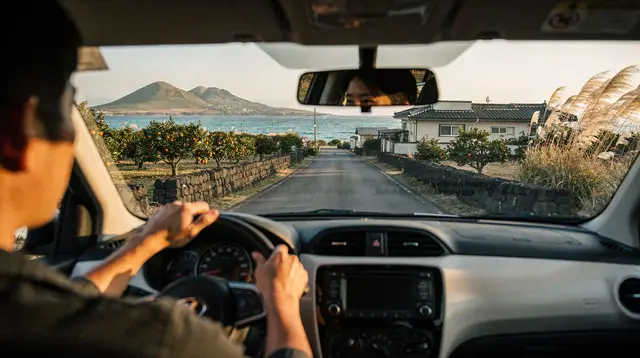
Car rental in Jeju and the IDP
How to rent a car in Jeju as a foreign visitor, why the International Driving Permit is mandatory, and what it costs.

Jeju airport transfers
Comparing every way from Jeju Airport (CJU) to your hotel — limousine bus, city bus, taxi, Kakao T, and private transfer, with real prices.

Seoul to Jeju flights
How to fly from Seoul to Jeju — Gimpo vs Incheon departure, airlines, flight times, prices, and when a ferry or KTX combo makes more sense.

Busan to Jeju flights
Flying from Busan to Jeju via Gimhae Airport — flight time, airlines, prices, and why routing through Busan can beat Seoul for some itineraries.
Ready to book? Top tours for this guide
We earn a small commission if you book through GetYourGuide — at no extra cost to you. Every tour is hand-picked and verified.
Jeju: Private Car Charter Tour
Jeju: Private Tour with an English Guide and a Vehicle

Private Tour of Jeju Island, by Car, at Your Own Pace

Jeju Island: Seongsan Ilchulbong & Private Transfer

Jeju: Private One Day Car Charter