
Car rental in Jeju and the IDP
Do I need an International Driving Permit to rent a car in Jeju?
Yes. Foreign visitors renting a car in South Korea must hold a valid International Driving Permit (IDP) issued in their home country before departure — Korea does not issue IDPs to arriving travelers. Bring the IDP alongside your regular driver's license; rental counters check both.
For most visitors, the decision about how to get around Jeju comes down to a single practical question: is a rental car worth the paperwork? For anyone planning to see more than the handful of sites reachable by bus from Jeju City or Seogwipo, the honest answer is yes — but the paperwork has one non-negotiable step that trips up more visitors than any other part of a Jeju trip.
| Requirement | IDP + home license, both physical documents |
| Cost | IDP around US$10-25 in your home country |
| Minimum age | Usually 21, sometimes 19-20 with surcharge |
| Fuel budget | Around ₩20,000-26,000 for a full coast-road day |
| Book ahead | 3-4 weeks in summer, spring bloom, October, holidays |
Why a rental car dominates how people see Jeju
Jeju’s public transit has improved over the past decade, but it was never built to cover a volcanic island with attractions scattered across coastal towns, inland highlands, and lava-tube systems tens of kilometers apart. The public bus network handles the Jeju City-Seogwipo corridor and a few of the biggest single sites reasonably well, but rural stretches of east Jeju and west Jeju — Bijarim Forest, Sanbangsan, the smaller oreums, back-road cafés and beaches — are served by buses that run once or twice an hour at best, often ending with a 20-30 minute walk from the nearest stop.
A rental car removes that friction entirely. It lets you chase sunrise at Seongsan Ilchulbong, detour to a random black-sand cove on a whim, and cover the coast road at your own pace rather than a bus timetable’s. This is why the large majority of independent (non-package) visitors to Jeju rent a car, and why rental counters at CJU airport and its surrounding lots are busy nearly year-round.
The tradeoff is that self-driving in a foreign country brings its own overhead: unfamiliar road signs, a licensing requirement most travelers have never dealt with before, and driving on roads that occasionally narrow to a single reliable lane between old stone walls. None of it is difficult once you know what to expect — but the IDP requirement below is the one item that actually derails trips.
The International Driving Permit: what it is and why it matters
An International Driving Permit is not a separate license — it’s a translation and certification document, issued under the 1949 Geneva Convention on Road Traffic, that confirms your home driver’s license is valid and translates its categories into multiple languages so a foreign traffic authority or rental agency can read it. It only works alongside your actual home license; you must carry both together, and neither one substitutes for the other.
South Korea is a signatory to the Geneva Convention framework, which is why an IDP issued in a Geneva Convention country works there. The catch, and the reason this shows up on every “mistakes visitors make in Jeju” list, is that Korea has no mechanism to issue an IDP to a visitor after arrival. It is not sold at CJU airport. It is not available at any government office, tourist center, or rental counter on the island. If you land without one, your options are renting from the small number of agencies that (inconsistently, and not reliably) accept a translated license or notarized document instead, paying for a chauffeured option, or falling back on buses, taxis, and Kakao T for the whole trip.
The IDP has to be obtained in your home country before you leave, typically through your national motoring association (AAA in the US, CAA in Canada, the AA or RAC in the UK, ADAC in Germany, and equivalent bodies elsewhere). Processing is usually same-day at a physical office and costs a modest fee (commonly the equivalent of US$10-25), plus passport photos. It’s valid for one year from issue and is a paper booklet, not a card — bring the physical document, since Korean agencies generally won’t accept a photo of it on your phone.
One more wrinkle: not every country’s driving permit qualifies, and issuance rules vary by home jurisdiction, so check your own country’s process rather than assuming it works exactly like a neighboring country’s. Build this into your pre-trip checklist alongside K-ETA and visa requirements — both are steps that must happen before departure, not after arrival.
Picking up a rental car at or near CJU
Jeju International Airport has both on-airport rental counters inside the terminal and a larger cluster of off-airport lots a short shuttle ride away, generally offering better rates than the counters directly inside the terminal. The typical process: after collecting your luggage, look for the rental company’s shuttle pickup point (clearly signed near the arrivals exits), ride the shuttle 5-10 minutes to the company’s lot, then complete paperwork there rather than inside the terminal itself.
At the counter, expect to present your passport, home driver’s license, IDP, and the credit card used for booking (a hold is typically placed on the card for the deposit/excess amount). Staff at the larger international-facing agencies generally speak workable English; smaller local operators may not, so having your reservation printed or saved offline, along with your IDP and license visible together, speeds things up considerably.
Age and license requirements
Most agencies set a minimum renter age of 21, and many additionally require that you’ve held your home license for at least 12 months before the rental date. A smaller number of companies will rent to drivers as young as 19-20, usually with a young-driver surcharge added to the daily rate. These requirements aren’t uniform across the industry, so if you’re near the age threshold, confirm directly with the specific agency before booking rather than assuming policy from a general search.
Insurance: what basic coverage actually leaves you exposed to
Nearly every rental includes a baseline insurance package by default, but “basic” coverage in Korea typically carries a deductible (called an excess) in the range of ₩300,000 to ₩1,000,000 for vehicle damage — meaning you’re responsible for repair costs up to that amount even with insurance in place. Upgrading to full or “super” coverage, usually priced at roughly ₩15,000-30,000 extra per day depending on vehicle class, reduces or eliminates that deductible.
Given how common minor scrapes are on Jeju’s narrower rural roads — stone walls close to the road edge, tight parking at cafés and beaches, unfamiliar right-hand traffic patterns for visitors from left-hand-drive countries — the daily cost of full coverage is, for most travelers, a reasonable trade against a five- or six-figure won repair bill. Read the policy terms at the counter rather than assuming “full coverage” means zero liability in every scenario; some policies still exclude specific circumstances like tire or undercarriage damage, or driving on unpaved roads.
If your home credit card offers rental car insurance as a cardholder benefit, check the fine print before relying on it in Korea specifically — coverage terms for overseas rentals vary widely by card issuer, and some exclude Korea or require the basic in-country policy to be declined at the counter, which isn’t always straightforward to arrange on the spot.
Basic versus full coverage, side by side
| Basic (included) | Full / super coverage | |
|---|---|---|
| Damage deductible | ₩300,000-1,000,000 | Near zero |
| Daily extra cost | None | Roughly ₩15,000-30,000 |
| Best for | Confident drivers, short rentals | Most visitors, narrow rural roads |
| Common exclusions | — | Tire/undercarriage damage, unpaved roads (check policy) |
Fuel costs and where to fill up
Gasoline prices in South Korea, including Jeju, run roughly ₩1,650-1,750 per liter as of mid-2026, fluctuating with global oil prices. Most rentals are handed over with a full tank and expect a full tank back — refuel at a station near the return point before dropping off the car, since agencies typically charge a marked-up flat refueling fee (often ₩3,000-5,000 above the pump rate per liter used) if you return it less than full. Stations are self-service or full-service depending on location; look for signage indicating 셀프 (self) if you want to pump your own.
Booking ahead: when it actually matters
Jeju’s rental car supply tightens noticeably during four windows: summer school-holiday season (July-August), the spring bloom period (April-May, driven by cherry blossoms and canola fields), October (the island’s best-weather month for hiking and photography), and the Lunar New Year and Chuseok holiday weeks, when domestic Korean travel to Jeju spikes sharply. During these periods, compact and mid-size cars — the most requested categories — can sell out three to four weeks in advance, leaving only SUVs, vans, or premium models at higher daily rates for last-minute bookers. Outside these windows, especially in winter (excluding the holiday weeks) and shoulder months, booking a week or so ahead is usually sufficient.
Navigation: why Google Maps won’t get you there
South Korea has long restricted the export of detailed mapping data used for turn-by-turn driving directions, a policy tied to national security regulations that predate the smartphone era and has never been fully lifted. The practical effect: Google Maps can show you Jeju’s roads and points of interest, but it generally cannot generate reliable driving directions or real-time routing on the island.
Kakao Map and Naver Map are the two apps that actually work for driving navigation in Korea, including Jeju. Kakao Map has an English-language toggle in its settings that’s usable for visitors, with place search, real-time traffic, and voice-guided turn-by-turn directions. Download whichever one before your trip, search for destinations in English or by their romanized name, and expect a short learning curve compared to Google Maps’ interface — it’s worth the adjustment for reliable routing rather than fighting an app that simply can’t route you correctly.
Protecting yourself at pickup: what to document
Rental damage disputes are one of the more common sources of visitor complaints about Jeju car rentals, and the fix is straightforward: before driving off the lot, walk around the entire vehicle and take timestamped photos or a short video of every panel — front bumper, rear bumper, both side profiles, all four wheels and hubcaps, the roof if accessible, and the interior including the odometer and fuel gauge reading. Point out any existing scratch, dent, or windshield chip to staff and ask them to note it on the paperwork before you sign.
This takes five minutes and is the single best protection against being billed for pre-existing damage at return — a complaint that shows up often enough in visitor reviews of budget agencies that it’s worth treating as standard practice rather than paranoia. Keep the photos accessible (not just on a phone that could be lost) until any deposit hold has cleared from your card.
Returning the car and settling up
Return processes mirror pickup: drive to the off-airport lot (or the counter, if you rented on-site), a staff member does a walkthrough comparing the car’s condition against your pickup photos and their own notes, and any fuel shortfall or new damage gets billed against your deposit hold. If there’s a dispute, your pickup photos are your primary evidence — this is the moment they pay off. Assuming no issues, the deposit hold releases within a few business days to a couple of weeks depending on your card issuer, which is worth knowing if you’re budgeting tightly around a hard return date.
Automatic versus manual, and English support inside the car
Most rental fleets aimed at the general market, including foreign visitors, default to automatic transmission — manual cars are a minority booking option and sometimes cheaper, but not worth the hassle unless you specifically prefer driving stick. In-car navigation systems are typically Korean-language only on the built-in dashboard unit, which is one more reason to rely on your own phone running Kakao Map or Naver Map rather than the car’s factory system; mounting a phone holder (bring your own, or check if the rental includes one) makes this far more comfortable than glancing at a phone in your lap at intersections.
A small but growing number of rental agencies on Jeju now offer electric vehicles, reflecting Korea’s broader EV push and Jeju’s own status as a testbed for EV infrastructure — charging stations are more widespread on Jeju than in most of mainland Korea outside major cities. If you book an EV, confirm the charging network compatibility and get a walkthrough of the charging app or card system at pickup, since it adds a layer of logistics that a gasoline rental doesn’t have.
Choosing a vehicle class for Jeju’s roads
A compact or subcompact sedan handles the vast majority of Jeju’s roads comfortably, including the narrower rural lanes near back-road cafés and coastal villages where a larger SUV can feel unwieldy in tight turns or parking. Travelers with more than two large suitcases, or groups of four-plus with luggage, generally do better in a mid-size sedan or small SUV for trunk space rather than upgrading purely for road capability — Jeju’s paved road network doesn’t require four-wheel drive or high clearance outside of the very rare unpaved forest track. Winter visitors driving toward Hallasan’s upper elevations after snowfall are the one group who benefit from all-wheel drive or agency-fitted winter tires, worth requesting specifically when booking a winter rental.
Once the class is chosen, check the transmission type, the fuel type and the exact pick-up point in each listing before you pay, since these differ between cars of the same size. For a winter trip toward Hallasan, make sure the tire or all-wheel drive request is attached to the reservation itself, and you can filter Jeju options through DiscoverCars for Jeju rentals.
Extra fees worth watching for before you sign
Beyond the headline daily rate, a handful of add-on fees show up often enough to budget for. A young-driver surcharge applies at agencies willing to rent to drivers under 21 (or under whatever their base threshold is), typically a flat daily addition. An additional-driver fee applies if more than one person on the trip wants to be a named driver — skipping this and having an unlisted person drive voids your insurance coverage entirely if something happens, so it’s not worth cutting the corner.
A one-way fee applies if you pick up at one location and return at another (for example, collecting near CJU airport and dropping off somewhere without a same-day flight out); flat-rate one-way fees can be substantial, so weigh whether returning to your original pickup point is genuinely worth avoiding. Child car seats and booster seats are usually available on request for a daily rental fee rather than included by default — reserve one in advance if traveling with young children rather than assuming the counter will have one on hand.
What to do if you land without an IDP
If you’ve read this far and realize, too late, that you don’t have an IDP, you have a few honest fallback options rather than none. A small number of agencies will, inconsistently, accept a certified translation of your home license through Korea’s Road Traffic Authority — but this isn’t standard practice, isn’t guaranteed at any given counter, and shouldn’t be relied upon as a backup plan. A private car charter or chauffeured tour, covered in the road trip and car charter guide, sidesteps the licensing question entirely since you’re not the one driving.
Jeju private car charter with driver — no license requiredOtherwise, the combination of public buses and Kakao T taxis can still cover a meaningful chunk of an itinerary focused on Jeju City and Seogwipo, even if it closes off the more spontaneous, scattered-site style of exploring that a car enables. None of these are as good as simply obtaining the IDP before departure, which is why it’s worth treating as a fixed pre-trip task rather than an optional one.
When a rental car isn’t the right call
Not every visitor needs to be behind the wheel. If your itinerary is genuinely centered on Jeju City and Seogwipo with day trips to a small number of well-connected sites, the public bus system combined with Kakao T taxis for the gaps can work reasonably well and removes the IDP requirement entirely. Travelers who’d rather have a private vehicle’s flexibility without personally navigating unfamiliar roads also have the option of a hired driver — covered in the road trip and car charter guide — which sidesteps both the IDP and the stress of driving on the left-brain-adjustment of Korean traffic patterns for visitors unfamiliar with them.
Jeju private taxi tour with licensed English-speaking driverWhat to do if you’re in an accident
Even a minor scrape requires the same basic process: stop safely, check for injuries, and call your rental agency’s emergency line before you do anything else — the number is on your rental contract and usually on a sticker inside the car. For anything beyond the most trivial bumper tap, or if another party is involved, also call the police (112) to get an official report, since insurance claims in Korea generally expect one for anything above minor cosmetic damage. Take photos of both vehicles, the road position, and any visible damage before cars are moved, the same way you documented the car at pickup. Your rental agency will talk you through next steps in English at most international-facing companies; smaller local operators may need a translation app for anything beyond the basics.
Airport counters versus the ferry terminal
Most visitors collect their rental at CJU airport, but travelers arriving by overnight ferry from the mainland can also pick up near Jeju’s ferry terminals, where a smaller number of local agencies operate. Selection and English support are generally weaker than at the airport cluster, and rates aren’t necessarily cheaper, so booking through an airport-based agency and taking a short taxi to the terminal is often more reliable than trying to arrange ferry-side pickup directly, unless a specific agency has confirmed ferry-terminal service in advance. Cruise passengers arriving at Jeju’s port for a single day have a different calculus entirely — the paperwork and pickup logistics of a short-term rental rarely make sense for a few hours ashore, and a pre-booked shore excursion or private car charter is almost always the more practical choice.
Toll roads, parking and traffic rules to know
Jeju has no toll expressways, unlike mainland Korea’s intercity highways, so budgeting doesn’t need to include toll costs. Parking at most attractions is either free or a modest flat fee, though the more popular sights (Seongsan Ilchulbong, Hallim Park, Camellia Hill) can fill their lots on weekends and holidays, in which case overflow parking is usually signed nearby. Speed limits are generally 60-80km/h on coastal roads and drop to 30-50km/h through village centers, enforced by both fixed and mobile cameras — the fines are billed to the rental agency and then charged to your card after the fact, so it’s worth taking village speed limits seriously even when the road looks empty.
Whichever option you choose, decide before you land: sorting out the IDP is a pre-departure task, not an airport-arrival one, and it’s the single detail most likely to derail an otherwise well-planned Jeju trip if left until the last minute.
Frequently asked questions about renting a car in Jeju
Can I get an International Driving Permit after I land in Jeju?
No. The IDP has to be issued by the licensing authority in your home country before you leave — there’s no equivalent document available to foreign visitors inside Korea. Showing up without one means most rental counters will simply refuse the booking, even if you prepaid online.
Is my regular driver’s license enough on its own?
No. Korean rental agencies require both the IDP and your home license together — the IDP alone isn’t valid without the underlying license it’s tied to. Bring both documents and your passport to the counter.
How old do I need to be to rent a car in Jeju?
Most agencies set a minimum age of 21, and some require that you’ve held your home license for at least one year. A handful of agencies rent to drivers as young as 19-20 with a young-driver surcharge, but this varies by company and isn’t guaranteed.
Is full insurance coverage worth the extra cost?
For most visitors, yes. Basic coverage usually carries a deductible in the ₩300,000-1,000,000 range for damage, while full or super coverage reduces that exposure to near zero for roughly ₩15,000-30,000 more per day. Given how often minor scrapes happen on narrow rural roads, the extra cost is generally worth it.
Which navigation app should I use while driving in Jeju?
Kakao Map or Naver Map, not Google Maps. Google Maps has long-standing restrictions on detailed driving directions inside South Korea, so it can’t reliably route you turn-by-turn. Kakao Map has a usable English interface and is what most rental staff will point you to.
What should I photograph before driving off the lot?
Every panel of the car — front, back, both sides, wheels, and the interior including the fuel gauge — with timestamps visible if your phone supports it. This is your evidence if the agency later claims a pre-existing scratch was caused during your rental.
How far in advance should I book a rental car for Jeju?
For summer (July-August), spring bloom season (April-May), October, and the Lunar New Year or Chuseok holidays, book at least 3-4 weeks ahead. Popular models and larger vehicles sell out first, leaving only premium or oversized options at inflated prices for late bookers.
How much should I budget for fuel?
Gasoline runs roughly ₩1,650-1,750 per liter as of mid-2026. A compact car doing the full coast-road loop (about 180-200km) will use roughly 12-15 liters, so figure ₩20,000-26,000 (about US$15-19) for a full-day round-island drive, plus whatever you use getting to and from individual sites.
Related guides

Jeju International Airport (CJU) guide
How Jeju International Airport (CJU) works — terminal layout, ground transport, luggage storage, SIM kiosks, and what to expect on arrival.

Driving around Jeju: road trip tips
Practical driving tips for a Jeju road trip: route lengths, speed enforcement, parking, fuel stops, and when a car charter beats self-driving.

Jeju airport transfers
Comparing every way from Jeju Airport (CJU) to your hotel — limousine bus, city bus, taxi, Kakao T, and private transfer, with real prices.

Seoul to Jeju flights
How to fly from Seoul to Jeju — Gimpo vs Incheon departure, airlines, flight times, prices, and when a ferry or KTX combo makes more sense.
Ready to book? Top tours for this guide
We earn a small commission if you book through GetYourGuide — at no extra cost to you. Every tour is hand-picked and verified.
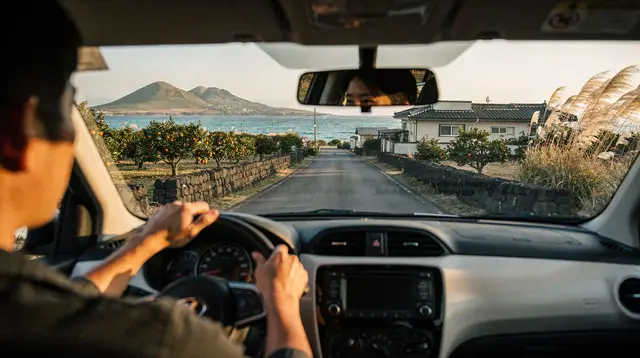
Jeju: Private Car Charter Tour
Jeju: Private Tour with an English Guide and a Vehicle

Private Tour of Jeju Island, by Car, at Your Own Pace
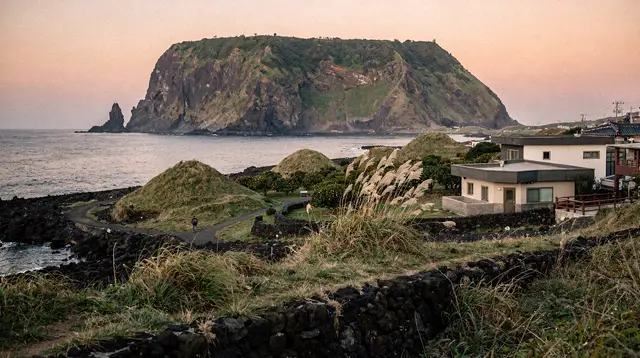
Jeju Island: Seongsan Ilchulbong & Private Transfer

Jeju: Private One Day Car Charter