
Haenyeo explained: Jeju's sea women
Long before Jeju had an airport, tour buses, or a single hotel, women here were free-diving into cold, current-heavy water to harvest abalone, conch, and sea urchin — without oxygen tanks, using breath-holding techniques passed down for generations. They’re called haenyeo, literally “sea women,” and they’re one of the only reasons Jeju’s culture reads as genuinely distinct from mainland Korea rather than a regional variation of it.
| Where to learn | Haenyeo Museum, northeast coast |
| Where to spot divers | Hado and other eastern/western coastal villages |
| Time needed | About an hour for the museum |
| UNESCO status | Intangible Cultural Heritage since 2016 |
| Etiquette | Ask before photographing; keep a respectful distance |
What haenyeo actually do
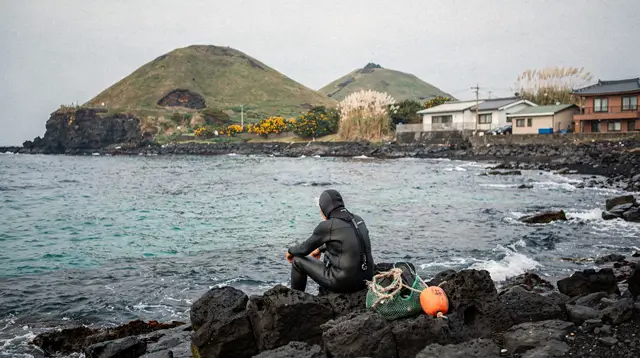
Haenyeo dive in wetsuits (a relatively modern addition — earlier generations wore cotton) with a simple mask, weight belt, and a floating net buoy called a tewak that marks their position and holds their catch. A single dive lasts roughly one to two minutes, though experienced divers can hold their breath for considerably longer, and a working session in the water typically runs several hours, repeated multiple times a week depending on season and tides. They surface with a distinctive whistling exhale — called sumbisori — that’s become one of the tradition’s most recognizable sounds, audible from shore on a calm day near an active diving ground.
What they harvest — abalone, conch, sea urchin, various seaweeds — has real economic value, and haenyeo income has historically supported entire households on Jeju, sometimes more reliably than their husbands’ farming or fishing. This is part of what makes haenyeo culturally significant beyond the physical feat of diving: for generations, Jeju’s family economy in coastal villages was frequently matriarchal in practice, women as primary earners, in a way that stood apart from the rest of Korea.
Why UNESCO recognized it
In 2016, UNESCO added haenyeo culture to its Representative List of the Intangible Cultural Heritage of Humanity — not for the diving technique alone, but for the surrounding social structure: village-level cooperative fishing rights, oral knowledge passed between generations, songs sung while diving or preparing gear, and a communal system for managing shared harvesting grounds sustainably. That last point matters more than it might seem — haenyeo communities have practiced informal marine conservation (rotating harvest areas, size limits on catch) for longer than most formal fisheries management systems have existed.
A tradition that’s visibly aging
The number of active haenyeo has dropped sharply over the past several decades — from tens of thousands at mid-20th-century peak to a few thousand today, and the average age of active divers now sits well into the 60s and 70s. Younger generations largely haven’t taken up the work, drawn instead to easier, better-paying jobs on an island whose economy has shifted heavily toward tourism. This is the quieter, less photogenic part of the haenyeo story: what you’re witnessing on any given visit is very likely one of the last active generations of this specific tradition, not a renewable cultural practice with an obvious next generation waiting behind it.
Where to actually see haenyeo
The Haenyeo Museum near Jeju’s northeast coast is the most complete starting point — it covers gear, technique, village social structure, and oral history through exhibits built with input from haenyeo communities themselves, rather than a generic “traditional Korea” framing. It’s a small museum, realistically an hour or so, but a genuinely useful primer before you go looking for the real thing along the coast.
Actually spotting working haenyeo requires some luck and respect for their working hours — they dive on their own schedule, dictated by tide and weather, not tourist convenience. Villages along the eastern and western coasts, particularly around Hado and smaller fishing communities, still have active diving cooperatives, and it’s not unusual to see haenyeo selling their catch directly from a small stall near the shore right after a diving session — freshly harvested abalone or sea urchin, often cheaper and fresher than what you’d find at a restaurant. If you do encounter working haenyeo, keep a respectful distance, ask before photographing them up close, and don’t treat a hard physical job as a photo backdrop.
For a more structured, respectful introduction, Jeju: Haenyeo Culture Experience with Seafood Tasting pairs cultural context with a tasting of what haenyeo actually harvest, and Jeju: Haenyeo UNESCO Sea Women Photoshoot Experience offers a consent-based photography session rather than photographing working divers uninvited.
The haenyeo song tradition
Part of what UNESCO’s listing protects is haenyeo norae — work songs traditionally sung while rowing out to diving grounds or preparing gear on shore. These aren’t performance pieces; they’re functional, rhythmic songs that coordinated group rowing and expressed the physical difficulty and danger of the work — drowning, decompression injury, and cold-water exposure were and remain real occupational hazards. Some cultural centers and the Haenyeo Museum include recordings or live demonstrations of these songs as part of their exhibits.
The economics behind the tradition’s decline
It’s worth understanding why haenyeo numbers have dropped so sharply, beyond the simple observation that younger generations haven’t taken up the work. Diving is physically punishing and genuinely dangerous — decompression injuries, cold-water exposure, and drowning remain real occupational risks even for experienced divers, and the work offers none of the stability or benefits of Jeju’s now-dominant tourism economy.
As tourism jobs (hospitality, tour guiding, retail) became widely available and comparatively easier, the economic case for a teenager or young adult choosing haenyeo diving over other work largely disappeared, particularly since the multi-year apprenticeship needed to become a skilled diver doesn’t pay well during the learning period. Some cooperative diving villages have experimented with subsidies, insurance programs, and cultural tourism revenue specifically to make the profession more economically viable for a small number of younger recruits, with limited but real success in a handful of communities.
Government and UNESCO protection efforts
Since UNESCO’s 2016 listing, both the Jeju provincial government and cultural preservation organizations have invested in documentation projects, training programs, and haenyeo-run cultural centers designed to keep the tradition visible and, where possible, sustain a small number of new entrants. These efforts acknowledge the reality that haenyeo diving as a widespread livelihood is very unlikely to return to its mid-20th-century scale, and instead focus on preserving the knowledge, songs, and cooperative social structures even as the practical fishing economy around it shrinks. Museums, oral history archives, and haenyeo-led educational programs are part of this broader preservation effort, distinct from — but connected to — the tourist-facing cultural experiences most visitors encounter.
Haenyeo in the wider Jeju story
The haenyeo tradition connects to several other threads in Jeju’s cultural history worth exploring if this topic interests you. The island’s turbulent 20th century, including the events covered in the guide to the Jeju 4.3 Incident, shaped the same coastal communities where haenyeo culture persisted. More recently, haenyeo imagery and stories have found their way into Korean film and television — see the roundup of K-drama filming locations in Jeju for productions that have drawn on haenyeo themes. If you’re planning independently rather than with a tour, the Jeju solo travel guide covers how to approach coastal villages respectfully without a guide.
For destination-level planning around the areas where haenyeo culture is most visible, East Jeju and Jeju’s islets both have active diving communities and museums or cultural centers worth building into a day. If hiking or coastal walking is part of your trip, several East Jeju itinerary stops pass directly through haenyeo fishing villages.
Haenyeo diving techniques and physical training
What makes haenyeo diving physiologically remarkable is that it relies entirely on trained breath-holding rather than any mechanical assistance — no scuba tanks, no oxygen supply, just repeated free-diving over hours-long sessions. Experienced haenyeo develop an enlarged lung capacity and a slowed heart rate response to submersion through decades of practice, a physiological adaptation that researchers have studied specifically because it offers insight into human free-diving limits more broadly.
Training traditionally began in childhood, with young girls in diving families learning basic technique in shallow water long before attempting the deeper, more dangerous dives that experienced haenyeo perform routinely. This multi-decade skill development is part of why the tradition is so difficult to simply “restart” with new recruits later in life — the physiological adaptations that make expert haenyeo diving possible take years to develop even for someone starting relatively young.
Three ways to actually experience haenyeo culture
| Option | What it gives you | Effort |
|---|---|---|
| Haenyeo Museum | Gear, history, oral testimony, structured context | Low — self-guided, about an hour |
| Spotting working divers along the coast | An authentic, unscripted glimpse | Higher — depends on tide, weather, luck |
| A structured cultural experience/tour | Guided context plus tasting or photography | Low — booked in advance |
Haenyeo cuisine: what to actually eat
Beyond watching or learning about haenyeo, tasting what they harvest is one of the more direct ways to engage with the tradition. Fresh abalone, sea urchin, and conch sold or served near diving villages are usually simpler and less processed than what shows up on a mainland restaurant menu — often just lightly seasoned or served raw, letting the seafood’s freshness carry the dish rather than heavy sauces. Prices vary with season and catch, but expect to pay a premium for genuinely fresh, diver-caught seafood compared to a standard seafood restaurant; a small stall selling directly from a haenyeo’s daily catch is usually the most honest value. Combining a Haenyeo Museum visit with a meal featuring their harvest gives a more complete sense of the tradition than either alone.
Why the haenyeo story resonates beyond Jeju
Haenyeo culture has drawn international academic and media attention well beyond Korea, partly because free-diving traditions with any comparable scale or documented history are genuinely rare worldwide — Japan’s ama divers are the closest parallel, sharing some cultural and historical overlap with haenyeo across the nearby waters. Researchers studying human physiological adaptation to repeated breath-hold diving have specifically examined haenyeo populations because of their long, well-documented history and the size of the tradition even in its diminished modern form. This broader scientific and cultural interest is part of why haenyeo culture, despite being a genuinely local Jeju tradition, has ended up as a reference point in conversations about aging societies, women’s labor history, and human physiology far outside Korea itself.
Building haenyeo into your Jeju trip
The simplest way to fit this tradition into a trip is to treat it as a thread running through your coastal days rather than a single stop. The Haenyeo Museum guide explains what to look for inside, and the broader haenyeo diving women culture guide goes deeper on the history behind what you see in the water. If you’d rather have someone else arrange the encounter, the haenyeo photoshoot experience explains how the consent-based session works.
Because diving depends on tide and weather, flexibility helps. A loose day in the east pairs well with the East Jeju day tour, and the UNESCO sites day tour places haenyeo culture next to the island’s other heritage listings. For travelers who prefer a guided format, an eastern UNESCO sites day that includes a haenyeo show combines the coast with a staged presentation of the tradition.
Food is the other easy way in. The Jeju abalone and seafood guide and the seafood markets guide cover where the catch ends up, and the food etiquette and tipping guide helps you order comfortably. If your interest in the island’s culture runs further, the Jeju dialect and language guide shows how the same coastal communities kept their own way of speaking. Travelers planning a first visit can slot all of this into the first-timer Jeju itinerary.
Frequently asked questions about haenyeo
What does haenyeo mean?
“Haenyeo” (해녀) translates literally to “sea women” — a term specifically for Jeju’s tradition of female free-divers who harvest seafood without oxygen tanks.
Are haenyeo still active today?
Yes, though their numbers have dropped sharply — from tens of thousands mid-20th century to a few thousand today, with most active divers now in their 60s, 70s, or older.
Can tourists watch haenyeo dive?
You can sometimes see them from shore near active fishing villages, though sightings depend on tide, weather, and the divers’ own schedule. Structured cultural experiences offer a more reliable and respectful way to learn about the tradition.
Why is haenyeo culture UNESCO-listed?
UNESCO recognized haenyeo culture in 2016 for its intangible heritage value — not just the diving technique, but the cooperative village fishing structure, oral knowledge transfer, and traditional work songs surrounding it.
What do haenyeo harvest?
Mainly abalone, conch, sea urchin, and various edible seaweeds, gathered by free-diving to depths of several meters without breathing apparatus.
Is it okay to photograph haenyeo?
Only with consent, and preferably not while they’re working. Structured, consent-based photography experiences exist specifically to avoid intruding on their actual dives.
Where is the Haenyeo Museum?
It’s located near Jeju’s northeast coast, dedicated specifically to haenyeo history, gear, and community structure, and is a useful starting point before visiting active diving villages.
Can I eat what haenyeo actually harvest?
Yes — fresh abalone, sea urchin, and conch are sold or served near diving villages, often simply prepared to let the seafood’s freshness stand out. Expect a premium for genuinely diver-fresh catch.
Related guides
Haenyeo: Jeju's Sea Women
Who Jeju's haenyeo sea women are, where to see them dive, and how to experience this UNESCO-listed living tradition without turning it into a photo op.

Haenyeo Museum
A practical guide to Jeju's Haenyeo Museum in Gujwa — hours, admission, exhibits, and why it's the best single stop for understanding the sea women

Haenyeo photoshoot experience
Book a haenyeo photoshoot on Jeju: what the experience involves, cost, respectful etiquette, and how it fits alongside cultural sites like the Haenyeo

The Jeju 4.3 incident: history explained
What the Jeju 4.3 Incident was, why it still matters, and how to visit the Jeju 4.3 Peace Park and related sites respectfully and with proper context.