
The Jeju 4.3 Incident, explained
Most visitors arrive on Jeju thinking about volcanic craters and hallabong tangerines, not mass violence — but understanding the Jeju 4.3 Incident is genuinely important to understanding the island’s modern identity, and it’s not a footnote you’ll find prominently signposted at most attractions. This is heavy material, and it deserves to be treated as such rather than skimmed as trivia.
| Where | Jeju 4.3 Peace Park, near Jeju City |
| Time needed | 1.5-2 hours for a thoughtful visit |
| Cost | Free entry to the memorial hall |
| Tone | Serious, contemplative — not a casual photo stop |
| Best paired with | Background reading beforehand for fuller context |
What happened
The Jeju 4.3 Incident refers to a period of civil unrest and violent suppression that took place on Jeju between 1948 and 1954, in the chaotic years following Korea’s liberation from Japanese colonial rule and its subsequent division. An uprising in 1948, tied to opposition against separate elections seen as cementing the peninsula’s division, was met with a brutal counterinsurgency campaign by South Korean government and military forces. Estimates of the death toll vary, but credible historical investigations place the number at tens of thousands of civilians killed — a substantial portion of Jeju’s population at the time — along with the destruction of a large number of villages across the island.
For decades, discussing the event openly was politically dangerous in South Korea, and it was largely suppressed from official history and public memory until democratization in the late 1980s and 1990s made investigation and acknowledgment possible. A formal government apology came in 2003, following an official truth commission report, and April 3rd is now a national memorial day in South Korea.
Why it’s still sensitive
Beyond the scale of loss, the 4.3 Incident remains politically and emotionally sensitive because of how long it was suppressed and how it intersects with the broader, still-contested history of Korea’s division and Cold War-era politics. Many Jeju families lost relatives, and some survivors and descendants only felt able to speak publicly about their experiences decades later, once the political climate allowed it. This isn’t a settled historical footnote in the way a visitor might assume — it’s living memory for a meaningful portion of the island’s older population, and it continues to shape how Jeju understands its own relationship with the mainland Korean state.
Where to learn the history respectfully
The Jeju 4.3 Peace Park, near Jeju City, is the primary memorial and museum dedicated to the event — it includes a research and exhibition hall, memorial monuments, and a records of victims, built with direct input from survivor and victim-family organizations. It’s a serious, contemplative site rather than a typical museum stop, and worth setting aside genuine time for rather than treating as a quick add-on between more upbeat attractions.
Guided tours that specifically cover the 4.3 Incident’s history and sites, like Jeju: 4.3 Incident History & Cultural Tour with a Guide, provide historical context that’s easy to miss visiting independently without background knowledge, and a guide trained in this specific history can navigate the sensitivity of the subject more thoughtfully than a self-guided visit.
The path to official recognition
The decades-long silence around 4.3 wasn’t accidental — during South Korea’s authoritarian governments through the 1980s, public discussion of the incident was actively suppressed, and survivors who spoke openly about their experiences risked serious consequences. It was only after South Korea’s democratization movement in 1987 that space opened for researchers, journalists, and survivor communities to begin documenting what had happened.
A National Assembly-mandated investigation in the late 1990s and early 2000s produced an official truth commission report, which formed the basis for President Roh Moo-hyun’s formal apology in 2003 — the first time a sitting South Korean president acknowledged state responsibility for the violence. This slow, decades-long path from suppression to acknowledgment is itself an important part of understanding why the event still carries such weight in Jeju’s collective memory.
The Dark Tourism angle, handled carefully
Some travel content categorizes 4.3 memorial sites under “dark tourism” alongside war memorials and disaster sites elsewhere in the world. That framing isn’t wrong, exactly, but it risks flattening a still-living history into a curiosity-driven checklist item. Approaching the Jeju 4.3 Peace Park with the same seriousness you’d bring to a Holocaust memorial or a 9/11 museum — rather than as an interesting historical curiosity to photograph and move on from — is the more appropriate frame, and it’s one the museum’s own design and curation clearly intends for visitors.
How it connects to the rest of Jeju’s culture
Understanding 4.3 adds real depth to other parts of Jeju’s cultural landscape. The haenyeo diving tradition, for instance, persisted through this same turbulent period — see Haenyeo explained: Jeju’s sea women for how that heritage intersects with the island’s broader 20th-century history. Jeju’s distinct dialect and cultural separation from the mainland, covered in why Jeju is called the “Hawaii of Korea”, also has roots in the island’s long history of being treated as peripheral to mainland Korean politics — a dynamic that fed directly into how the 1948 uprising and its suppression unfolded.
More recently, some Korean film and television productions have engaged with this history directly or indirectly; the Jeju K-drama filming locations guide notes where popular culture has touched on Jeju’s more difficult history alongside its scenic filming spots.
How the incident shaped Jeju’s relationship with the state
The scale and suppression of the 4.3 violence left a lasting imprint on how Jeju’s population relates to the mainland South Korean state, one that persisted for generations after the events themselves ended in 1954. Some historians and sociologists point to this history as a contributing factor in Jeju’s stronger regional identity and its more recent political push for the special self-governing province status it holds today — a status that grants it somewhat more administrative autonomy than other South Korean provinces. Understanding this thread helps explain why Jeju’s regional identity feels notably distinct from the rest of the country in ways that go beyond geography or dialect alone, rooted partly in a specific, painful shared historical experience that most of the mainland didn’t undergo in the same way.
Visiting respectfully
If you visit the 4.3 Peace Park or other memorial sites, treat them the way you would any serious historical memorial — quiet, reflective, and not primarily as a photo opportunity. Reading a summary of the history beforehand (rather than encountering it cold at the exhibit) makes the visit considerably more meaningful, since the museum assumes some baseline familiarity with 20th-century Korean history that many international visitors simply don’t have context for. If you’re interested in a broader understanding of how this period fits into Jeju’s identity as a destination independent of mainland Korea, the comparison in Jeju City’s destination guide and the island-wide overview in Seogwipo both touch on the historical layers beneath the modern tourist landscape.
Ongoing debates and unresolved questions
Even with the 2003 apology and subsequent official acknowledgment, aspects of the 4.3 Incident’s history remain subjects of active debate within South Korea — including disputes over exact casualty figures, the classification of the initial 1948 uprising, and how the event should be framed within school curricula. Some political factions have periodically pushed back against fuller acknowledgment or memorialization, reflecting the incident’s continued entanglement with broader, unresolved debates about South Korea’s Cold War-era history and the legacy of anti-communist state violence during that period. Visitors encountering this history for the first time should understand that what they’re learning at the Peace Park represents a hard-won but still not universally settled account, rather than a fully closed historical chapter.
Literature and film addressing the incident
Beyond the Peace Park’s exhibits, a body of Korean literature and film has engaged directly with 4.3’s legacy over the past several decades, including novels and documentary work by Jeju-connected writers and filmmakers who’ve worked to preserve survivor testimony in narrative form. Seeking out some of this material before or after your visit — much of it now available in translation — can add a personal, human dimension to the history that a museum’s more formal, curated presentation sometimes can’t fully capture on its own. This kind of preparation is optional but genuinely enriches a visit for travelers who want to engage with the history seriously rather than as a brief stop between more lighthearted attractions.
Preparing before you go
Reading even a short summary of the timeline — the 1948 uprising, the counterinsurgency campaign, the decades of suppression, the 2003 apology — before arriving at the Peace Park changes the visit considerably. The exhibits assume a baseline of context that international visitors often don’t have walking in cold, and arriving with even basic background lets you engage with the specific testimonies and artifacts rather than spending the visit piecing together the broader timeline for the first time. Setting aside at least 90 minutes, rather than treating it as a 20-minute drive-by stop, matches the seriousness the site itself is built around.
Jeju: 4.3 Incident History & Cultural Tour (Southwest Route) covers the memorial alongside other southwest historical sites for visitors who want a guided, contextualized route through this history rather than a self-directed visit.
How this history shapes conversations with locals
If you strike up a genuine conversation with older Jeju residents, references to 4.3 sometimes surface indirectly — a family history, a village’s founding story, a reason a particular building or site holds meaning. This isn’t something to probe for as a curiosity, but understanding the broad outline of the history means you’re less likely to unintentionally treat a sensitive reference lightly if it comes up naturally. Younger Jeju residents, who grew up after the 2003 apology and the subject’s fuller entry into public education, tend to discuss it somewhat more openly than the generation that lived through the suppression era, though it remains a topic approached with real care across age groups.
Going deeper before and after your visit
If you want a longer written account of the events, the Jeju 4.3 Incident history guide walks through the same period from a visitor’s point of view, and it makes a good companion read the evening before you go. For other places that keep the island’s past alive, the Jeju museums roundup helps you choose which ones deserve your time, and the Haenyeo Museum guide shows how the sea women’s story is told in a very different register.
Fitting a heavy visit into a trip
A visit like this changes the mood of a day, so it helps to plan around it. Pair it with something quiet rather than something loud: a slow walk, a long lunch, or an evening in town. The first-timer Jeju itinerary and the first-time Jeju planning guide both show how to leave room in a schedule so a contemplative stop doesn’t feel squeezed. If you’re building a route around Jeju City, one day in Jeju City is a natural place to start, and the Jeju City destination page gives the wider setting.
Travelers who like to go beyond the obvious stops will also find the hidden gems off the beaten path article a useful counterweight, since it points toward the quieter, more local side of the island where this history is still felt. For practical manners around food and conversation once you’re back among everyday island life, the Jeju food etiquette and tipping guide is a helpful read.
Frequently asked questions about the Jeju 4.3 Incident
What was the Jeju 4.3 Incident?
A period of civil unrest and violent government suppression on Jeju Island between 1948 and 1954, resulting in tens of thousands of civilian deaths and the destruction of numerous villages, tied to opposition against Korea’s division-era politics.
Why is it called “4.3”?
The name refers to April 3, 1948, the date of the initial uprising that triggered the broader period of violence and suppression that followed.
Is there a memorial for the 4.3 Incident?
Yes — the Jeju 4.3 Peace Park near Jeju City is the primary memorial and museum, built with direct involvement from survivor and victim-family organizations.
When did the South Korean government acknowledge the event?
A formal government apology came in 2003 following an official truth commission investigation. April 3rd is now recognized as a national memorial day.
Is it appropriate for tourists to visit 4.3 memorial sites?
Yes, and it’s genuinely worthwhile — approach it as a serious historical memorial rather than a casual attraction, and consider reading background history before your visit for more context.
How many people died in the 4.3 Incident?
Estimates vary, but credible historical investigations place the death toll at tens of thousands of civilians, a substantial portion of Jeju’s population at the time.
How much time should I set aside for the Peace Park?
At least 90 minutes for a thoughtful visit — treating it as a quick 20-minute stop undersells both the scale of the exhibits and the seriousness of the subject.
Related guides

The Jeju 4.3 incident: history explained
What the Jeju 4.3 Incident was, why it still matters, and how to visit the Jeju 4.3 Peace Park and related sites respectfully and with proper context.
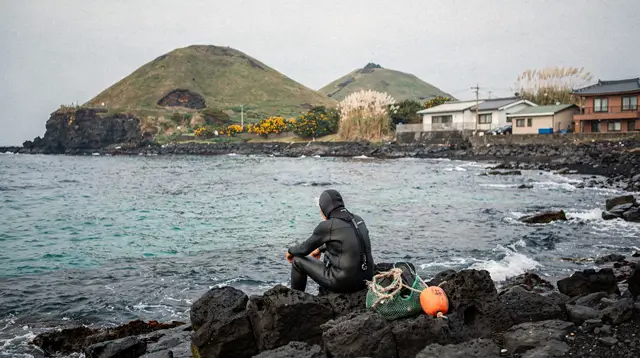
Haenyeo: Jeju's Sea Women
Who Jeju's haenyeo sea women are, where to see them dive, and how to experience this UNESCO-listed living tradition without turning it into a photo op.

Jeju's best museums: a 100+ roundup
Jeju has over 100 museums, from serious art institutions to novelty theme collections — a practical guide to which ones actually deserve your time.

K-drama filming locations in Jeju
Where popular K-dramas filmed on Jeju, from When Life Gives You Tangerines to older classics — practical visiting info for each real-world location.