Best photography spots in Jeju
Where are the best photography spots in Jeju?
Seongsan Ilchulbong and Seopjikoji for sunrise, Jusangjeolli and Yongmeori Coast for dramatic basalt geology, the Seogwipo waterfall circuit for forest-and-water shots, and Yongduam Dragon Rock for a quick sunrise silhouette near Jeju City.
Jeju rewards photographers with an unusual density of distinct landscape types packed into a relatively small island — volcanic tuff cones, hexagonal basalt columns, ocean-falling waterfalls, subtropical forest, and grassy coastal headlands, all within a couple hours’ drive of each other. This guide covers the island’s strongest photography locations by region and subject, along with practical timing and gear notes, rather than repeating a generic “top 10 places to see” list that doesn’t account for light, crowds, or access logistics.
| Where | East coast (sunrise), southwest (basalt), Seogwipo (waterfalls), west coast (sunset) |
| Cost | Most sites free–low entry; guided photography experiences from around ₩80,000–150,000 |
| Time needed | A focused day covers 3-4 locations; 3-4 days for a dedicated photography trip |
| Getting there | Rental car close to essential for chasing tide/light windows |
| Best time | Golden hour for landscapes; October for the clearest, most reliable conditions overall |
Sunrise locations: the east coast
Seongsan Ilchulbong (“Sunrise Peak”) is the obvious headline location, and its reputation is earned — the crater rim’s east-facing profile catches first light dramatically, though reaching the best vantage point requires a genuine hike up before dawn. A flatter, easier alternative sits a short drive away: Seopjikoji’s grassy headland offers sweeping eastward views, including a distant look at Seongsan Ilchulbong’s silhouette, without requiring a climb. Both locations draw a crowd of photographers at dawn — arriving 30-45 minutes before official sunrise secures a decent vantage point at either.
Sunrise near Jeju City: Yongduam
For travelers based in or near Jeju City who don’t want to drive an hour to the east coast before dawn, Yongduam Dragon Rock offers a genuinely different but still rewarding sunrise composition — a compact lava rock silhouette against the brightening sky over open water, a 10-15 minute drive from central Jeju City or the airport. It’s a smaller-scale subject than Seongsan Ilchulbong, better suited to a quick, low-effort sunrise stop than a dedicated photography expedition.
Basalt and coastal geology: the southwest
Jusangjeolli Cliff, near Jungmun, delivers Jeju’s most geometrically striking landscape — hexagonal basalt columns viewed from a boardwalk, best photographed at high tide when waves crash dramatically against the formation. A short drive further west, Yongmeori Coast offers a different kind of coastal geology: layered, striped sedimentary cliffs walked directly at sea level, though access depends on tide conditions. Both reward a polarizing filter to manage glare off wet rock, and both photograph noticeably better in the lower-angle light of morning or late afternoon than under flat midday sun.
Waterfalls and forest: Seogwipo
The Seogwipo waterfall circuit — Cheonjiyeon, Jeongbang, and Cheonjeyeon — offers three distinct compositions within a short drive of each other: Cheonjiyeon’s forest-framed pool, Jeongbang’s rare ocean-falling cascade against an open horizon, and Cheonjeyeon’s three-tiered falls linked by the arched Seonimgyo bridge. A small tripod and neutral density filter help for long-exposure silky-water shots, though flow depends entirely on recent rainfall — a dry winter stretch produces a noticeably thinner subject than after spring rain or the tail end of typhoon season.
Haenyeo culture: a different kind of photography
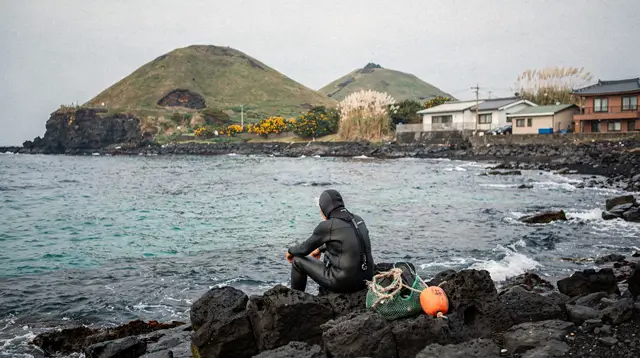
Beyond landscape, Jeju’s haenyeo (sea women) divers offer one of the island’s most distinctive cultural photography subjects — women who free-dive for seafood using traditional techniques recognized by UNESCO as intangible cultural heritage. A dedicated haenyeo photoshoot experience arranges access and context that’s difficult to replicate independently, and it’s covered in full detail in its own guide linked here.
Highland and forest: Hallasan and the oreums
Away from the coast, Hallasan National Park’s trails offer a genuinely different photographic register — dense forest, volcanic crater rim views from the summit on a clear day, and, in winter, snow-flocked trees that are among the most striking single images available on the island. The trade-off is effort: reaching the best highland views requires a real hike, not a short walk from a parking lot, and Hallasan’s summit weather is notoriously unpredictable, with cloud cover obscuring the crater view on a meaningful share of visits regardless of season. The scattered volcanic oreums (parasitic cones) across the island offer a lower-effort alternative — rolling grassy hills with sweeping views, often less crowded than the marquee sites, and well worth scouting if time allows for more than the standard coastal circuit.
Beach and ocean-horizon photography
Jeju’s west-coast beaches, particularly Hyeopjae and Gwakji, offer a different palette from the volcanic drama further south and east — pale sand, turquoise shallow water, and, at Hyeopjae, a view toward the small offshore island of Biyangdo that anchors many wide beach compositions. These locations work best in the mid-morning or late afternoon, when the sun angle brings out the water’s color without the flat glare of midday overhead light. Sunset from the west coast, facing directly out to open ocean, is one of the more reliable sunset-photography setups on the island, less dependent on the specific cloud and haze conditions that can mute an east-coast sunrise.
Post-processing realities
Jeju’s combination of strong coastal haze, high humidity, and intense midday sun means a meaningful share of usable landscape shots benefit from at least basic post-processing — dehazing, a modest contrast boost, and white balance correction for the blue-grey cast that coastal haze often introduces. This isn’t a criticism of the locations themselves; it’s simply a realistic expectation for tropical-adjacent coastal photography anywhere, and shooting in RAW format rather than JPEG-only gives considerably more room to correct for these conditions after the fact, particularly for basalt and rock-formation shots where color accuracy in the stone matters.
Guided versus self-guided photography days
A guided photography experience makes the most sense for visitors without a rental car, those wanting posed portraits with professional lighting and composition guidance, or anyone short on time who wants a curated multi-location day without researching logistics themselves. Self-guided photography makes more sense for visitors with their own transport, a specific shot list in mind, and the flexibility to chase weather and tide conditions on their own schedule — since, as covered above, several of this guide’s best locations (Jusangjeolli’s wave action, Yongmeori’s tide-dependent access) reward being able to adjust timing at short notice rather than following a fixed tour departure time.
Guided photography options
For visitors who want expert composition advice or a posed portrait session against Jeju’s landscapes rather than managing gear and timing solo, Jeju: Professional Photography Experience at Jeju Landmarks pairs a photographer with a multi-location itinerary across the island’s most photogenic sites. For a more culturally specific session, Jeju: Haenyeo UNESCO Sea Women Photoshoot Experience focuses specifically on the sea-women tradition, and Jeju Island: Sunrise Guided Tour with Hotel Pickup removes the pre-dawn driving logistics for sunrise photography near Jeju City.
Weather planning for photographers
Jeju’s weather shifts faster and more locally than most first-time visitors expect, given the island’s volcanic topography and its exposure to open ocean on all sides — a clear morning on the west coast can coincide with fog or rain in Seogwipo, and Hallasan’s summit frequently sits in cloud even on days that are sunny at sea level. Checking a location-specific forecast rather than a general “Jeju” forecast the morning of a planned shoot avoids wasted trips, particularly for sunrise sessions where cloud cover on the eastern horizon can mute or entirely block the effect you’re chasing. Typhoon season (late August-September) brings the least predictable conditions of the year and the highest chance of site closures affecting boardwalks and cliff-edge paths specifically.
Ethical and etiquette notes
Several of Jeju’s most photogenic subjects are also living cultural practices, not backdrops — haenyeo divers are working, not performing, even during a scheduled demonstration, and treating them and their catch with basic respect (asking before close-up portraits, not blocking their work area for a shot) matters more here than at a purely scenic site. At natural formations like Jusangjeolli and Yongmeori, staying on marked paths isn’t just a safety measure but a conservation one — visible erosion from unauthorized foot traffic has affected similar basalt-column sites elsewhere in the world, and Jeju’s management of these boardwalks exists specifically to prevent that outcome here.
Gear that actually matters
A wide-angle lens (16-24mm equivalent) covers most of Jeju’s sweeping coastal and cliff compositions; a mid-range zoom (24-70mm) handles waterfalls and more intimate framing. A polarizing filter is the single most useful accessory on this island, cutting glare off wet basalt, ocean surfaces, and waterfall spray consistently across nearly every location in this guide. A small, packable tripod earns its weight for sunrise, sunset, and long-exposure waterfall shots, though it’s largely unnecessary for the boardwalk and headland sites where handheld shooting in daylight is the norm. A lens cloth is worth carrying everywhere — Jeju’s coastal humidity and sea spray fog lenses more often than inland locations elsewhere.
Drone photography restrictions
Drone use is restricted or outright banned at many of Jeju’s protected natural sites, including sections of Hallasan National Park, and near CJU airport’s flight paths. Rules shift periodically and vary by specific site, so checking current regulations — via the Korea Civil Aviation Safety Authority or a local rental agency — before flying is essential rather than assuming any given coastal or mountain location is open to drones. Several of the sites in this guide, including Jusangjeolli and the Seogwipo waterfalls, have posted restrictions at the entrance.
Building a multi-day photography-focused trip
A single day, as sketched below, covers the island’s headline locations, but a photographer with three or four days can go considerably deeper — a dedicated Hallasan hiking day for highland and forest work, a full day on the west coast for beaches and sunset, and a second pass at whichever coastal geology site (Jusangjeolli or Yongmeori) had disappointing tide or wave conditions the first time. Building in this kind of redundancy matters specifically because several of Jeju’s best shots — high tide at Jusangjeolli, low tide at Yongmeori, clear skies at Hallasan’s summit — depend on conditions that don’t always cooperate on a single scheduled visit, and a multi-day trip has the flexibility to simply try again.
Instagram-specific spots
For photographers prioritizing a single strong social-media shot over broader landscape work, the Jeju Instagram spots guide covers cafes and installations built specifically around a photogenic backdrop — a different category from the landscape and geology locations covered here, but a useful complement for a well-rounded photo trip.
Night and star photography
Jeju’s rural interior and less-developed southwest coast offer genuinely dark skies away from Jeju City’s light pollution, making the island a reasonable, if not world-class, destination for night sky photography on clear, moonless nights. The area around Sanbangsan and Yongmeori Coast, and the higher elevations of Hallasan’s lower trails before the restricted summit zone, tend to offer the darkest accessible conditions. A sturdy tripod is non-negotiable for this kind of shooting, and a wide, fast lens (f/2.8 or faster) makes a meaningfully bigger difference for star photography than for any of the daytime landscape work covered elsewhere in this guide. Light pollution maps, freely available online, are worth checking before committing to a specific location for a night shoot.
Camera settings starting points
For waterfall long exposures, starting around f/8-f/11 with a 1-2 second shutter speed (using a neutral density filter in bright daylight) produces the smooth, silky water effect most photographers are after at sites like Cheonjiyeon and Cheonjeyeon. For sunrise and sunset silhouettes at Seongsan Ilchulbong, Seopjikoji, or Yongduam, exposing for the sky and letting the foreground fall into shadow generally produces a more dramatic result than trying to preserve foreground detail with fill flash or heavy exposure compensation. For the basalt columns at Jusangjeolli, a narrower aperture (f/11-f/16) keeps both the foreground columns and the background sea and sky reasonably sharp, useful given how much of that composition’s appeal depends on the full scene rather than a shallow-depth-of-field portrait style.
Seasonal photography notes
Spring (cherry blossoms in late March, canola fields in April-May) offers Jeju’s most colorful window, though blooms peak for only a few days and require checking bloom forecasts rather than fixed calendar dates. Autumn, especially October, combines the clearest skies of the year with the strongest post-typhoon-season waterfall flow — arguably the single best all-around month for landscape photography on the island. Summer brings lush green landscapes but also haze, humidity, and the monsoon; winter brings the clearest air on good days but the harshest wind at exposed coastal sites like Jusangjeolli and Seopjikoji.
Avoiding crowds in your shots
Nearly every site in this guide follows the same crowd pattern: tour buses cluster in the late morning through early afternoon (roughly 10 a.m.-2 p.m.), while the hour after opening and the hour or two before closing are consistently quieter — and, not coincidentally, offer better light. Building a photography-focused itinerary around this rhythm, rather than a standard sightseeing schedule, makes a bigger difference to the quality of your shots than almost any gear upgrade.
Logistics: renting a car for a photography trip
Because so much of Jeju’s best photography depends on being in a specific place at a specific time — before dawn, at a particular tide, in the last hour before a site closes — a rental car is close to essential for a genuinely dedicated photography trip, considerably more so than for a standard sightseeing itinerary where tour buses and fixed schedules are perfectly adequate. An International Driving Permit is required to rent and drive on Jeju, and it needs to be obtained before departure rather than on arrival. For photographers without a car, building a trip around the guided options above, supplemented by taxis for the specific sunrise or sunset windows a tour schedule doesn’t cover, is the realistic alternative.
A realistic one-day photography itinerary
Start before dawn at Seongsan Ilchulbong or Seopjikoji for sunrise, then head to Manjanggul or the Seogwipo waterfall circuit for midday forest shade during the harshest light, and finish at Jusangjeolli or Yongmeori Coast for golden-hour basalt photography timed against high tide if possible. This sequence uses the island’s geography efficiently — east coast at dawn, south coast at midday, southwest coast at sunset — without excessive backtracking, and covers the range of landscape types this guide describes in a single well-paced day.
Phone-only photography: what works and what doesn’t
A modern smartphone handles a genuinely large share of this guide’s subjects well — Jusangjeolli’s columns, Seopjikoji’s grassy headland, Hyeopjae’s turquoise water, and most cafe or portrait-style shots all work fine without a dedicated camera, especially with a phone’s built-in HDR handling Jeju’s frequent high-contrast coastal light better than it used to. Where a phone genuinely falls short is long-exposure waterfall shots (though some phones now offer a basic long-exposure mode), night sky photography, and telephoto compression for distant subjects like Seongsan Ilchulbong’s silhouette viewed from Seopjikoji. A clip-on polarizing filter for a phone is a worthwhile, inexpensive upgrade that closes much of the gap on glare-heavy shots at the coastal and basalt sites.
Renting camera gear locally versus bringing your own
Dedicated camera rental services exist in Jeju City, catering mostly to the wedding and pre-wedding photography market rather than casual travelers, so options and availability are more limited than in a major mainland city — travelers with a specific gear list in mind are better off bringing their own body and lenses rather than counting on local rental. Tripods and simple accessories are easier to source or rent locally if checked baggage space is tight, but core camera gear is worth packing from home given the inconsistent local rental supply.
Where lava tubes fit into a photography trip
Manjanggul and Jeju’s other accessible lava tubes offer a genuinely different subject from anything else in this guide — dark, cool underground passages requiring a much wider aperture or higher ISO than the daylight shots covered elsewhere, and a tripod is close to essential given how little ambient light reaches the walkway sections. It’s a strong midday addition to an itinerary otherwise built around dawn and dusk light, since the interior lighting doesn’t depend on the sun’s position at all, making it one of the few genuinely weather- and time-of-day-independent stops in this guide.
Comparing the island’s signature basalt sites
| Site | Best light | Access | Notes |
|---|---|---|---|
| Jusangjeolli | High tide, morning/late afternoon | Boardwalk, always open | Most geometrically dramatic |
| Yongmeori Coast | Low tide | Tide-dependent, can close | Layered sedimentary cliffs |
| Yongduam | Sunrise | Roadside, quick stop | Best near Jeju City with limited time |
Related guides

Jeju sunrise & sunset photography
The best sunrise and sunset photography spots on Jeju — Seongsan Ilchulbong, Seopjikoji, Yongduam, and west-coast beaches — with timing and gear advice.

Jeju Instagram spots
Jeju's best Instagram spots — themed cafes, pink muhly fields, Hello Kitty Island, and coastal viewpoints — with honest notes on what's worth the trip.

Haenyeo photoshoot experience
Book a haenyeo photoshoot on Jeju: what the experience involves, cost, respectful etiquette, and how it fits alongside cultural sites like the Haenyeo

Hiking Seongsan Ilchulbong at Sunrise
Hiking Seongsan Ilchulbong for sunrise means an early start, a short but steep climb, and genuine crowds — here's how to plan it well.
Ready to book? Top tours for this guide
We earn a small commission if you book through GetYourGuide — at no extra cost to you. Every tour is hand-picked and verified.