Jeju sunrise & sunset photography
Where's the best place to photograph sunrise in Jeju?
Seongsan Ilchulbong is the classic sunrise location, with Seopjikoji and Yongduam Dragon Rock as easier, less demanding alternatives. For sunset, the west coast — particularly Hyeopjae and Gwakji beaches, or Jusangjeolli's cliffs — faces directly into the setting sun over open ocean.
| Sunrise spot | Seongsan Ilchulbong (climb) or Seopjikoji/Yongduam (flat) |
| Sunset spot | Hyeopjae, Gwakji beaches, or Jusangjeolli cliffs |
| Best season | Autumn, especially October, for clearest skies |
| Start time | around 4:30-5 a.m. for a summer sunrise climb |
| Cost | free at most spots; Seongsan and Jusangjeolli are ticketed |
Jeju’s coastal geography — a roughly round island with dramatically different terrain on its east and west sides — creates a natural division for sunrise and sunset photography: the east coast, anchored by Seongsan Ilchulbong (“Sunrise Peak”), is where most sunrise pilgrimages happen, while the west coast’s open-ocean beaches and cliffs generally offer the stronger sunset views. This guide covers the specific locations, timing, and practical logistics for both, rather than treating “golden hour” as a single generic recommendation that applies the same way everywhere on the island.
Seongsan Ilchulbong: the classic sunrise climb
Seongsan Ilchulbong’s name translates directly to “Sunrise Peak,” and its reputation as Korea’s premier sunrise viewing location is genuinely earned — the volcanic tuff cone’s crater rim offers a dramatic elevated view directly into the sunrise over open water, with the climb itself part of a long-standing local and national tradition, particularly around New Year’s when crowds gather specifically for the first sunrise of the year. The hike takes roughly 20-30 minutes each way on a real trail with genuine elevation gain, meaning a 4:30-5 a.m. start is typical to reach the summit before first light, depending on the season’s specific sunrise time.
If you want the climb itself explained step by step, the dedicated Seongsan Ilchulbong sunrise peak guide and the sunrise peak hike guide go deeper on the trail, while the Seongsan destination page helps you place the peak within the surrounding area.
Seopjikoji: the easier alternative
For photographers who want strong east-facing sunrise views without Seongsan’s climb, Seopjikoji’s flat, grassy headland a short drive away offers sweeping views including a distant look at Seongsan Ilchulbong’s silhouette against the sunrise — a genuinely different but still rewarding composition, reachable without any significant elevation gain.
Yongduam Dragon Rock: sunrise near Jeju City
Travelers based in or near Jeju City who don’t want to drive to the east coast before dawn have a solid closer option in Yongduam Dragon Rock, a compact lava formation whose silhouette against the brightening sky photographs well at sunrise, a 10-15 minute drive from central Jeju City or the airport rather than the hour-plus drive to Seongsan.
West coast sunset: Hyeopjae and Gwakji
Jeju’s west-coast beaches, particularly Hyeopjae and Gwakji, face directly into the setting sun over open ocean, making them the island’s most reliable sunset photography locations — pale sand and shallow turquoise water in the foreground, with Hyeopjae’s view toward the small offshore island of Biyangdo adding a useful compositional anchor point on the horizon.
For the beaches themselves, the Hyeopjae Beach guide and the Gwakji Beach guide cover access and what each shoreline is like, and the West Jeju destination page shows how the coast fits together if you want to string several sunset stops into one evening.
Sunset at Jusangjeolli
Jusangjeolli’s basalt columns face roughly southwest, meaning the last hour or two before closing (check posted hours, since the boardwalk doesn’t stay open past dusk) offers low-angle light raking across the columns’ texture — a different, more geological kind of sunset photography than a straightforward beach horizon shot, and one of the better combinations of golden-hour light and dramatic rock formation on the island.
The cultural weight of “haemaji” in Korea
Watching the first sunrise, called haemaji in Korean, carries genuine cultural significance beyond a purely photographic pursuit — a long-standing New Year’s tradition across Korea involves traveling specifically to see the year’s first sunrise, with Seongsan Ilchulbong ranking among the most popular destinations nationwide for exactly this purpose, drawing visitors from the mainland specifically for the occasion. Understanding this context explains why the crater rim can feel less like a quiet nature spot and more like a genuinely significant cultural gathering point around December 31st into January 1st, an atmosphere worth experiencing at least once even if the crowd management is more demanding than an ordinary sunrise visit.
Composition ideas by location
At Seongsan Ilchulbong, the strongest compositions typically place the crater’s grassy rim or a foreground climber in silhouette against the rising sun, rather than shooting the sun in open sky alone — the human scale and the crater’s texture both add depth that a plain horizon shot lacks. At Seopjikoji, incorporating the lighthouse as a foreground anchor point, with Seongsan’s distant silhouette in the background, creates a layered composition that a flat headland shot alone doesn’t achieve. At Hyeopjae and Gwakji, low-tide conditions expose wet sand that reflects the sunset sky, effectively doubling the color in frame — worth timing a visit around low tide specifically for this reflection effect if it’s available on your visit date.
Moon photography and supermoons
Beyond sun-based golden hour, Jeju’s clear coastal horizons also make it a reasonable location for moonrise photography, particularly during a supermoon or full moon rising over the eastern sea near Seongsan Ilchulbong or Seopjikoji — a subject that uses much of the same composition and timing logic as sunrise photography but shifted to align with the moon’s rising time rather than the sun’s, worth checking a moon-phase calendar for if this specific subject interests you during your travel dates.
Apps and tools worth using
A dedicated sun-position app (several free options calculate exact sunrise, sunset, and golden-hour timing along with the sun’s compass direction for any given location and date) removes the guesswork of estimating where the sun will actually rise or set relative to a specific foreground subject like Seongsan’s crater or the Yongduam rock. Tide tables matter almost as much as sun position for shots at Hyeopjae, Gwakji, or Jusangjeolli, where wet-sand reflections or wave action against the coast depend on tide level independent of the light itself.
Timing: how sunrise and sunset shift by season
Jeju’s sunrise and sunset times shift meaningfully across the year — roughly 5:15-5:30 a.m. sunrise and 7:30-7:45 p.m. sunset near the June solstice, compared to around 7:30 a.m. sunrise and 5:15 p.m. sunset near the December solstice. This isn’t a minor detail: a summer sunrise shoot requires a genuinely early start well before 5 a.m., while a winter visit allows a far more civilized wake-up time for the same shot. Checking the specific date’s sunrise and sunset time via a weather app, rather than relying on a rough seasonal memory, avoids arriving either too early in the dark or too late after the light has already peaked.
Guided options for sunrise photography
Jeju Island: Sunrise Guided Tour with Hotel Pickup removes the logistics of a pre-dawn solo drive on unfamiliar roads, a genuine consideration given how early a summer sunrise shoot requires setting out. For a more comprehensive, multi-location photography day including sunrise, midday, and sunset locations with professional guidance, Jeju: Professional Photography Experience at Jeju Landmarks covers a broader itinerary. Photographers specifically wanting the Seongsan Ilchulbong hike itself with guided support can consider Jeju: UNESCO Sites & Sunrise Peak Hiking Small Group Tour, which combines the climb with other nearby UNESCO-listed stops.
Safety on pre-dawn drives
A meaningful share of Jeju’s sunrise photography requires driving unfamiliar coastal roads in the dark, often before 5 a.m. in summer — worth planning the route the night before rather than navigating cold, and allowing extra buffer time given that wildlife crossings, narrow rural roads, and reduced visibility all factor differently at night than during a daytime scouting drive. Fuel up the evening before rather than assuming a gas station will be open at 4 a.m. in a rural area, and confirm parking availability at the destination, since some sunrise-popular sites fill their lots well before the actual event.
How Seongsan Ilchulbong compares internationally
Within the broader category of “hike to a crater rim for sunrise” experiences across Asia, Seongsan Ilchulbong holds up well against comparable options — the climb is shorter and less technically demanding than many volcanic sunrise hikes elsewhere in the region, while the crater rim’s scale and the UNESCO World Heritage-listed geology give the location a level of visual and historical substance that a purely scenic viewpoint elsewhere might lack. Photographers who’ve done sunrise hikes at other well-known Asian volcanic sites generally find Seongsan a comparatively accessible, lower-commitment version of the same genre.
Accessibility considerations
Seongsan Ilchulbong’s summit trail, given its stairs and elevation gain, isn’t accessible for visitors with significant mobility limitations — Seopjikoji and Yongduam, both flat, are the practical alternatives for sunrise photography without a climb. For sunset, Hyeopjae and Gwakji beaches offer flat, generally accessible approaches to the shoreline, while Jusangjeolli’s paved boardwalk is fully accessible along its entire length, making it one of the more inclusive sunset photography options on the island.
Weather and cloud cover realities
Sunrise and sunset photography on Jeju, as anywhere, depends heavily on cloud conditions at the horizon specifically — a clear sky overhead doesn’t guarantee a clear horizon line, and a bank of low cloud sitting just above the sea can mute or entirely block the dramatic color show a clear horizon produces. Checking a location-specific forecast the evening before, and building in a backup morning if a first attempt is clouded out, meaningfully improves the odds over a single fixed attempt on a trip with only one sunrise slot planned.
Gear for low-light shooting
A tripod matters more for sunrise and sunset photography than for almost any other category covered on this site, given the low-light conditions before sunrise and after sunset when some of the most dramatic color often appears. A graduated neutral density filter, or simple exposure bracketing if shooting without one, helps balance a bright sky against a darker foreground — particularly useful at Seongsan Ilchulbong and Seopjikoji, where the crater or headland foreground sits noticeably darker than the sky during the minutes just before and after the sun itself appears.
Crowds at popular sunrise spots
Seongsan Ilchulbong draws a genuinely significant crowd for sunrise, particularly on weekends, holidays, and especially New Year’s Day, when the crater rim can be uncomfortably packed for anyone hoping for an unobstructed tripod position. Arriving at least 45-60 minutes before sunrise, rather than the more typical 30-minute buffer, secures a meaningfully better vantage point during peak periods. Seopjikoji and Yongduam see smaller but still real crowds of dedicated sunrise photographers, generally more manageable than Seongsan’s numbers.
Other east-coast sunrise alternatives
Beyond the three main east-coast options covered above, the coastline around Gimnyeong and the broader Jocheon area also offers workable sunrise views for photographers seeking a quieter, less-visited alternative to Seongsan Ilchulbong’s crowds — generally less dramatic in composition than the crater rim itself, but genuinely peaceful, and a reasonable choice on a second or third morning of a multi-day trip once the headline location has already been covered.
Combining sunrise and sunset in one trip
Given the east-west split in this guide’s recommendations, a single day covering both a sunrise shoot at Seongsan Ilchulbong or Seopjikoji and a sunset shoot on the west coast requires driving across the island during the day — entirely feasible given Jeju’s compact size (roughly 180-200 km around the full perimeter), but worth planning as a deliberate full-day itinerary rather than an afterthought squeezed between other activities.
Seasonal photography quality by month
Autumn, particularly October, offers the clearest skies and least atmospheric haze of the year for both sunrise and sunset photography, making it the season most photographers should prioritize if timing is flexible. Winter can produce dramatically clear, high-contrast light on good days, though conditions are more variable and cold wind at exposed coastal sites is a real factor. Summer’s humidity frequently introduces haze that mutes color saturation at both ends of the day, and the July monsoon adds outright rain risk to the mix.
Budget notes
Beyond the modest entry fees at Seongsan Ilchulbong (ticketed) and Jusangjeolli (ticketed), the locations in this guide are largely free — Seopjikoji’s core headland, Yongduam, and the west-coast beaches carry no admission charge, making a full sunrise-to-sunset photography day one of the more budget-friendly ways to spend a day on the island beyond fuel or transport costs. Guided photography tours add cost but remove logistics, a reasonable trade for travelers without a rental car or those uncomfortable navigating pre-dawn roads independently.
Common mistakes to avoid
The most common mistake is arriving at the exact minute of official sunrise or sunset rather than 30-45 minutes earlier — much of the most interesting color and light happens in the approach to and departure from the actual sun-on-horizon moment, not at that instant itself. A second common mistake is fixating exclusively on Seongsan Ilchulbong for sunrise without considering whether the climb, crowd, and early wake-up genuinely suit your trip, when Seopjikoji or Yongduam might deliver a satisfying result with considerably less effort. A third is neglecting tide and cloud-cover checks in favor of relying on a fixed time alone, missing the conditional factors that actually determine whether a given morning or evening will produce a strong shot.
A realistic sunrise-to-sunset day
Start with a pre-dawn drive or tour to Seongsan Ilchulbong or Seopjikoji for sunrise, spend the midday hours at inland or forest locations where harsh light matters less (the Seogwipo waterfall circuit or Manjanggul lava tube), then drive west across the island in the afternoon to reach Hyeopjae Beach or Jusangjeolli in time for golden hour and sunset. This sequence uses Jeju’s east-to-west geography efficiently and delivers both ends of the day’s best light without excessive backtracking.
Phone photography versus a dedicated camera
Modern smartphone cameras handle sunrise and sunset scenes reasonably well thanks to built-in HDR processing, and for casual documentation a phone is entirely adequate — no need to feel underequipped without a dedicated camera. Where a dedicated camera with manual controls genuinely pulls ahead is in the more demanding scenarios covered above: balancing a bright sky against a dark foreground at Seongsan Ilchulbong, or shooting long exposures of wave action at Jusangjeolli. A basic phone tripod mount is a lightweight, inexpensive way to get some of a dedicated camera’s stability benefit without the extra gear weight, useful if you’re traveling light and photographing mainly for personal memory rather than large prints or serious portfolio work.
Where to read next
Timing the seasons well pays off, so the month-by-month guide and the best sunrise spots blog post are good companions to this page. Because a pre-dawn start is far easier with your own vehicle, the driving tips for a Jeju road trip are worth a read before you commit to a dark-hours drive. If you would rather fold photography into a wider plan, the East Jeju itinerary and the West Jeju itinerary line up naturally with the sunrise and sunset halves of this guide.
Fitting sunrise photography around the rest of your trip
A pre-dawn sunrise shoot doesn’t have to consume the rest of your day — most photographers are back at their accommodation or a breakfast spot by 7-8 a.m., leaving the full day ahead for other sightseeing. Pairing a Seongsan Ilchulbong sunrise with a same-morning visit to nearby Manjanggul lava tube or a walk at Seopjikoji makes efficient use of an already-early wake-up, since you’re in the east-coast area regardless. For visitors building a broader photography-focused day, the Jeju photography spots guide covers additional locations beyond the sunrise/sunset focus of this page.
What to do if your first sunrise attempt is clouded out
A clouded-out first attempt is a common enough outcome that it’s worth planning for rather than treating as a rare disappointment — building in at least one backup morning during a multi-day Jeju trip, rather than a single fixed attempt, meaningfully improves your odds of catching genuinely dramatic light at least once. If Seongsan Ilchulbong is clouded out, a same-trip second attempt at Seopjikoji or Yongduam, both requiring far less commitment than a repeat crater climb, is a reasonable way to still get a sunrise shot without repeating the more demanding hike a second time.
Combining sunrise photography with cultural experiences
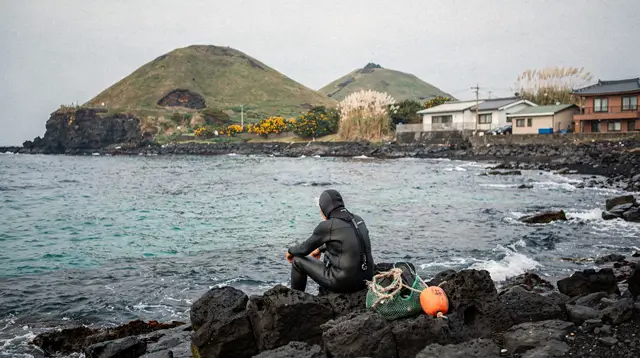
Some visitors extend a sunrise outing into a broader cultural morning — a haenyeo photoshoot experience near the east coast can be scheduled around the same early start, since haenyeo diving activity itself often begins in the morning hours. This kind of combined outing rewards an early wake-up with two distinctive Jeju experiences rather than just one, particularly for visitors specifically drawn to both the island’s landscape and its living cultural traditions.
Related guides

Best photography spots in Jeju
Jeju's best photography locations by region and time of day — waterfalls, basalt cliffs, sunrise peaks, and haenyeo culture, with gear and timing advice.

Jeju Instagram spots
Jeju's best Instagram spots — themed cafes, pink muhly fields, Hello Kitty Island, and coastal viewpoints — with honest notes on what's worth the trip.

Haenyeo photoshoot experience
Book a haenyeo photoshoot on Jeju: what the experience involves, cost, respectful etiquette, and how it fits alongside cultural sites like the Haenyeo

Hiking Seongsan Ilchulbong at Sunrise
Hiking Seongsan Ilchulbong for sunrise means an early start, a short but steep climb, and genuine crowds — here's how to plan it well.
Ready to book? Top tours for this guide
We earn a small commission if you book through GetYourGuide — at no extra cost to you. Every tour is hand-picked and verified.