
Manjanggul Lava Tube
What is Manjanggul and how long is the walkable section?
Manjanggul is a lava tube cave near Gimnyeong in east Jeju, formed roughly 200,000-300,000 years ago and part of the UNESCO Jeju Volcanic Island designation. About 1 kilometer of the roughly 7.4km total system is open to visitors, ending at a 7.6-meter lava column; entry costs around ₩4,000 (~US$3).
Manjanggul is the longest lava tube in South Korea and one of the longest in the world, a roughly 7.4-kilometer underground tunnel formed when a river of molten lava flowed out from an eruption and its outer surface cooled and hardened while the still-liquid interior drained away, leaving a hollow tube behind. It’s part of the UNESCO Jeju Volcanic Island and Lava Tubes World Natural Heritage designation, and unlike Seongsan Ilchulbong’s sun-exposed climb, a visit here means a cool, dim, echoing walk underground — a genuinely different kind of Jeju nature experience.
| Where | Near Gujwa, east Jeju, about 30-40 minutes from Jeju City |
| Cost | Around ₩4,000/adult (~US$3), reduced for children and teens |
| Time needed | 40-60 minutes for the walkable public section |
| Getting there | Rental car, infrequent bus, or guided transfer |
| Best time | Any season — it’s weather-independent; bring a light jacket year-round |
How the cave formed
Manjanggul formed somewhere between 200,000 and 300,000 years ago, during an eruption from the Geomunoreum volcanic cone several kilometers away. As lava flowed downhill toward the coast, its outer edges cooled and solidified into a hard shell while lava kept flowing through the interior; when the eruption ended and the remaining liquid lava drained out or flowed onward, it left behind a long hollow tunnel — the lava tube. The cave’s interior still shows the geological fingerprints of that process: ropy lava-flow textures on the floor and walls, lava stalactites and stalagmites formed by dripping molten rock, and shelf-like “lava rafts” left where the flow level dropped in stages.
What the walkable section actually looks like
Only about 1 kilometer of the cave’s roughly 7.4km total length is open to the public — the rest is preserved for research and conservation, home to a resident bat population and other cave-adapted species. The public section is a straightforward, flat, well-lit walking path (with some uneven natural rock underfoot in places), taking most visitors 40-60 minutes round trip at an unhurried pace. It ends at the cave’s signature feature: a roughly 7.6-meter lava column, the tallest known of its kind, formed where lava dripped from the ceiling and built up from the floor simultaneously until the two connected.
The temperature inside sits at a near-constant 11-21°C year-round regardless of the season outside, which means it feels refreshingly cool in Jeju’s hot, humid summer and noticeably cold relative to a mild spring or autumn day. Bring a light jacket even if it’s warm outside — this catches first-time visitors off guard more than almost anything else about the site.
Entry fees and opening hours
Entry costs around ₩4,000 for adults (roughly US$3), with reduced rates for children, teens, and Jeju residents. The cave typically opens in the morning and closes in the late afternoon, with last entry cutoff well before closing time to ensure everyone completes the walk — check current hours before visiting, since they can shift seasonally. Photography is generally permitted, though flash photography is sometimes restricted in sections to protect the cave’s bat population; look for posted signage inside.
Jeju: Private Transfer to Manjanggul Cave and Ticket bundles round-trip transport from central Jeju with entry, a practical option if you’re not renting a car specifically for this stop or don’t want to navigate parking near the entrance yourself.
Getting there
Manjanggul sits near the town of Gujwa in east Jeju, roughly 30-40 minutes from Jeju City and CJU airport by car, and about 20 minutes from Seongsan Ilchulbong. Public buses connect from Jeju City, though service is infrequent enough that most visitors combine a car rental or organized tour with other east Jeju sites rather than making a dedicated bus trip. Parking at the entrance is free and generally has enough capacity outside the busiest holiday weekends.
Is it accessible for kids and less mobile visitors?
The walkable path is mostly flat and manageable for most walking-capable visitors, including children, though the natural cave floor has uneven sections and can be slippery where moisture collects — not stroller-friendly, and challenging for wheelchairs or serious mobility limitations given the uneven surface and lack of a paved path throughout. Sturdy, closed-toe shoes are worth wearing regardless of age; sandals or flip-flops make the uneven, sometimes-damp floor uncomfortable and mildly risky.
What to bring
Beyond a light jacket for the constant cool temperature, a phone flashlight is a reasonable backup even though the main path has electric lighting — some sections are dimmer than others, and having a light handy makes footing easier on the more uneven stretches. Closed-toe shoes with decent grip matter more here than at most Jeju attractions, given the naturally uneven, occasionally damp cave floor. A small backpack or crossbody bag is more practical than a loose shoulder bag, since some sections narrow enough that a bulky bag can catch on the rock walls; leave anything you don’t need in the car rather than carrying excess weight through the uneven floor sections.
Pairing Manjanggul with other east Jeju sites
Manjanggul’s location in east Jeju makes it a natural stop alongside other volcanic and geological sites in the region. Seongsan Ilchulbong, about 20 minutes away, offers a striking contrast — sun-exposed summit views versus cool underground passages — and the two are commonly visited on the same day. Inland, Sangumburi Crater and Bijarim Forest round out a quieter geological loop, while Seopjikoji adds a coastal headland to the mix if you’re building a full day around east Jeju’s UNESCO cluster.
Jeju: Eastern UNESCO Tour with Haenyeo covers several of these sites together with a guide, including a haenyeo (sea women) cultural element, for visitors who’d rather not self-drive between each stop.
Guided visit or independent walk-through?
Manjanggul’s public walkway is well-signed enough that most visitors don’t need a guide to appreciate the cave’s main features — informational panels along the route explain the lava column, the ropy floor textures, and the cave’s formation in both Korean and English. A guided tour adds value mainly through transport logistics and the ability to pair the cave with other east Jeju sites in a single organized day, as with Jeju: Eastern UNESCO Tour with Haenyeo, rather than through deeper interpretation of the cave itself, which the on-site signage covers reasonably well for a self-guided visit.
Visiting with young children or older relatives
The cave’s mostly flat but naturally uneven floor makes it a moderate consideration for visitors with mobility concerns — manageable for most people who can walk unassisted for 40-60 minutes, but genuinely more effortful than a flat paved path given the natural rock surface and occasional damp patches. Young children generally do fine with the walk itself, though the darker, dimmer sections and echoing acoustics can be startling for the youngest visitors, worth mentioning beforehand rather than as a surprise partway through. Handrails are present in some but not all sections, so supervise children closely on the more uneven stretches near the far end of the walkway.
What’s near Manjanggul: Gimnyeong Maze Park and the coast
The nearby coastal town of Gujwa and neighboring Gimnyeong area have a scattering of smaller attractions — a maze park, quiet beaches, and cafés — that make sensible add-ons if you have time beyond the cave itself. None are essential, but they round out a half-day in the area if Manjanggul alone feels too short a stop to justify the drive out.
Photography inside the cave
The lit public walkway makes handheld photography possible without a tripod for most standard shots, though the dimmer stretches and the naturally dark stone surfaces mean images can come out grainier than outdoor photography on a phone camera — a bump in ISO or a slightly longer exposure helps if your camera allows manual adjustment. The lava column at the far end of the walk is the obvious focal point and the most-photographed single feature in the cave; arriving when the walkway is less crowded (weekday mornings tend to be quieter than weekend afternoons) makes it easier to get a clean shot without other visitors in frame. Wide-angle shots of the tunnel itself, capturing the scale and the ropy floor texture stretching into the distance, are also worth prioritizing over close-up detail shots if you only have time for a few photos.
Crowd patterns and the best time to visit
Manjanggul sees a fairly steady stream of visitors throughout the day rather than the sharp early-morning spike that defines a sunrise site like Seongsan Ilchulbong, but weekday mornings, particularly outside Korean school holidays, are noticeably quieter than weekend afternoons. Because the cave’s single walkway is a there-and-back route rather than a wide open space, crowding shows up mainly as slower-moving foot traffic near the lava column at the far end rather than a packed feeling throughout — arriving earlier in the day generally means a more comfortable pace rather than being funneled behind a slow-moving group in the narrower sections.
Seasonal notes
Manjanggul’s underground climate makes it one of the few Jeju attractions that’s genuinely weather-independent — rain, heat, or wind outside don’t affect the experience inside, which makes it a reliable backup plan on a poor-weather day when outdoor sites like Seongsan or the coastal cliffs are less appealing. That said, the near-constant cool interior temperature means it’s worth packing a layer regardless of when you visit, and summer visitors in particular should expect a noticeable temperature drop stepping inside from Jeju’s humid heat.
Geomunoreum: the source of the eruption
Manjanggul is one of several lava tubes connected to a single eruption from Geomunoreum, a volcanic cone several kilometers inland that’s the namesake of the wider Geomunoreum Lava Tube System — the broader UNESCO-listed complex that Manjanggul belongs to. Other tubes in the same system, including Bengdwigul and Gimnyeonggul, are not open to the public, which makes Manjanggul the only practically visitable part of this particular volcanic system. Understanding this bigger picture helps explain why Manjanggul carries UNESCO status specifically, rather than being recognized purely as an isolated cave: it’s the accessible showcase of a much larger underground network that geologists consider one of the best-preserved lava tube systems in the world.
The cave’s ecosystem
Beyond the geological formations, Manjanggul supports a small resident population of cave-adapted bats, along with other organisms specially adapted to the cave’s constant temperature and darkness — a detail that partly explains the restrictions on flash photography and access to the cave’s unopened sections. Visitors sometimes catch a glimpse of bats near the entrance area, particularly at dusk, though sightings during a standard daytime visit through the lit public walkway are less common. The cave’s microclimate also supports certain mineral formations distinct from limestone caves elsewhere in Korea, since lava tubes form through an entirely different process than the dissolution that creates limestone stalactites.
Facilities and practical logistics
The visitor area near the Manjanggul entrance includes restrooms, a small parking lot, and basic signage in Korean and English explaining the cave’s formation and key features along the route. There’s minimal food service directly at the site — pack a snack or plan to eat in nearby Gujwa or Gimnyeong before or after your visit rather than expecting on-site dining options. Lockers are sometimes available near the entrance for visitors who don’t want to carry bags through the uneven cave floor sections, though availability can vary.
Manjanggul versus Seongsan Ilchulbong at a glance
| Manjanggul | Seongsan Ilchulbong | |
|---|---|---|
| Setting | Underground, cool and dim | Outdoor summit climb, sun-exposed |
| Time needed | 40-60 minutes | 1-1.5 hours round trip |
| Weather dependency | None — same experience year-round | High — best at sunrise, clear days |
| Entry | ~₩4,000 | Separate entry fee, timed for sunrise |
| Good pairing | Combine same day, about 20 minutes apart | Combine same day, about 20 minutes apart |
Comparing Manjanggul to other lava tubes on Jeju
Jeju has several other lava tube systems beyond Manjanggul, most notably the smaller, more compact Ssangyong Cave at Hallim Park in west Jeju. If you’re based in west Jeju and don’t want to make the drive east, Hallim Park’s caves offer a scaled-down version of the same underground lava-tube experience, though without Manjanggul’s scale or its tallest-known lava column. For visitors with time to see only one lava tube on their trip, Manjanggul remains the more complete and geologically significant choice given its UNESCO status and larger public walking section.
An honest take
Manjanggul is worth the detour, but manage expectations about scale relative to what’s shown in photographs: a kilometer of walkable tunnel is enough to feel the scale and see the lava column, but it’s a single, out-and-back walk rather than a sprawling underground network you explore at will — the remaining 6+ kilometers are closed to protect the ecosystem, and there’s no way around that even for the curious. If you’re expecting a vast adventure-caving experience, this is a managed, well-lit walking path instead; it’s still one of the more distinctive and least crowded of Jeju’s major sights, and a genuinely worthwhile hour if you’re already in east Jeju.
Frequently asked questions about Manjanggul
How long does a Manjanggul visit take?
The walkable public section takes most visitors 40-60 minutes round trip at a relaxed pace, plus time for photos at the lava column at the far end.
How cold is it inside the cave?
The interior stays at a fairly constant 11-21°C year-round. Bring a light jacket regardless of the season outside — this is the single most common thing visitors forget.
Is Manjanggul suitable for young children?
Generally yes, given the mostly flat path, though the natural cave floor has uneven and sometimes damp sections that require supervision for younger kids, and it isn’t stroller-accessible throughout.
Do I need to book tickets in advance?
No advance booking is required for independent visits — tickets are sold at the entrance. Advance booking mainly matters if joining a guided tour with transport, given limited daily capacity on some tour departures.
How does Manjanggul compare to Seongsan Ilchulbong?
They’re different experiences entirely — Seongsan is an outdoor climb to a summit viewpoint, while Manjanggul is a cool, flat underground walk. Many visitors do both on the same day since they’re about 20 minutes apart.
Can I see the entire 7.4km lava tube?
No — only about 1 kilometer is open to the public. The remainder is preserved for research and to protect the cave’s bat population and geological formations.
Is Manjanggul a good rainy-day activity?
Yes, it’s one of the best weather-independent options on Jeju, since the entire experience is underground and unaffected by rain, wind, or heat outside.
Are there restrooms and facilities at Manjanggul?
Yes, basic restrooms and a small parking area sit near the entrance, along with informational signage, but there’s minimal on-site food service — plan to eat before or after your visit in nearby Gujwa or Gimnyeong.
How far is Manjanggul from Jeju City?
Roughly 30-40 minutes by car, and about the same distance from CJU airport, making it a manageable half-day trip from either.
Is Manjanggul part of a larger cave system?
Yes — it’s the publicly accessible section of the wider Geomunoreum Lava Tube System, formed by a single ancient eruption from the Geomunoreum volcanic cone. Other tubes in the same system aren’t open to visitors.
Are there bats inside Manjanggul?
Yes, a small resident bat population lives in the cave, which is part of why flash photography is restricted in some sections and why the majority of the tube’s length remains closed to protect their habitat.
Related guides
Seongsan Ilchulbong (Sunrise Peak)
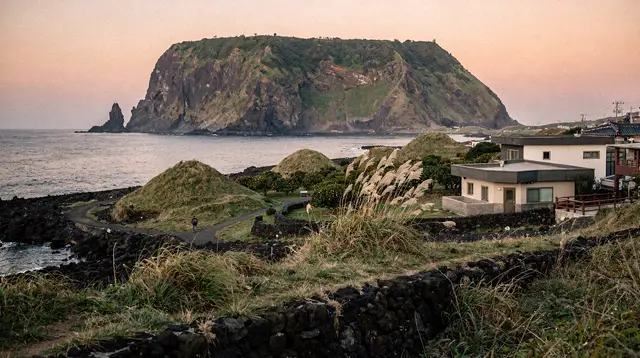
Seongsan Ilchulbong is Jeju's UNESCO volcanic tuff cone. Gate hours, sunrise timing by month, entry fees, and the climb itself, honestly assessed.

Bijarim Forest
Bijarim Forest is a nutmeg-yew grove in east Jeju with trees over 800 years old, walkable on flat trails. Entry fees, trail lengths, best times to visit.

Sangumburi Crater
Sangumburi is a rare flat-floored maar crater near Seongsan, walkable via boardwalk with grassland views and far fewer crowds than Jeju's headline sites.

Camellia Hill
Camellia Hill is a 6,000-tree camellia garden in west Jeju, at its best from November through March. Bloom timing, entry fees, and what else to see there.
Ready to book? Top tours for this guide
We earn a small commission if you book through GetYourGuide — at no extra cost to you. Every tour is hand-picked and verified.
JEJU: UNESCO Mt Halla & South Jeju Coastal Wonders Day Tour

Jeju: Private Transfer to Manjanggul Cave and Ticket

Jeju: Spirited Garden Entry Ticket

Jeju West: Small Group Healing Tour w/Caves & Dolphins
Jeju Island: Sunrise Guided Tour with Hotel Pickup
