
Sangumburi Crater
What makes Sangumburi Crater different from Seongsan Ilchulbong?
Sangumburi is a maar crater — flat-floored rather than cone-shaped, formed by a phreatomagmatic explosion rather than a lava-building eruption. It's inland in east Jeju, reached via a boardwalk trail, with a grassland-covered crater floor and noticeably thinner crowds than Seongsan.
Sangumburi is one of Jeju’s least-visited natural monuments relative to how geologically distinctive it actually is: a maar crater, meaning it formed through a single explosive steam eruption when rising magma met groundwater, rather than through the slower buildup of lava or ash that shapes most of Jeju’s other volcanic cones. The result is a wide, flat-floored depression rather than a raised cone — visually the opposite of what most visitors picture when they hear “crater,” and part of why it’s easy to underestimate from photos alone.
| Where | Inland east Jeju, 15-20 min from Seongsan Ilchulbong |
| Cost | Around ₩4,000 for adults |
| Time needed | 30-50 minutes (flat boardwalk loop) |
| Crowds | Noticeably lighter than Seongsan Ilchulbong |
| Getting there | Rental car or organized tour; no direct bus |
What a maar crater actually is
Most of Jeju’s volcanic landforms are either shield volcanoes (Hallasan itself, built from slow, layered lava flows) or tuff cones (Seongsan Ilchulbong, built from explosive ash deposits piling into a cone shape). A maar crater forms differently: a single violent explosion, triggered when hot magma contacts groundwater and flashes it to steam, blasts out a roughly circular depression without building much of a surrounding cone. Sangumburi is a textbook example, and one of the better-preserved maar craters in the country — designated a Natural Monument for its geological and ecological value.
The crater itself is roughly 2 kilometers in circumference and about 100 meters deep, its floor and inner slopes covered in native grassland rather than water or forest, home to over 400 recorded plant species across its microclimates. Unlike a crater lake, there’s no water feature to see — the appeal here is the landform itself and the grassland ecosystem it hosts, along with the quiet.
The boardwalk trail
Sangumburi is accessed via a well-maintained boardwalk and gravel path circling above the crater rim, giving visitors views down into the depression without descending into it — entry to the crater floor itself is restricted to protect the grassland habitat. The full loop takes most visitors 30-50 minutes at an easy pace, flat and low-effort compared to the climb at Seongsan Ilchulbong, making it a genuinely relaxed alternative for visitors who want geological interest without the exertion.
Entry costs around ₩4,000 for adults (roughly US$3), with discounts for children, teens, and seniors. Opening hours generally run from morning through early evening, with seasonal adjustments — check current hours before visiting, particularly in winter when daylight is shorter. Tickets are sold at a small booth near the entrance, and both cash and card are generally accepted; there’s rarely a meaningful queue given the site’s lower visitor numbers compared to Jeju’s more heavily trafficked attractions, so arriving without advance planning is a reasonable approach here in a way it isn’t for a sunrise visit to Seongsan Ilchulbong.
Why it’s quieter than Seongsan
Sangumburi sits inland rather than on the coast, has no sunrise-viewing tradition to draw predawn crowds, and lacks the same instantly recognizable silhouette that makes Seongsan Ilchulbong a magnet for Korean domestic tourism and social media. The result is a site that gets a fraction of Seongsan’s visitor numbers even in peak season, which for many travelers is exactly the appeal — a chance to experience Jeju’s volcanic geology without elbowing through crowds for a viewpoint. If you’ve already done Seongsan and want a second, calmer crater experience, or if crowds at major sites have worn you down, Sangumburi is a deliberate antidote.
Photography at Sangumburi
Because the crater floor is broad and open rather than dramatically vertical, the most effective photographs tend to be wide shots taken from elevated points along the boardwalk that capture the sweep of the grassland basin rather than close-in details. Autumn light, when the grass has turned gold-brown, produces the most striking contrast against a blue sky, and shooting in the late afternoon when the sun is lower tends to bring out texture in the grassland that flat midday light flattens out. Unlike Seongsan Ilchulbong, there’s no single iconic “money shot” angle that dominates promotional photography of Sangumburi — this is a site that rewards exploring the boardwalk’s various vantage points rather than rushing to one specific spot.
A good stop for a slower-paced day
Sangumburi works particularly well for travelers building a deliberately unhurried day in east Jeju — pairing it with a relaxed lunch in a nearby town and a quiet afternoon rather than trying to cram it between two more demanding, crowd-heavy sites. Its short, flat loop and low visitor numbers make it one of the easier places on the island to simply slow down, sit on a bench along the boardwalk, and take in the grassland view without the sense of being rushed along by other visitors that’s common at Jeju’s more popular sights.
Travelers who prefer a guided, unhurried rhythm may like an east Jeju tour designed for people who walk at a relaxed pace, which fits the character of this stop well. To place the day in a wider plan, the east Jeju itinerary and the east Jeju day tour guide show how it can sit alongside Seongsan and the nearby oreum hiking guide options.
Getting there
Sangumburi sits inland in east Jeju, roughly 30-40 minutes from Jeju City by car and about 15-20 minutes from Seongsan Ilchulbong. There’s no meaningful public bus service directly to the site, which makes a rental car or organized tour the practical way to visit — this is one of the harder east Jeju sites to reach car-free. Parking is available at the entrance and rarely fills up given the lower visitor volume.
Best time of day to visit
Because Sangumburi has no sunrise tradition and no dramatic lighting requirement the way Seongsan Ilchulbong does, almost any time of day works reasonably well here — a genuinely flexible stop compared to sites that demand a specific time slot. That said, late afternoon light tends to bring out the texture of the grassland most effectively, and visiting outside the small midday tour-bus window (when a handful of organized day tours tend to pass through together) offers the quietest experience if solitude matters to you.
Pairing Sangumburi with other east Jeju sites
Sangumburi combines naturally with Bijarim Forest, a similarly quiet, similarly inland site about 15-20 minutes away, for a half-day of low-crowd nature sights away from the coastal headliners. It also sits within reasonable driving distance of Manjanggul Lava Tube and Seongsan Ilchulbong, making it easy to slot into a fuller east Jeju day if you’re already covering the region’s UNESCO sites and want one more inland stop that doesn’t require another paid tour or major detour.
Seasonal notes
Sangumburi’s grassland changes character noticeably across the seasons — green and lush in summer, turning gold-brown through autumn (a particularly photogenic period as the grass catches low-angle light), and pale and dormant in winter. Spring brings fresh growth and wildflowers along the boardwalk edges. Unlike coastal sites, Sangumburi is relatively sheltered from wind given its inland position and the surrounding terrain, making it a slightly more comfortable stop on a blustery day than an exposed coastal cliff.
How Sangumburi fits into a broader east Jeju itinerary
Travelers building a multi-day east Jeju itinerary often treat Sangumburi as a deliberate palate-cleanser between more intense stops — a short, low-effort visit that breaks up a day otherwise spent climbing Seongsan Ilchulbong, walking the length of Manjanggul’s lava tube, or navigating crowds at Seopjikoji. Because it requires so little physical effort and takes under an hour including the drive time from most east Jeju bases, it slots easily into a half-day plan without displacing a more substantial activity. Some visitors specifically save it for a day when they’re feeling worn out from more strenuous sightseeing but still want to see something rather than resting entirely.
History of the site’s protection
Sangumburi’s Natural Monument designation dates back several decades, reflecting an early recognition — well before Jeju’s UNESCO Global Geopark status was formalized in 2010 — that the site’s maar crater formation was scientifically significant enough to warrant protection distinct from ordinary parkland. This early designation is part of why the crater has remained relatively undeveloped compared to some of Jeju’s other natural sites: strict protections have limited commercial development around the crater rim, preserving both the geological feature and its surrounding grassland habitat largely in their natural state, with infrastructure limited to the boardwalk, a small visitor center, and parking.
What to bring
Given the flat, boardwalk-based walking, ordinary walking shoes are entirely sufficient — no need for the sturdier footwear that helps at Manjanggul or the steeper climb at Seongsan. Sun protection is worth carrying regardless of season, since the boardwalk loop offers minimal shade. There’s a small visitor facility near the entrance with basic amenities, but not much in the way of food options, so plan meals around a stop in a nearby town rather than expecting much on-site.
Conservation status and why it’s protected
Sangumburi has been designated a Natural Monument by the Korean government, a status that reflects both its geological rarity as a well-preserved maar crater and the ecological value of its grassland habitat, which supports species not found in comparable density elsewhere on the island. This protection is the direct reason visitors can’t descend into the crater itself — unlike a purely scenic restriction, the closure exists to prevent trampling and disturbance to a genuinely rare plant community that has developed in relative isolation on the crater’s inner slopes and floor. Researchers occasionally conduct fieldwork within the restricted zone, another reason the boardwalk-only access policy is enforced fairly strictly compared to some of Jeju’s less formally protected sites.
The visitor center and what it offers
A small visitor center near the entrance provides basic orientation, including information panels explaining the maar crater formation process and the site’s ecological significance, generally in both Korean and English. It’s a useful five-minute stop before starting the boardwalk loop if you want context for what you’re looking at, though it’s not an extensive museum-style exhibit — treat it as a supplement to the walk rather than a destination in its own right. Basic restroom facilities are available here as well.
Comparing Sangumburi to Jeju’s other craters
Jeju has several notable crater-type landforms, each formed through a different volcanic process. Seongsan Ilchulbong is a tuff cone, built from explosive ash deposits into a raised, climbable cone shape. Sangumburi, by contrast, is a maar — a flat-floored depression from a single steam explosion. This distinction matters for visitors trying to decide which sites to prioritize: if you want a dramatic, climbable landform with sweeping coastal views, Seongsan is the better choice; if you’re drawn to a quieter, more scientifically distinctive landform and don’t mind a subtler visual payoff, Sangumburi offers something genuinely different rather than a lesser version of the same experience.
Wildlife and plant life
Beyond the over 400 recorded plant species within the crater’s varying microclimates — shaded slopes, sun-exposed grassland, and damper low-lying sections all support slightly different plant communities — Sangumburi’s relative quiet and protected status make it a reasonable spot for birdwatching, particularly in spring and autumn migration periods, though it isn’t specifically marketed or equipped as a birdwatching site. Visitors with a botanical interest may want to allow extra time at the interpretive signage points along the boardwalk, which highlight some of the more notable or unusual plant species visible from the path.
An honest take
Sangumburi won’t produce the dramatic photographs that Seongsan Ilchulbong does, and visitors expecting a comparably jaw-dropping landform will likely leave a little underwhelmed — this is a subtler, flatter site that rewards an interest in geology and quiet grassland scenery more than a demand for spectacle. For travelers who’ve already ticked off Jeju’s headline volcanic sights and want something calmer, or who simply prefer low-crowd nature over crowded viewpoints, it’s a genuinely worthwhile hour. Going in with the right expectations — quiet and understated rather than dramatic — is the key to enjoying it on its own terms.
Sangumburi in the context of a broader Jeju trip
For travelers building an itinerary around Jeju’s UNESCO Global Geopark network specifically — rather than just the headline World Natural Heritage sites of Hallasan, Seongsan Ilchulbong, and the Geomunoreum lava tube system — Sangumburi is one of the supporting sites worth including to get a fuller picture of the range of volcanic landforms the island’s geopark designation actually covers. It’s a reasonable stop for visitors with a specific interest in geology or in seeing beyond the standard highlight reel, even if it isn’t essential for travelers with more limited time and a narrower set of priorities.
Sangumburi at a glance across the seasons
| Season | Grassland appearance | Comfort | Notes |
|---|---|---|---|
| Spring | Fresh green, wildflowers along boardwalk edges | Comfortable | Good light, low crowds |
| Summer | Deep green | Warm, minimal shade on loop | Sun protection worth carrying |
| Autumn | Gold-brown | Comfortable | Most photogenic light, especially late afternoon |
| Winter | Pale, dormant | Sheltered relative to coastal sites | Shorter daylight; check hours |
Combining Sangumburi with a rainy-day plan
Because the boardwalk loop is short, flat, and largely uncovered, Sangumburi is a fair-weather stop rather than a rainy-day fallback — heavy rain makes the walk unpleasant without much shelter along the route. On a wet day, an indoor alternative such as Manjanggul Lava Tube or one of the island’s museums makes more sense, saving Sangumburi for a clearer day when the grassland and light are actually worth the detour. The Jeju rainy day activities guide covers more indoor options for exactly this kind of weather call.
Visiting without a rental car
Sangumburi is genuinely one of the harder east Jeju nature sites to reach without your own vehicle, since no direct bus route serves the entrance and the inland location puts it beyond comfortable taxi or walking range from Seongsan or other coastal towns. Some general east Jeju day tours cover this inland stretch alongside coastal UNESCO sites — worth checking the specific itinerary before booking, since coverage varies by operator:
Jeju: East Full-Day Bus Tour with Entry Fees IncludedIf you would rather not share a bus, a private transfer based around the Seongsan area can also give you a driver for the inland leg, which suits anyone who wants to leave the wheel to someone else. For driving rules and permits, see the car rental and IDP guide, and for the other options, the Jeju bus guide and the Kakao T taxi guide.
For travelers with more flexibility, a rental car remains the simplest way to guarantee Sangumburi fits into a self-timed east Jeju day alongside Bijarim Forest, Manjanggul, and Seongsan Ilchulbong.
Facilities on site
Beyond the small visitor center and basic restrooms near the entrance, don’t expect much in the way of amenities — no restaurant, no gift shop of note, and minimal shelter along the boardwalk itself, all consistent with a lightly developed Natural Monument rather than a commercially built-out attraction.
A realistic budget for a Sangumburi stop
Beyond the roughly ₩4,000 entry fee, a Sangumburi visit costs little else — there’s minimal on-site food or shopping to spend money on, which makes it one of the cheaper hour-long stops on the island. Parking is included with entry and rarely requires a separate fee, unlike some of Jeju’s more developed paid attractions. Travelers on a tight Jeju budget looking for low-cost ways to fill an inland afternoon will find Sangumburi one of the better value stops on the east side of the island precisely because there’s little incentive to overspend once you’re there.
How Sangumburi’s boardwalk compares to other easy Jeju walks
For travelers specifically seeking a low-effort, flat walk rather than a climb, Sangumburi sits alongside sites like Seopjikoji as one of the gentler options on the island — no stairs, no significant elevation change, and a surface suited to ordinary walking shoes rather than hiking gear. This makes it a reasonable choice for travelers with mobility considerations or simply a day already packed with more strenuous stops like Seongsan Ilchulbong or Hallasan who want a lower-intensity site to balance the day.
Frequently asked questions about Sangumburi Crater
How is Sangumburi different from a typical volcanic crater?
It’s a maar crater, formed by a single explosive steam eruption rather than the slow buildup of lava or ash — the result is a flat-floored depression rather than a raised cone, and there’s no crater lake or dramatic rim to climb.
Can I walk down into the crater?
No, the crater floor is off-limits to protect its grassland ecosystem. Visitors view it from the boardwalk and path circling the rim above.
How long does a visit take?
Most visitors complete the full boardwalk loop in 30-50 minutes at an easy, flat pace — considerably less strenuous than the climb at Seongsan Ilchulbong.
Is Sangumburi worth visiting if I’ve already seen Seongsan Ilchulbong?
Yes, if you’re interested in geology or want a quieter, less crowded contrast to Seongsan’s crowds — the two sites showcase genuinely different volcanic processes.
Can I get to Sangumburi by public bus?
Not practically — there’s no direct, frequent bus service, so a rental car or organized tour is the realistic way to visit.
What’s the best season to visit?
Autumn, when the grassland turns gold-brown and catches the low afternoon light well, though the site is pleasant in any season given its inland, relatively sheltered position.
Is there food or dining near Sangumburi?
Very limited on-site — plan to eat before or after your visit in a nearby town rather than relying on facilities at the crater itself.
Why can’t I walk into the crater at Sangumburi?
The crater floor and inner slopes are protected as a Natural Monument to preserve a rare grassland plant community that has developed there — walking access is restricted to prevent trampling and disturbance.
Is Sangumburi suitable for a family with young children?
Yes, the flat boardwalk loop is low-effort and safe for most children, though the lack of dramatic scenery compared to sites like Seongsan Ilchulbong may make it less engaging for kids expecting a more visually exciting stop.
Is Sangumburi part of Jeju’s UNESCO Global Geopark network?
Yes, it’s included among the sites recognized under Jeju’s UNESCO Global Geopark status, which encompasses a broader network of geologically significant locations across the island beyond the core World Natural Heritage sites like Hallasan and Seongsan Ilchulbong.
How does the grassland at Sangumburi change with the seasons?
It shifts from green in spring and summer to a gold-brown color through autumn — a particularly photogenic period — before turning pale and dormant in winter, similar to the seasonal grassland changes seen at Jeju’s oreums.
Related guides

Manjanggul Lava Tube
Manjanggul is Korea's longest lava tube, a UNESCO site near Gimnyeong. Opening hours, entry fees, what the walkable section actually looks like.
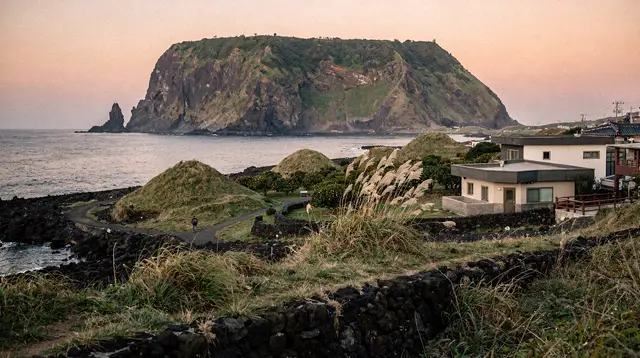
Seongsan Ilchulbong (Sunrise Peak)
Seongsan Ilchulbong is Jeju's UNESCO volcanic tuff cone. Gate hours, sunrise timing by month, entry fees, and the climb itself, honestly assessed.

Bijarim Forest
Bijarim Forest is a nutmeg-yew grove in east Jeju with trees over 800 years old, walkable on flat trails. Entry fees, trail lengths, best times to visit.

Saebyeol Oreum
Saebyeol Oreum is a grassy volcanic cone near Hallasan popular for sunset hikes. Trail length, difficulty, and why it's a quieter alternative to Seongsan.
Ready to book? Top tours for this guide
We earn a small commission if you book through GetYourGuide — at no extra cost to you. Every tour is hand-picked and verified.
JEJU: UNESCO Mt Halla & South Jeju Coastal Wonders Day Tour
Jeju: Private Transfer to Manjanggul Cave and Ticket

Jeju: Spirited Garden Entry Ticket

Jeju West: Small Group Healing Tour w/Caves & Dolphins
Jeju Island: Sunrise Guided Tour with Hotel Pickup
