
Bijarim Forest
What is Bijarim Forest and how long does it take to walk?
Bijarim Forest is a nutmeg-yew (bija) tree grove in east Jeju, home to over 2,800 trees, some over 800 years old, on flat, well-marked trails. The short loop takes about 30 minutes, the longer loop closer to an hour; entry costs around ₩3,000 (~US$2.20).
| Where | Inland east Jeju, ~30-40 min from Jeju City |
| Cost | Around ₩3,000 adults |
| Time needed | 30 min (short loop) to 45-60 min (long loop) |
| Getting there | Rental car or tour; no practical direct bus |
| Best time | Year-round (evergreen); shade helps on hot summer days |
Bijarim Forest is one of Jeju’s quieter natural attractions and also one of its most botanically unusual: a dense grove of over 2,800 nutmeg-yew (bija) trees, the largest single-species forest of its kind in the world, with some individual trees estimated at more than 800 years old. It sits inland in east Jeju, a short drive from the region’s more famous volcanic sights, and offers a genuinely different kind of nature experience — cool, shaded, and slow-paced rather than the open, sun-exposed landscapes at Seongsan or Sangumburi. For visitors who’ve spent a few days working through Jeju’s headline coastal and volcanic sights, Bijarim often lands as an unexpectedly memorable stop precisely because it asks so little of you: no climb, no crowds jostling for a viewpoint, just a quiet walk beneath trees that have been standing since well before the island’s modern tourism industry existed.
What makes the forest distinctive
The nutmeg-yew (Torreya nucifera) is a slow-growing conifer that can live for centuries, and Bijarim’s concentration of ancient specimens — some with trunks wide enough that multiple people are needed to encircle them — makes it a genuine botanical rarity rather than just a pleasant woodland walk. The oldest tree in the forest, estimated at around 800-830 years, is a designated highlight along the main trail, along with several other centuries-old specimens marked with informational signage. Beneath the yew canopy, the forest floor supports ferns, mosses, and understory plants that thrive in the shaded, humid microclimate the dense tree cover creates.
Trail options and how long to allow
Bijarim offers two main loop options: a shorter route of roughly 900 meters (about 30 minutes at an easy pace) that covers the forest’s core ancient-tree section, and a longer loop of around 1.5 kilometers (closer to 45-60 minutes) that extends further into secondary forest and a section with volcanic rock features. Both trails are flat, well-marked, and surfaced with a mix of packed earth and boardwalk sections — genuinely easy walking suitable for most fitness levels and reasonably manageable with a stroller on the shorter loop, though tree roots create some uneven patches to watch for.
Entry fees and opening hours
Entry costs around ₩3,000 for adults (roughly US$2.20), with reduced rates for children, teens, and seniors. The forest typically opens in the morning and closes in the early evening, with hours adjusted seasonally for daylight — check current times before visiting, especially in winter. There’s a small visitor center near the entrance with basic facilities.
What to expect at the entrance and visitor facilities
A small visitor center and ticket booth sit at the forest entrance, with basic restroom facilities and limited seating available before you start either loop. There’s minimal food service on-site — a vending machine or small snack stand is sometimes available, but not a proper restaurant, so plan a meal in a nearby town before or after your visit rather than counting on eating here. Maps showing the two loop options and their approximate lengths are typically posted near the entrance, useful for deciding between the shorter and longer routes before committing.
Getting there
Bijarim sits inland in east Jeju, roughly 30-40 minutes by car from Jeju City and about 15-20 minutes from Sangumburi Crater. As with Sangumburi, there’s no practical direct bus route, making a rental car or organized tour the realistic way to visit. Parking at the entrance is free and rarely crowded outside of Korean holiday periods.
Jeju: Eastern UNESCO Tour with Haenyeo covers Bijarim alongside other east Jeju sites for visitors who’d rather join a guided day rather than self-drive between each inland stop.
Why it’s worth the detour
Compared to Jeju’s headline coastal sights, Bijarim doesn’t offer dramatic ocean views or a striking silhouette to photograph from a distance — its appeal is more contemplative: walking slowly among trees that predate the founding of most modern nations, in a quiet, shaded setting that’s a deliberate change of pace from the island’s sun-drenched coastal attractions. On a hot summer day, the forest’s shade and slightly cooler microclimate also make it one of the more comfortable outdoor stops on the east side of the island.
Pairing Bijarim with nearby sites
Bijarim combines naturally with Sangumburi Crater, about 15-20 minutes away, for a half-day loop of quieter, inland east Jeju nature sights. It’s also within reasonable range of Manjanggul Lava Tube and Seongsan Ilchulbong, making it easy to add to a fuller day covering the region’s UNESCO cluster if you have a car and want one more stop that doesn’t require significant extra driving.
Photography in a shaded forest
Bijarim’s dense canopy creates a genuinely different photography challenge than Jeju’s open coastal and grassland sites — dappled, filtered light rather than direct sun, which can produce attractive, soft-edged images of the ancient trees but requires a bit more care with exposure than a bright outdoor shot. Midday, when the sun is more directly overhead, tends to filter through the canopy more evenly than early morning or late afternoon, when longer shadows can create harsher contrast between lit and shaded patches on the forest floor. The oldest, widest trees near the start of the main loop are the most obvious subjects, but don’t overlook the smaller details — moss-covered roots, fern clusters, and the reddish bark texture up close — that are easy to miss if you’re focused only on capturing the whole tree.
Comparing Bijarim to Jeju’s other forested areas
Jeju has other wooded areas, including sections of Hallasan’s lower slopes and scattered oreum forests, but none match Bijarim’s specific character as a single-species old-growth grove managed as a dedicated, ticketed attraction. Hallasan’s forested trail sections are typically experienced as part of a longer hike toward the summit rather than as a destination in themselves, while Bijarim is designed around a leisurely, standalone walk with no elevation gain or hiking commitment required. For visitors who want the sensory experience of an old forest — quiet, shaded, humid — without committing to a longer hike, Bijarim is the more purpose-built option.
A note on quiet and pace
Bijarim rewards a slower pace more than almost any other stop covered in this guide series. Because there’s no single dramatic viewpoint or photo opportunity that draws visitors to rush toward one spot, as at Seongsan Ilchulbong or Sanbangsan, the appeal here is genuinely in the walking itself — the quality of the quiet, the smell of the forest floor after rain, the scale of trees that have stood for centuries. Visitors who treat it as a box to check quickly, rushing through the shorter loop in fifteen minutes, tend to get noticeably less out of the experience than those who slow down and actually spend the recommended 30-plus minutes taking it in.
Seasonal notes
Bijarim is a genuinely year-round destination given its status as an evergreen forest — the yew canopy doesn’t change dramatically with the seasons the way deciduous forests do, which means it’s a reliable option regardless of when you visit. Winter brings a milder, more sheltered feel than exposed coastal sites given the tree cover, while summer offers welcome shade from Jeju’s heat. Rain doesn’t meaningfully disrupt a visit either, since the canopy provides some natural cover, though the trail surface can get slippery in wet conditions.
What to bring
Ordinary walking shoes are sufficient for both trail options, though something with grip is worth it after rain given the occasional slick boardwalk sections and exposed tree roots. Given the forest’s shade, sun protection matters less here than at coastal or grassland sites, but insect repellent is worth carrying in summer, when the humid understory can attract mosquitoes.
The nutmeg-yew tree, explained
The Torreya nucifera, known locally as bija, is a slow-growing evergreen conifer native to East Asia, prized historically for its seeds, which were pressed for oil and used in traditional Korean medicine and cooking. Bijarim’s concentration of over 2,800 mature specimens across roughly 448,000 square meters makes it the largest single-species forest of its kind anywhere, a designation that reflects both the tree’s naturally slow growth rate — reaching maturity over centuries rather than decades — and the long, undisturbed history of this particular tract of land. Individual trees are identifiable by their reddish-brown, deeply furrowed bark and dense, needle-like foliage, distinct from the pines and cedars found in other parts of Jeju’s forested interior.
Designation and conservation
Bijarim Forest holds Natural Monument status in recognition of both its unique concentration of ancient nutmeg-yew trees and its ecological role as a relatively undisturbed old-growth forest ecosystem — increasingly rare on an island that has seen significant agricultural and tourism development pressure over the past several decades. This protected status is part of why the forest has been maintained as a managed, ticketed site with defined trails rather than left as an unregulated woodland open to unrestricted access, helping preserve both the ancient trees themselves and the understory ecosystem that depends on the stable, shaded microclimate they create.
What the forest floor looks like up close
Beneath the yew canopy, Bijarim’s understory supports a distinct community of ferns, mosses, and shade-tolerant plants that thrive in the humid, low-light conditions created by the dense tree cover overhead — a noticeably different plant community from the open grassland at nearby Sangumburi or the exposed slopes of Jeju’s coastal oreums. Volcanic rock outcrops appear along some sections of the longer trail loop, a reminder that even this quiet forest sits atop the same volcanic geology that shapes the rest of the island. Informational signage at several points along both trails identifies notable trees and explains some of the forest’s ecological features for visitors interested in more than a casual walk.
Guided visits versus walking independently
Bijarim’s trails are well-marked enough that most visitors navigate comfortably without a guide, using the signposted route markers and the two clearly defined loop options. A guided visit through Jeju: Eastern UNESCO Tour with Haenyeo adds value mainly by bundling transport and pairing the forest with other east Jeju sites in a single day, rather than through significantly deeper interpretation than the on-site signage already provides — a reasonable option if you’re not renting a car, less essential if you are.
Visiting with children or less mobile travelers
The shorter loop’s mostly flat, boardwalk-supported surface makes Bijarim one of the more accessible nature sites on this list for families with young children or visitors with moderate mobility concerns, though exposed tree roots create occasional uneven patches worth watching for, especially with younger kids prone to running ahead. The longer loop extends into less consistently smooth terrain and isn’t recommended for strollers. Benches are placed at intervals along both routes, useful for older visitors who want to pause periodically rather than complete either loop without a break.
An honest take
Bijarim is a low-key attraction by Jeju’s standards, and visitors chasing dramatic landscape photography or must-see bucket-list energy may find it underwhelming relative to Seongsan or the coastal cliffs. But for anyone genuinely interested in the trees themselves — their age, their rarity as a concentrated single-species grove — or simply looking for a quiet, shaded walk away from crowds, it delivers exactly what it promises without overselling itself. It’s a supporting attraction rather than a headline one, and best approached with that framing rather than as a must-do centerpiece of an east Jeju day.
Noise and silence as part of the experience
One detail that’s easy to overlook in a written description but immediately obvious on the ground: Bijarim Forest is genuinely quiet in a way few other Jeju attractions are, given the sound-dampening effect of dense tree cover combined with lower visitor numbers than the island’s headline sites. Birdsong and the rustle of wind through the yew canopy are often the loudest sounds along the trail outside of peak holiday periods, a sensory quality that’s part of what makes the forest memorable to visitors who take the time to actually notice it rather than treating the walk as a quick box to check.
Combining Bijarim with a full-day east Jeju itinerary
For visitors building a full day around east Jeju’s geological and volcanic sights, Bijarim works best as a mid-day or late-afternoon stop after the more physically demanding activities — a climb at Seongsan Ilchulbong, a walk through Manjanggul — rather than as a starting point, since its calm, unhurried pace suits a slower final stretch of the day better than an opening activity. Ending a busy east Jeju day with a quiet walk among centuries-old trees is a genuinely pleasant way to wind down before heading back to your accommodation.
Weather and rain planning
Because the yew canopy offers meaningful natural cover, Bijarim is one of the more rain-tolerant outdoor stops on the island — a light shower rarely forces a change of plans the way it would at an exposed site like Seongsan Ilchulbong’s crater climb. Heavier rain does make the boardwalk sections and exposed tree roots slicker, so slower, more deliberate footing is worth adopting in wet conditions rather than moving at the pace you’d use on a dry day. If typhoon-season weather (late August-September) is genuinely severe rather than a light shower, treat Bijarim the same as any other outdoor site and check current conditions before heading out, since the forest can still close during serious storms even though normal rain rarely disrupts a visit.
How the entry fee compares to nearby paid nature sites
Bijarim’s ₩3,000 entry fee sits at the lower end of Jeju’s paid nature attractions, cheaper than the average admission at Sangumburi Crater or Manjanggul Lava Tube, reflecting both its lighter infrastructure and its positioning as a supporting rather than headline stop. For a family or larger group stacking several paid inland stops into one east Jeju day, the relatively low individual costs add up more gently than a coastal day built around bigger-ticket attractions like Aqua Planet, which is worth keeping in mind when budgeting a full day trip rather than assuming every stop carries similar cost.
Fitting Bijarim into a broader inland-nature day
Beyond the Sangumburi pairing already covered, visitors with a deeper interest in Jeju’s inland, less-photographed nature spots can extend the day with a stop at Saebyeol Oreum for an easy volcanic-cone climb with panoramic views, a genuinely different pace and payoff from Bijarim’s flat, shaded walk. Together, the three sites — Bijarim, Sangumburi, and Saebyeol Oreum — cover forest, crater, and oreum in a single inland loop that most coastal-focused itineraries skip entirely. Anyone building a trip around Jeju’s oreum hiking guide will find Bijarim a useful contrast: no elevation gain, no hiking commitment, just a slow walk that rewards patience rather than effort.
A realistic budget for the visit
Beyond the ₩3,000 entry fee, a Bijarim visit costs almost nothing extra on-site, since there’s no proper restaurant and limited retail beyond a small stand. Budget for a meal before or after in a nearby east Jeju town, and factor in fuel or a taxi fare if you’re not already driving through the area as part of a larger east Jeju day. Compared to paid attractions elsewhere on the island — Manjanggul Lava Tube or Seongsan Ilchulbong both charge similar or slightly higher entry — Bijarim is one of the cheaper stops on an east Jeju itinerary, which makes it an easy addition even on a tight budget.
Frequently asked questions about Bijarim Forest
How old are the oldest trees in Bijarim Forest?
The forest’s oldest documented tree is estimated at around 800-830 years old, with several other specimens also reaching centuries in age, marked along the main trail.
How long does a visit take?
The shorter loop takes about 30 minutes; the longer loop closer to 45-60 minutes. Most visitors comfortably complete either in under an hour.
Is Bijarim Forest stroller-friendly?
The shorter loop is mostly manageable with a stroller given its flat, boardwalk-supported surface, though tree roots create occasional uneven patches. The longer loop is less consistently smooth.
Can I visit Bijarim Forest by public bus?
Not practically — there’s no frequent direct bus route, so a rental car or organized tour is the realistic way to get there.
Is Bijarim Forest worth visiting in winter?
Yes, since it’s an evergreen forest that doesn’t change dramatically by season, and the tree cover offers some shelter from Jeju’s winter wind compared to exposed coastal sites.
How does Bijarim compare to Sangumburi Crater?
They’re complementary rather than competing sights — Bijarim is a shaded forest walk among ancient trees, while Sangumburi is an open grassland crater viewed from a boardwalk. Both are quiet, inland alternatives to Jeju’s busier coastal attractions and sit about 15-20 minutes apart.
Are the trees at Bijarim Forest protected?
Yes, the site holds Natural Monument status, recognizing both the rarity of its concentrated nutmeg-yew grove and its value as a relatively undisturbed old-growth forest ecosystem.
Is Bijarim Forest a good option on a hot summer day?
Yes, the dense canopy provides meaningful shade and a slightly cooler microclimate than Jeju’s exposed coastal and grassland sites, making it one of the more comfortable outdoor stops in peak summer heat.
Can I bring a picnic to Bijarim Forest?
There’s no dedicated picnic area within the forest itself, and eating isn’t permitted along the protected trail sections — plan a meal before or after your visit in a nearby town instead.
Does Bijarim Forest get crowded?
Rarely, outside Korean holiday periods — it’s one of the quieter attractions on this list, part of its appeal for visitors seeking a calmer alternative to Seongsan Ilchulbong or Manjanggul.
Can I combine Bijarim with an oreum hike the same day?
Yes — Saebyeol Oreum sits within reasonable driving distance and pairs well as a contrast: an easy volcanic-cone climb with panoramic views versus Bijarim’s flat, shaded forest walk.
Related guides

Manjanggul Lava Tube
Manjanggul is Korea's longest lava tube, a UNESCO site near Gimnyeong. Opening hours, entry fees, what the walkable section actually looks like.
Seongsan Ilchulbong (Sunrise Peak)
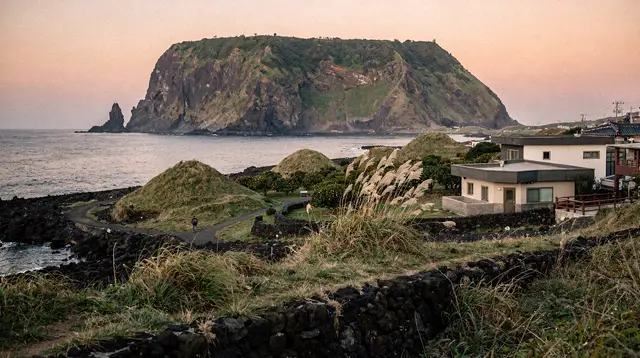
Seongsan Ilchulbong is Jeju's UNESCO volcanic tuff cone. Gate hours, sunrise timing by month, entry fees, and the climb itself, honestly assessed.

Sangumburi Crater
Sangumburi is a rare flat-floored maar crater near Seongsan, walkable via boardwalk with grassland views and far fewer crowds than Jeju's headline sites.

Camellia Hill
Camellia Hill is a 6,000-tree camellia garden in west Jeju, at its best from November through March. Bloom timing, entry fees, and what else to see there.
Ready to book? Top tours for this guide
We earn a small commission if you book through GetYourGuide — at no extra cost to you. Every tour is hand-picked and verified.

JEJU: UNESCO Mt Halla & South Jeju Coastal Wonders Day Tour
Jeju: Private Transfer to Manjanggul Cave and Ticket

Jeju: Spirited Garden Entry Ticket

Jeju West: Small Group Healing Tour w/Caves & Dolphins
Jeju Island: Sunrise Guided Tour with Hotel Pickup
