
1100 Highland Wetland
What is 1100 Highland Wetland and how do I get there?
1100 Highland Wetland is a Ramsar-listed subalpine wetland at roughly 1,100 meters elevation on Hallasan's western slope, reached via a rest area directly on 1100 Road (Provincial Route 1139), the mountain-crossing road connecting Jeju City and Seogwipo. A short boardwalk loop of 20-40 minutes covers the main wetland area; no separate entry fee or reservation is required, unlike Hallasan's summit trails.
Most visitors who pass 1100 Highland Wetland do so at highway speed, driving 1100 Road between Jeju City and Seogwipo without realizing there’s a genuine wetland ecosystem sitting a short walk from the rest area parking lot. It’s one of the easiest high-elevation nature stops on the island to add to a driving day — no hiking permit, no summit attempt, no advance reservation — and one of the more overlooked, given how little effort it takes relative to the payoff.
| Where | 1100 Road (Route 1139), Hallasan’s western flank, ~1,100m |
| Cost | Free, no reservation |
| Time needed | 20-40 min boardwalk loop |
| Getting there | Rental car only — no public bus stop here |
| Best time | Year-round; clearest views in autumn, snow possible in winter |
Where it sits and why the elevation matters
The wetland sits at roughly 1,100 meters on Hallasan’s western flank, directly alongside 1100 Road (Provincial Route 1139), the mountain-crossing route that connects Jeju City in the north to Seogwipo in the south. That elevation places it well above Jeju’s coastal and midland landscapes, in a subalpine zone with noticeably cooler temperatures, different vegetation, and a genuinely different ecosystem than anything found at sea level elsewhere on the island. Because it sits directly on a road already used by countless visitors driving between the island’s north and south coasts, it’s one of the most accessible high-elevation nature stops on Jeju — no separate drive or detour is needed if you’re already using this route.
What makes it a wetland at this elevation
Unlike Dongbaekdongsan’s lower-elevation, spring-fed wetland pool, 1100 Highland Wetland formed in a natural depression at altitude where poor drainage through the volcanic terrain allows water to collect and support wetland vegetation despite the surrounding slope’s overall elevation. This kind of subalpine wetland is ecologically distinct from both Jeju’s coastal wetlands and typical mountain terrain elsewhere, supporting specific plant communities adapted to the cooler, wetter, higher-altitude conditions found here. The site’s genuine ecological rarity — a functioning wetland ecosystem at this elevation on a relatively small volcanic island — is part of what earned it Ramsar recognition alongside Dongbaekdongsan.
Ramsar designation
1100 Highland Wetland received Ramsar Convention recognition as a wetland of international importance, part of the same broader effort to document and protect Jeju’s ecologically significant wetland sites that led to Dongbaekdongsan’s designation. The two sites offer a useful contrast in how differently a “wetland” can present depending on elevation and formation — a low-elevation, forest-embedded spring pool at Dongbaekdongsan versus a high-altitude depression wetland here, both meeting the ecological criteria for international wetland protection despite looking and functioning quite differently.
The boardwalk trail
A boardwalk loop, elevated above the actual wetland surface to protect the fragile ecosystem from foot traffic, covers the main viewing area in roughly 20-40 minutes depending on your pace and how long you linger at viewing points along the way. The boardwalk design means the trail itself is flat and easy underfoot — a notable contrast to the uneven, natural terrain found at ground-level nature walks like Dongbaekdongsan or a gotjawal forest trail — making this one of the more universally accessible high-elevation nature stops on the island.
Parking and the rest area
The rest area directly serves both the wetland trailhead and general travelers passing through on 1100 Road, meaning parking is generally straightforward and free, shared with drivers simply stopping for a break during their mountain crossing. Basic facilities — restrooms and sometimes a small snack or drink vendor — are typically available at the rest area itself, though don’t expect a full restaurant or extensive services given the site’s function primarily as a highway rest stop rather than a destination attraction in its own right.
Weather at altitude
Temperatures at 1,100 meters run noticeably cooler than Jeju’s coastal towns, often by several degrees, and conditions can shift quickly given the mountain’s tendency to generate its own localized weather, including fog and cloud cover that settles over the highland areas even on clear days at sea level. Bring a layer beyond what feels necessary at your coastal hotel before heading up — a warm, sunny morning in Jeju City or Seogwipo doesn’t guarantee the same conditions at this elevation, and the wetland’s exposed boardwalk offers little shelter from wind or sudden temperature drops.
Fog and visibility
Because 1100 Road crosses through Hallasan’s midsection at meaningful elevation, fog is a genuinely common occurrence here, sometimes reducing visibility dramatically even when the coast below sits in clear sunshine. This has two implications worth knowing: first, driving 1100 Road itself requires extra caution during foggy conditions, and second, a foggy visit to the wetland itself can actually be atmospheric and photogenic in its own right, lending the subalpine vegetation and boardwalk a moody, distinct look that a clear-sky visit doesn’t offer. Neither condition should be treated as a reason to skip the stop — just adjust expectations and driving speed accordingly.
Best time to visit
The wetland is accessible essentially year-round, though each season delivers a genuinely different character: summer brings peak greenery and the fullest water levels after Jeju’s wet season, autumn brings changing foliage color on the surrounding vegetation, and winter occasionally brings snow at this elevation when coastal areas see none at all, a detail worth knowing if you’re chasing snow photos during a Jeju winter trip that coastal areas alone won’t deliver. Spring sees the vegetation returning after winter dormancy, with wildflowers appearing in the wetland margins as temperatures rise.
Winter snow at this elevation
Because 1,100 meters sits high enough on Hallasan to reliably collect snow when coastal Jeju sees only rain or nothing at all, this is one of the more accessible spots on the island to see snow without committing to a full Hallasan summit hike. The boardwalk and rest area remain generally accessible even with light snow cover, though check road conditions on 1100 Road before heading up during winter weather, since the mountain crossing road can occasionally close or require chain restrictions during heavier snow events.
Anyone who would rather leave the winter mountain driving to someone else can look at a guided winter tour of Hallasan’s snowy scenery, which keeps the snow without the worry about road conditions.
Vegetation and wildlife at this elevation
The plant communities found at 1,100 meters differ meaningfully from anything growing at Jeju’s coastal or midland elevations, including cold-tolerant subalpine species and wetland-specific plants adapted to the site’s poorly drained, waterlogged soil. Amphibians and other wildlife adapted specifically to highland wetland conditions inhabit the site, distinct from the coastal and lowland species found elsewhere on the island — a detail that makes this a genuinely useful stop for visitors with a broader interest in how Jeju’s ecosystems shift with elevation, from coastal scrub up through midland forest to this subalpine wetland zone and finally the barren, wind-scoured terrain near Hallasan’s summit.
Interpretive signage and what to expect on-site
Basic interpretive signage along the boardwalk generally explains the wetland’s ecological significance, its Ramsar designation, and some detail on the specific plant communities found here, giving self-guided visitors reasonable context without needing a guide. Don’t expect an elaborate visitor center or extensive multimedia displays — the infrastructure here is deliberately minimal, consistent with the site’s function as a protected ecological area accessed via a highway rest stop rather than a purpose-built tourist attraction.
A highland driving loop covering multiple stops
For visitors interested in exploring more of Hallasan’s western highland corridor in a single day, 1100 Road connects toward both the Yeongsil trail and Eorimok trail entrances, making it feasible to combine the wetland stop with one of these trailheads and still complete a full Jeju City-to-Seogwipo crossing within a single day. This kind of highland-focused day trip offers a genuinely different experience from a coastal or single-region itinerary, exposing visitors to Hallasan’s less-visited western slope rather than only the more heavily trafficked eastern approach via Seongpanak.
Local recreational use versus tourist visits
Beyond international and mainland Korean visitors, the rest area and wetland trail see regular use from local Jeju residents simply stopping during a highway crossing, giving the site a noticeably more everyday, unpolished character than a purpose-built tourist attraction elsewhere on the island. This local usage pattern also means the site rarely feels artificially curated for visitors — the rest area facilities serve a genuine transportation function first, with the wetland trail as a bonus rather than the main draw for many who stop here.
Combining with a broader Hallasan itinerary
Visitors planning a full day around Hallasan’s western slopes can reasonably combine this wetland stop with a Yeongsil or Eorimok trail hike, plus a stop at Hallasan National Park’s visitor information points, covering both the highland ecology angle and an active hiking component within a single itinerary. This kind of combined day works particularly well for visitors who want more from their Hallasan visit than a summit attempt alone — the mountain’s ecological diversity, illustrated partly by this wetland, is easy to miss if a hiking day is treated purely as a physical challenge rather than a broader natural history experience.
For a day that links the mountain with the island’s UNESCO-recognized sites without any self-driving, a southwest day tour covering Hallasan and the UNESCO highlights is a practical alternative to piecing the route together yourself.
Getting there
Reaching 1100 Highland Wetland requires a car, since it sits directly on 1100 Road rather than near any public bus route — this isn’t a site accessible via Jeju’s intracity or intercity bus network in a practical way. It’s most commonly visited as a stop during a drive between Jeju City and Seogwipo, or as an add-on for visitors driving toward the Yeongsil trail entrance, which sits further along the same general route on Hallasan’s western side.
Pairing with a Hallasan hiking day
Because it sits close to the Yeongsil trail access road, 1100 Highland Wetland makes a natural pre- or post-hike stop for visitors tackling Yeongsil’s roughly 3-4 hour round trip — a low-effort wetland walk on the boardwalk pairs well as a warm-up before the trail or a gentle cool-down after, without adding meaningful extra driving. See the broader Hallasan hiking guide for how the mountain’s various trailheads, including the summit-bound Seongpanak and Gwaneumsa routes, compare for different fitness levels and time budgets.
How it compares to Dongbaekdongsan
Both 1100 Highland Wetland and Dongbaekdongsan hold Ramsar designations, but they represent genuinely different wetland types — this one a high-altitude, boardwalk-accessible depression wetland with cooler temperatures and subalpine vegetation, Dongbaekdongsan a lower-elevation, forest-embedded spring pool inside dense gotjawal terrain. Visitors with a specific interest in Jeju’s wetland ecology benefit from seeing both, since together they illustrate the ecological range packed into a relatively small island — from sea-level forest wetlands to subalpine mountain wetlands within an hour’s drive of each other.
Photography at 1100 Highland
The boardwalk offers straightforward, level shooting positions across the wetland, with the surrounding subalpine vegetation and, on clear days, Hallasan’s slopes rising in the background providing a sense of scale uncommon at Jeju’s lower-elevation nature sites. Fog, as noted above, can actually enhance rather than ruin photography here, lending an atmospheric quality that a clear day doesn’t replicate — worth embracing rather than avoiding if conditions turn misty during your visit. Winter snow cover offers a genuinely rare photo opportunity for a Jeju trip, since snow this accessible without a summit hike is uncommon elsewhere on the island.
What to bring
A warm layer, even in summer, is worth packing given how much cooler this elevation runs compared to the coast, along with a light rain shell since weather at altitude shifts more unpredictably than at sea level. Sturdy but not necessarily technical footwear suffices given the boardwalk’s flat, controlled surface — this isn’t the uneven natural terrain found at a ground-level forest wetland like Dongbaekdongsan. A fully charged phone or offline map is a reasonable precaution given the less reliable mobile signal at this elevation, particularly if fog reduces visibility while driving.
Who this stop suits
This is one of the easiest nature stops on the island to recommend broadly, given its combination of zero entry fee, flat boardwalk access, and direct roadside location — it suits nearly any visitor already driving 1100 Road, from families with young children to visitors with limited mobility who can’t manage more strenuous nature walks elsewhere on this list. It’s a poor match only for visitors without a rental car and no plans to drive this specific route, since reaching it independently via public transport isn’t realistic.
Safety considerations at altitude
Beyond fog and cooler temperatures, altitude sickness isn’t a realistic concern at 1,100 meters — this is well below elevations where that becomes a factor — but sudden weather changes are worth taking seriously given how quickly conditions on Hallasan’s slopes can shift compared to the coast. If you’re driving 1100 Road specifically to reach this wetland or a nearby trailhead, check current road and weather conditions before setting out, particularly in winter when snow or ice can affect the crossing, and keep in mind that mobile signal can be less reliable at this elevation than in Jeju’s coastal towns.
How it fits a wider Hallasan ecology story
Jeju’s volcanic geology creates an unusually compressed ecological gradient — coastal scrub and citrus groves give way within a short drive to midland forest, then subalpine terrain like this wetland, and finally the barren, wind-scoured rock near Hallasan’s summit. Few volcanic islands pack that range into such a short vertical distance, which is part of why this modest boardwalk stop carries more ecological weight than its size suggests.
Visitors curious about the island’s oreums — the roughly 360 smaller volcanic cones scattered across Jeju — will notice the same underlying volcanic processes at work here, just expressed through standing water and wetland vegetation rather than a cinder cone’s exposed crater. Understanding that broader picture makes the short stop feel less like an isolated curiosity and more like one data point in a genuinely coherent island-wide story, one that a purely coastal itinerary — beaches, Seongsan Ilchulbong, lava tube caves — never quite reveals on its own.
Seasonal photography notes
Each season changes what the boardwalk actually looks like, beyond the general “greener in summer, colder in winter” pattern. Early autumn brings a narrow window where the subalpine vegetation shifts color noticeably earlier than lower-elevation foliage spots tracked in the island’s broader autumn foliage guide, often a week or two ahead of Jeju City’s parks.
Spring’s wildflower margins are subtle rather than showy compared to the island’s more famous cherry blossom or canola flower displays lower down, but they reward a slower, more deliberate look at the boardwalk’s edges rather than a quick drive-by stop. Photographers chasing Jeju’s better-known seasonal spectacles elsewhere on the island should treat this less as a highlight-reel destination and more as a quiet, technical complement to those trips — the payoff here is atmosphere and ecological detail, not the kind of postcard color that draws crowds to the island’s coastal flower fields.
Doing it as a guided day instead of self-drive
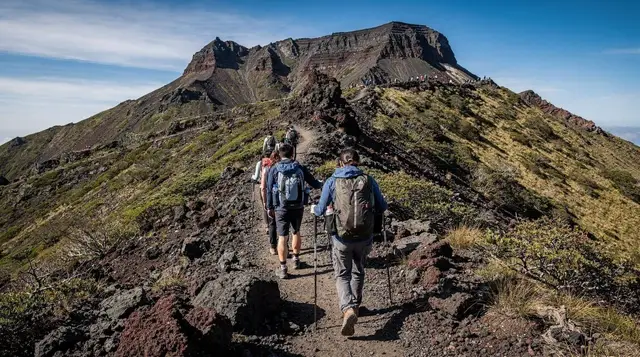
Visitors without a rental car, or who’d rather not navigate 1100 Road’s fog and altitude shifts themselves, can still fold a highland stop into a guided Hallasan day. A small-group guided hike covering Hallasan’s western trails is a reasonable way to combine the mountain’s ecology — including the kind of subalpine terrain this wetland represents — with an experienced driver-guide handling the mountain crossing.
Small-group Hallasan nature hike with lunchBuilding it into a wider itinerary
Because 1100 Highland Wetland adds so little time to a route you’re likely already driving, it fits naturally into most multi-day plans rather than needing its own dedicated outing. Visitors following a Jeju road trip loop itinerary or a hiking-focused itinerary can slot it in on a day already crossing between the north and south coasts. For first-time visitors still mapping out a broader plan, the first-timer Jeju itinerary and first-time planning guide are useful starting points for deciding which day should include a 1100 Road crossing. Anyone renting a car specifically to reach highland stops like this should also check the car rental and IDP guide and general driving road trip tips before setting out, since mountain-road driving differs meaningfully from coastal routes.
An honest take
1100 Highland Wetland is genuinely one of the best effort-to-reward nature stops on Jeju — it requires no hiking permit, no significant physical effort, and no detour if you’re already using 1100 Road, yet delivers a subalpine ecosystem and, depending on season, a legitimate shot at snow that most coastal-focused Jeju itineraries never encounter. The tradeoff is that it’s genuinely modest in scale and won’t deliver the dramatic payoff of a full Hallasan summit hike or a coastal cliff — treat it as a worthwhile, low-commitment addition to a driving day rather than a standalone destination worth a special trip on its own.
Frequently asked questions about 1100 Highland Wetland
Do I need a permit or reservation to visit?
No — unlike Hallasan’s summit-bound trails, which require timed entry during busy periods, the 1100 Highland Wetland boardwalk has no reservation system or entry fee.
How long does the wetland walk take?
Roughly 20-40 minutes for the boardwalk loop at a relaxed pace.
Can I visit without a car?
Not practically — the site sits directly on 1100 Road with no nearby public bus service, so a rental car or private transport is necessary.
Does it snow here in winter?
Yes, at 1,100 meters elevation, this is one of the more reliable spots on Jeju to see snow in winter, even when coastal areas see none.
How does it compare to Dongbaekdongsan Wetland?
Both are Ramsar-listed, but this is a higher-elevation depression wetland with cooler subalpine conditions, while Dongbaekdongsan is a lower-elevation, forest-embedded spring wetland — genuinely different ecosystems.
Is the boardwalk accessible for strollers or wheelchairs?
Yes, generally — the flat, level boardwalk design makes this one of the more universally accessible nature stops on this list.
What should I pair this stop with?
Its position on 1100 Road makes it a natural pairing with the Yeongsil trail entrance or a broader Jeju City-to-Seogwipo driving day.
Is fog common here?
Yes, given the elevation — fog and cloud cover can settle over this stretch of Hallasan even on clear coastal days, so drive 1100 Road cautiously and treat foggy conditions as a photogenic bonus rather than a reason to skip the stop.
Is there a restaurant or café at the rest area?
Only basic facilities — restrooms and sometimes a small snack or drink vendor. It functions primarily as a highway rest stop, so plan a proper meal in Jeju City or Seogwipo instead.
Can I combine this stop with a guided tour instead of driving myself?
Yes — a small-group Hallasan hiking tour with an English-speaking driver-guide can incorporate the western highland corridor, which is a practical option if you’d rather not navigate 1100 Road’s fog and altitude shifts solo.
Related guides

Dongbaekdongsan Wetland
Dongbaekdongsan is a Ramsar-listed gotjawal wetland forest near Seonheul, northeast Jeju. Trail length, entry fees, and what makes it distinct.

Camellia Hill
Camellia Hill is a 6,000-tree camellia garden in west Jeju, at its best from November through March. Bloom timing, entry fees, and what else to see there.

Cheonjiyeon Waterfall
Cheonjiyeon Waterfall in Seogwipo: a 22m drop through subtropical forest, entry fees, opening hours, night illumination, and how it compares to Jeju's

Jusangjeolli Cliff
Jusangjeolli's hexagonal basalt columns near Jungmun: how they formed, entry fees, best time to visit for waves, and safety on the boardwalk.
Ready to book? Top tours for this guide
We earn a small commission if you book through GetYourGuide — at no extra cost to you. Every tour is hand-picked and verified.
JEJU: UNESCO Mt Halla & South Jeju Coastal Wonders Day Tour

Jeju: Private Transfer to Manjanggul Cave and Ticket

Jeju: Spirited Garden Entry Ticket

Jeju West: Small Group Healing Tour w/Caves & Dolphins
Jeju Island: Sunrise Guided Tour with Hotel Pickup
