
The Hallasan permit system, explained
A system that surprises most first-time visitors
Nowhere else on a standard Jeju itinerary requires this kind of advance planning, which is exactly why the Hallasan permit system trips up so many visitors who’ve otherwise done their homework on car rental, K-ETA, and hotel bookings. Most people research Hallasan the way they’d research any other hike — trail length, difficulty, what to pack — and only discover the reservation requirement once they’re already deep into planning, sometimes only days before departure when the popular slots are already gone. Treating the Hallasan reservation as a first-priority booking, done at the same time as flights and accommodation rather than as an afterthought once on the island, avoids the single most common regret reported by visitors who wanted to summit and couldn’t.
| Cost | Free reservation; parking around ₩1,800-3,000 |
| Booking window | Opens roughly one month ahead |
| Trails needing a slot | Seongpanak, Gwaneumsa (summit trails only) |
| No booking needed | Eorimok, Yeongsil, Donnaeko, Eoseungsaengak |
| Cut-off | Around midday at checkpoints; rangers close the gate strictly |
Why Hallasan needs a reservation at all
South Korea’s highest peak is also one of its most heavily visited national parks, and the two trails that actually reach the summit crater — Seongpanak and Gwaneumsa — have a hard daily cap on how many hikers can start. The reservation system isn’t a paywall; it’s crowd control on a mountain where the descent from the crater rim takes hours and a bottleneck near sunset has real consequences. Every other trail on Hallasan (Eorimok, Yeongsil, Donnaeko, Eoseungsaengak) is free to walk without booking anything, but none of them reach the crater itself — they stop at scenic viewpoints below the rim. If the summit is the goal, the reservation is not optional.
For the bigger picture of the mountain itself, the Hallasan National Park destination page and the broader Hallasan hiking guide show how the five trails relate to one another, which makes it easier to decide whether a summit slot is really what you want or whether a lower trail would suit your group better.
How the booking actually works
Reservations open through the Hallasan National Park website and the Korea National Park app roughly one month ahead, released in a rolling window rather than all at once. There’s no cash cost — this trips up a lot of first-time visitors who assume “permit” means a fee, when in practice it’s a free timed-entry ticket tied to a specific trail and a specific start-time slot. The catch is that slots for Seongpanak, the easier and more popular of the two summit routes, disappear within minutes during peak windows: weekends from April through June, all of October, and any stretch of clear-sky forecast during typhoon season when everyone books the same three good days.
The booking portal is primarily in Korean, though the Korea National Park app has partial English support. You’ll need a phone number that can receive a Korean SMS for verification on some booking flows, which is the single biggest practical obstacle for visitors without a Korean SIM. Renting an eSIM or physical SIM before attempting to book — even a day ahead of your intended hike — solves this. Bring a printed or screenshotted confirmation; rangers check at the trailhead gate and turn back anyone without one, no exceptions for a “we didn’t know.”
Our eSIM and SIM guide for Jeju walks through the options, and it is worth sorting out before you sit down to book. If you plan to drive to the trailhead, the car rental and IDP guide covers what you need to have in hand, and the Jeju bus guide is the fallback if you would rather not drive in the dark.
Seongpanak vs. Gwaneumsa: which reservation to chase
Seongpanak is the longer but gentler route — about 9.6 km one-way, 5-6 hours up, and the trail most people mean when they talk about “climbing Hallasan.” It’s also the only trail where hikers can descend a different way (down Gwaneumsa) if both reservations line up, though most people simply hike Seongpanak round-trip. Gwaneumsa is shorter in distance but steeper and rockier, with a reputation among Jeju locals as the “real” climb; it also tends to have slightly more slots available precisely because it scares off casual hikers. If Seongpanak is sold out for your date, checking Gwaneumsa availability is worth the extra effort before giving up on the summit entirely.
Full details on distances, cut-off times, and what to expect on each trail are in the separate Seongpanak trail guide and Gwaneumsa trail guide.
What the reservation actually looks like on your phone
Once booked, the confirmation is a simple digital ticket tied to your name, the trail, and the date and time slot — no physical card, no barcode scanning at automated gates the way some other countries handle national park entry. At the trailhead, park staff or volunteers do a visual check against a printed list or a phone screen, so a working phone with the confirmation email or app screenshot pulled up (or a paper printout as backup, useful if battery or signal is a concern in the early morning) is enough. Rangers are generally understanding about minor formatting confusion in the confirmation but strict about the core requirement: no reservation, no entry, regardless of how far someone has traveled or how empty the trail looks that morning.
What happens if you can’t get a slot
This is more common than the park’s marketing suggests, especially for anyone planning a trip with less than two weeks’ notice in shoulder season. A few realistic alternatives:
- Hike a non-summit trail instead. Yeongsil and Eorimok both reach dramatic crater-adjacent viewpoints (Witse Oreum on Yeongsil is a genuine highlight, not a consolation prize) without any booking at all.
- Check for cancellations the morning of. No-shows happen, and released slots occasionally reappear the evening before or the morning of a hike, particularly for Gwaneumsa.
- Book a guided small-group tour. Licensed tour operators hold a separate allocation of trail slots, which is functionally the easiest workaround for visitors who can’t navigate the Korean-language booking system at all.
If that sounds like the least stressful route, a small-group nature hike on Hallasan with lunch included lets someone else handle the logistics while you concentrate on the walking. Check the exact route and what it covers on the booking page before you commit, since not every guided option goes to the crater rim. For a comparison of the trails you might be guided on, see the Eorimok trail guide and the Yeongsil trail guide.
Time limits and cut-off points
Both summit trails have strict cut-off times at checkpoints partway up — typically around noon at Jindallaebat on Seongpanak and a similar midday point on Gwaneumsa — after which rangers close the gate regardless of how far you’ve come. Miss the cut-off and the hike ends there; there’s no negotiating with the ranger station. This is a weather-and-daylight safety measure, not bureaucracy for its own sake, since the summit sees fog roll in fast and the descent alone takes 3-4 hours. Starting at first light (trailheads typically open around 5:00-6:00 AM depending on season) is the only reliable way to guarantee reaching the crater before the cut-off, especially on the longer Seongpanak route.
Seasonal closures on top of the daily cap
Beyond the daily reservation cap, both trails close entirely during specific windows: heavy snow and ice in deep winter (typically January-February, weather-dependent), and any day with a typhoon warning or high wind advisory in effect. The park also occasionally closes trails for ecological rest periods on a rotating basis. None of this is announced far in advance — checking the Hallasan National Park website or app the day before is the only way to know for certain, which is one more reason a rigid one-day Hallasan-or-bust itinerary is risky. Building in a buffer day, especially during typhoon season, saves a wasted flight.
Winter deserves its own planning. If snow on the mountain is part of the appeal rather than an obstacle, a guided winter scenery tour of Hallasan is a more sensible way to see it than improvising on icy trails. The Jeju winter guide and the typhoon season guide explain what each season does to trail access and flight plans.
How the system compares to other Korean national parks
Hallasan isn’t unique within Korea in gating its most popular routes — several mainland national parks, including sections of Seoraksan, have introduced similar timed-entry systems in recent years as visitor numbers have climbed nationwide. What makes Hallasan’s version feel more consequential is that it’s a genuine bucket-list summit for a large share of Jeju’s visitors, many of whom are on the island for a fixed, short window and can’t simply try again the following weekend the way a local hiker could. That asymmetry — locals treating a missed slot as a minor inconvenience, visitors treating it as a once-in-a-trip disappointment — is worth keeping in perspective when weighing how much effort to put into securing a specific date.
Packing and preparation once the reservation is secured
Having a confirmed slot solves the access problem but not the mountain itself: Hallasan’s weather can shift from clear skies at the trailhead to fog and wind at altitude within an hour, and temperatures at the crater rim run noticeably cooler than at sea level even in summer. Layered clothing, a headlamp for pre-dawn starts, more water than seems necessary, and proper trail shoes rather than casual sneakers all matter more here than the reservation logistics themselves — a secured permit is only the first of several things that need to go right for a successful summit day.
Seongpanak vs Gwaneumsa at a glance
| Seongpanak | Gwaneumsa | |
|---|---|---|
| Distance | ~9.6 km one-way | Shorter, steeper |
| Difficulty | Longer but gentler | Steeper, rockier, harder on knees |
| Popularity | Most-booked, sells out fastest | Slightly more slots available |
| Reputation | The “default” summit route | The “real” climb among locals |
What to do the night before your reserved hike
The reservation itself is only step one — the night before a summit attempt matters almost as much for a successful climb. Check the current weather and any closure notices on the Hallasan National Park site, since fog, wind advisories, or a late-season snow warning can close the trail entirely regardless of your booking.
Lay out layered clothing, a headlamp, and more water than feels necessary the night before rather than rushing in the pre-dawn dark, since most successful summit attempts start at first light to beat the midday cut-off with margin to spare — the Jeju hiking gear and safety guide has a fuller packing checklist if this is your first serious Korean summit hike. Confirming your accommodation is genuinely close to the trailhead you’ve booked — Seongpanak and Gwaneumsa sit on different sides of the mountain — avoids a stressful early-morning drive that eats into your cut-off buffer. The where to stay guide can help you choose a base, and the hiking adventure itinerary shows how a summit day can fit between other walks, with the oreum hiking guide offering gentler warm-up climbs if you want to test your legs first.
What happens after you reach the summit
Reaching the crater rim isn’t the end of the day — the descent takes 3-4 hours on either trail, and rangers factor this into the cut-off times specifically because a summit reached too late leaves too little daylight for a safe way down. Pace yourself accordingly rather than treating the ascent as the only part of the hike that requires planning; many hikers underestimate how much the descent taxes tired knees, particularly on Gwaneumsa’s steeper, rockier sections. Bringing a headlamp even for a well-timed hike is sensible insurance in case the descent runs longer than expected, especially heading into autumn or winter when daylight hours shrink.
Frequently asked questions about the Hallasan permit system
Is there a fee for the Hallasan permit?
No. The reservation is free; it’s a timed-entry booking, not a paid permit. Parking at the trailheads does cost a small fee (around ₩1,800-3,000 depending on vehicle size), which is separate.
How far in advance should I book?
As early as the booking window opens, roughly one month out. For weekends and October, book the moment slots appear — they can sell out within the hour.
Can I hike Hallasan without a reservation?
Only on the non-summit trails: Eorimok, Yeongsil, Donnaeko, and Eoseungsaengak. These don’t reach the crater but are free to walk without any booking.
Do children need their own reservation?
Yes, every person entering the summit trails needs an individual booking slot, including children, though there’s no separate age-based fee since the reservation itself is free.
What if it rains on my reserved day?
The reservation isn’t automatically refunded or transferable since there’s no payment involved, but if the park itself closes the trail for safety, that’s a park-side closure rather than a no-show — check the official site for closure announcements rather than assuming your slot still stands.
Is Gwaneumsa really harder than Seongpanak?
Yes, noticeably — steeper grades, rockier footing in sections, and a reputation for testing knees on the descent. It’s shorter in raw distance, which makes it a common mistake for hikers who assume “shorter” means “easier.”
Can I hike up one trail and down the other?
Some hikers do this on Seongpanak up, Gwaneumsa down, or the reverse, but it requires holding reservations for both trails on the same day, which is harder to secure than a single round-trip slot. Most first-timers should plan a straightforward there-and-back on one trail.
What’s the descent time after reaching the summit?
Around 3-4 hours on either trail, which is why rangers enforce the midday cut-off strictly — a late summit leaves too little daylight for a safe descent.
For the wider question of what to do if Hallasan doesn’t work out at all — weather, sold-out slots, or simply not enough time — the hidden gems guide covers strong alternatives that don’t involve a lottery system.
Related guides
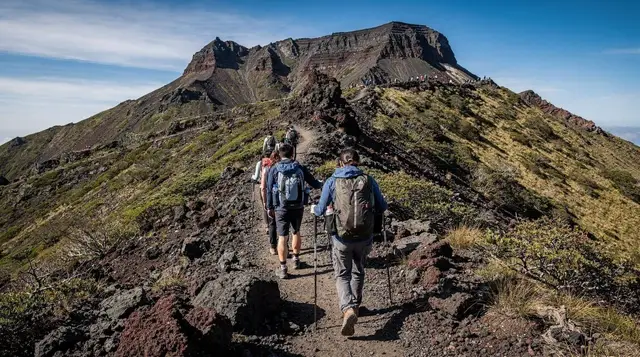
Hiking Hallasan: Complete Guide
Compare all four Hallasan trails — Seongpanak, Gwaneumsa, Yeongsil, Eorimok — by distance, difficulty, reservation rules, and what each one delivers.

Hallasan: Seongpanak Trail
Seongpanak is the longer but gentler of Hallasan's two summit trails — 9.6km one way, reservation required, 8-9 hours round trip.

Hallasan: Eorimok Trail
Eorimok is the gentlest of Hallasan's four trails, climbing toward Witse Oreum from the west — no reservation, roughly 4.7km one way.

Hallasan: Gwaneumsa Trail
Gwaneumsa is the shorter but steeper of Hallasan's two summit trails — 8.7km one way, rockier upper sections, reservation required.