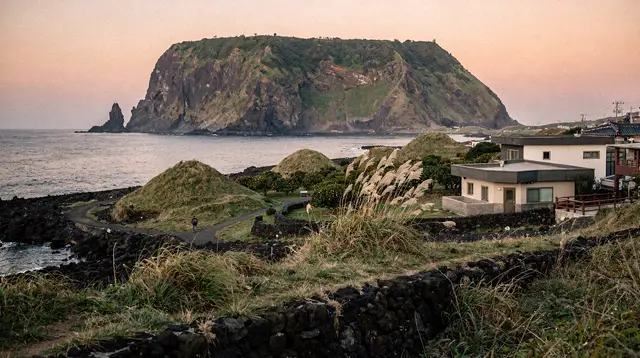
Udo Island day trip guide
How do I plan a Udo Island day trip from Jeju?
Ferries to Udo depart from Seongsan's port in east Jeju, a roughly 15-minute crossing running frequently in good weather (about every 20-30 minutes in peak season). Most visitors rent a bike or e-bike on arrival to cover the island's 17km perimeter road, budgeting a half day to a full day and around ₩40,000-60,000 (US$30-45) per person including ferry and rental.
Udo, whose name translates to “cow island” for its shape as seen from above, is by far the most-visited of Jeju’s outlying islets — flat enough to circle comfortably by bike in a few hours, ringed by beaches with an unusually pale, coral-fragment sand, and known island-wide for a local specialty: peanut ice cream, made from peanuts grown on the island itself. A day trip here is one of the most consistently recommended add-ons to a Jeju itinerary, and for good reason, though it does require some planning around ferry schedules and weather. For visitors who’ve spent several days on the main island, the shift in pace — a small, flat, bike-friendly island with no cars beyond a handful of local vehicles — often feels like a genuine change of scenery rather than more of the same.
| Where | Seongsan port, east Jeju |
| Cost | Around ₩40,000-60,000/person (ferry + rental + food) |
| Time needed | Half day to full day (4-6 hours) |
| Getting there | 60-70 min drive/bus from Jeju City to Seongsan |
| Best time | Spring and autumn; first ferry for fewest crowds |
Getting to the ferry: Seongsan port
Udo-bound ferries depart from a terminal near Seongsan Ilchulbong in far east Jeju, roughly 60-70 minutes by car from Jeju City and CJU airport. Because of this drive time, most visitors pair a Udo day trip with a Seongsan Ilchulbong visit on the same day — climbing the sunrise peak in the morning, then continuing to the ferry terminal a few minutes further down the road. Parking near the terminal is available but fills quickly during peak season, so arriving with some buffer time is worth it.
Ferry schedules and prices
The crossing itself takes about 15 minutes and runs frequently in good weather — roughly every 20-30 minutes during peak season, less often in shoulder and winter periods. Round-trip tickets cost around ₩8,500-10,500 depending on the ferry company and whether you’re bringing a rental scooter or bike aboard (bikes typically incur a small additional fee). Tickets are generally sold at the terminal on the day, though it’s worth checking current published schedules before your visit rather than assuming a fixed timetable, since departures adjust seasonally.
The single most important planning fact about any Udo ferry is that crossings depend on sea conditions and can be cancelled with limited notice when winds or swell pick up — this applies most acutely during typhoon season (late August-September) and winter storms, but can affect any day of the year. Check morning-of conditions rather than assuming a booked crossing will run, and build slack into your schedule if the trip matters.
Getting around Udo: bike, e-bike, or scooter
Once on the island, most visitors rent a bicycle, e-bike, or scooter near the ferry dock to cover Udo’s roughly 17-kilometer perimeter road — walking the full loop is possible but takes most of a day on foot alone, while cycling comfortably fits the loop into 2-4 hours with stops. E-bikes are worth the modest extra cost over standard bicycles if the full loop, including some inclines, feels ambitious; they rent for roughly ₩15,000-25,000 for a half day. Rental shops near the port can run low on bikes during peak season weekends, so arriving on an earlier ferry improves your odds of getting your preferred rental option.
Jeju: Udo Island E-Bike, Seongsan Ilchulbong & Speed Boat bundles the ferry crossing with e-bike rental in a single booking, a practical way to avoid arranging each piece separately, particularly useful in peak season when rental availability is tightest.
A suggested loop route
Starting from the main ferry dock (Cheonjin-ri or Haumok-dong, depending on which terminal your ferry uses), a clockwise loop typically passes Seobin Baeksa Beach’s pale coral sand, continues past coastal viewpoints and a small lighthouse area, and takes in Udo’s own miniature landmark — Udo Peak (Udobong), a small hill at the island’s eastern end with a short, moderate climb offering wide views back across the island and toward Seongsan Ilchulbong on the mainland side. Most visitors stop for the island’s signature peanut ice cream at one of several cafés along the route, and a lunch stop at a seafood restaurant near the harbor is a common way to break up the loop.
Building in stops rather than racing to complete the loop is the better approach here — Udo rewards a slower pace more than a rushed circuit, and the beaches in particular are worth time rather than a quick photo stop.
How much time to budget
A comfortable Udo day trip runs 4-6 hours door to door once you factor in the drive to Seongsan, the ferry crossing both ways, and time on the island itself — treat it as a half-day-plus commitment rather than a quick add-on. Visitors who want to combine Udo with a full sunrise climb at Seongsan beforehand should plan for closer to a full day, starting before dawn and returning to the mainland by mid-to-late afternoon.
Alternatives to a full perimeter loop
Not every Udo visit needs to cover the entire 17km loop — visitors with less time or less interest in a full cycling circuit can focus on the sections nearest the ferry dock, covering Seobin Baeksa Beach, a handful of cafés, and perhaps a short walk toward Udobong, treating the visit as a shorter, more relaxed stop rather than a complete island circuit. This scaled-down approach works well for travelers combining Udo with a demanding morning at Seongsan Ilchulbong, when energy for a full day of cycling afterward may be limited.
Budget for a Udo day trip
Beyond the ₩8,500-10,500 round-trip ferry, budget ₩15,000-25,000 for a half-day bike or e-bike rental, plus food — peanut ice cream, cafés, and a seafood lunch typically run comparable to mainland Jeju prices, sometimes slightly higher given the logistics of supplying a small island. All told, a full day covering ferry, rental, ice cream, and lunch comes to roughly ₩40,000-60,000 (about US$30-45) per person, not including the cost of getting to Seongsan itself if you’re not driving your own rental car.
Best time of year for a Udo visit
Spring and autumn offer the most reliable combination of calm ferry conditions and comfortable cycling weather, avoiding both summer’s heat and humidity and winter’s sharper coastal wind. Summer does bring warm enough water for swimming at Udo’s beaches, a genuine draw not available in cooler months, but also the risk of monsoon rain in July and typhoon disruption in late August and September. Winter visits are possible and considerably quieter in terms of crowds, but the exposed perimeter road can feel genuinely cold on a bike, and some seasonal cafés and rental shops may operate reduced hours.
Crowd patterns throughout the day
Udo tends to see its heaviest crowds around midday, when day-trip visitors from across the main island converge, particularly on weekends and during Korean holiday periods. An early ferry crossing, ideally one of the first departures of the day, offers a noticeably quieter experience for the first couple of hours before the midday rush arrives — worth prioritizing if a calmer, less crowded visit matters to you. Late-afternoon crossings, timed to catch a quieter final stretch of daylight before the last return ferry, are another reasonable strategy for avoiding the busiest window.
What to pack
Wind picks up around much of the island’s exposed coastal road, so a light windbreaker is worth carrying regardless of season. Sun protection matters more than usual given how much of the perimeter route runs exposed with minimal shade — sunscreen and a hat are worth the extra bag space. Bring some cash: while larger vendors increasingly accept cards, smaller island cafés and rental shops sometimes remain cash-preferred or cash-only.
Udo’s beaches in more detail
Seobin Baeksa Beach, near the main ferry dock, is known for its unusually pale sand, made partly of coral fragments rather than the volcanic black sand common on much of the main island’s coastline — a genuinely distinctive visual that draws swimmers and photographers alike in warmer months. Other smaller beaches around the island’s perimeter road offer quieter alternatives with fewer crowds, worth seeking out if the main beach feels too busy on a peak-season day. Water temperatures are swimmable roughly from June through September, though currents and conditions can vary, so check for any posted warnings before swimming, particularly on the more exposed sections of coastline.
Udo Peak (Udobong)
Udo’s own miniature landmark, Udobong, is a small hill at the island’s eastern end offering a short, moderate climb — nothing like the elevation gain at Seongsan Ilchulbong, but enough to raise your heart rate — rewarded with wide views back across Udo itself and toward Seongsan Ilchulbong on the mainland side. It’s a worthwhile stop if you’re already cycling the loop and have the extra 20-30 minutes to spare for the short detour and climb, offering a different vantage point than anything visible from the flat coastal road itself.
Udo’s peanut ice cream and other local specialties
Udo’s cultivation of peanuts as a local specialty crop has turned peanut-based treats, particularly peanut ice cream, into something close to a required stop for visitors — sold at multiple cafés along the main routes near the ferry dock and scattered around the loop. Beyond peanuts, the island’s seafood restaurants draw on the surrounding waters for fresh catch, and a number of cafés along the coast lean into scenic ocean views as much as their menus, making a slower café stop as much a scenery experience as a food one.
Renting a bike or scooter: what to expect
Rental shops cluster near the main ferry dock, offering a range of options from standard bicycles to e-bikes and, in some cases, small scooters, generally rented for a half-day or full-day period. Prices vary by rental type and duration, with e-bikes commanding a premium over standard bicycles given the assistance they provide on the loop’s occasional inclines. It’s worth comparing a couple of nearby rental shops rather than committing to the first one you see, since pricing and bike condition can vary meaningfully between vendors, especially during peak season when demand is highest.
An honest take
Udo is heavily marketed as an essential Jeju add-on, and it’s genuinely worthwhile — but it’s fair to say it doesn’t dramatically outshine some of the main island’s own coastal scenery. Much of the appeal is the novelty of the ferry crossing and the change of pace from mainland Jeju, rather than unique scenery unavailable elsewhere on the island. Visitors with limited time debating between a Udo day trip and an additional day exploring east Jeju in more depth shouldn’t feel obligated to prioritize the islet crossing, especially if ferry weather looks uncertain on the day. If the ferry does get cancelled, the Jeju islets ferry guide and the Gapado and Marado day trip guide cover the island’s other ferry-accessible islets, which sometimes run when Udo’s crossing doesn’t, or vice versa, depending on which side of the island the weather is affecting.
A suggested loop timing
For a clockwise loop starting from the main ferry dock, this rough timing helps pace a half-day-to-full-day visit without rushing the beaches:
| Stop | Approx. time from dock | Suggested time to spend |
|---|---|---|
| Seobin Baeksa Beach | 5-10 min | 20-30 min |
| Coastal viewpoints & lighthouse area | 30-45 min | 15-20 min |
| Udobong (Udo Peak) climb | 60-75 min | 30-40 min |
| Harbor-area seafood lunch | 90-100 min | 45-60 min |
| Peanut ice cream café stop | Anywhere along the loop | 15-20 min |
Treat this as a loose guide rather than a fixed schedule — the whole point of Udo is a slower pace than the main island’s itinerary-driven days.
Udo across different trip lengths
Travelers with only one or two days total on Jeju generally shouldn’t prioritize a Udo crossing over deeper exploration of the main island, given the time cost of the drive to Seongsan and the ferry logistics involved. For trips of four days or longer, Udo becomes a much easier addition to justify, particularly when paired with a Seongsan Ilchulbong sunrise on the same morning — a combination that makes efficient use of the drive out to the island’s easternmost point rather than requiring a separate dedicated trip for each.
If you would rather not drive to Seongsan
The drive out to the ferry is the least relaxing part of the day for many visitors, especially after an early start. Travelers without a rental car can take a look at a private transfer to Seongsan Ilchulbong to reach the ferry area without juggling bus connections, and those who prefer a guided day covering several east coast stops can compare a guided east Jeju highlights day trip with doing the island on their own. Our private vs group day tours guide and the east Jeju day tour guide explain how these formats differ in pace and flexibility.
Where Udo fits among other east Jeju stops
Udo works best as one piece of a wider east coast day rather than a stand-alone outing. Nearby, Seongsan and Gujwa offer further places to stop on the way back, while Seopjikoji lighthouse and cliffs and Manjanggul lava tube are natural companions for a second east Jeju day. The Udo island destination page gathers the essentials in one place, and the longer Udo Island day trip blog post offers a more narrative take. For getting around before and after the ferry, the Jeju bus guide, Kakao T taxi guide and car rental and IDP guide cover the practical options, and the first-timer Jeju itinerary shows how a Udo day can slot into a longer stay.
Traveling to Udo without joining a group tour
Independent travelers who’d rather skip an organized tour entirely can manage every piece of a Udo day trip on their own with a bit of planning: drive or bus to Seongsan, walk to the ferry terminal, buy a same-day round-trip ticket, and rent a bike on arrival — none of these steps requires advance booking outside of peak season. The main advantage an organized tour offers over this independent approach is bundled logistics and, in some cases, modestly discounted combined pricing, rather than access to anything an independent traveler couldn’t otherwise arrange.
A reasonable way to close out a Jeju trip
Because a Udo day trip pairs so naturally with a Seongsan Ilchulbong visit, many travelers use the combination as a fitting way to close out a longer Jeju itinerary — a sunrise climb followed by a slower, more relaxed island crossing makes for a memorable final full day before flying home from CJU, which sits within a reasonable drive back from Seongsan for an afternoon or evening departure. The east Jeju itinerary builds a full multi-day plan around this side of the island, including where Udo fits best.
Udo versus Gapado and Marado
Udo isn’t the only ferry-accessible islet off Jeju’s coast, and travelers with extra days sometimes weigh it against Gapado and Marado, reachable from the southwest instead of Seongsan. Udo is larger, has more infrastructure (cafés, bike rentals, a proper loop road) and pairs naturally with Seongsan Ilchulbong; Gapado is flatter and quieter, known for green barley fields rather than beaches, while Marado is Korea’s southernmost point and more of a quick there-and-back than a half-day loop. Doing both Udo and the Gapado/Marado pair on the same trip is possible but means two separate ferry legs on two different sides of the island — most itineraries pick one rather than both unless the trip runs a week or longer.
Weather beyond typhoon season
Ferry cancellations aren’t limited to the peak typhoon window covered in the typhoon season guide — winter storms and even a stiff spring wind can ground the crossing for a morning. If the forecast looks marginal, build a backup plan into the day (a longer Seongsan Ilchulbong visit or extra time in east Jeju) rather than treating Udo as the fixed centerpiece.
Frequently asked questions about a Udo Island day trip
How do I get to the Udo ferry from Jeju City?
Drive or take a bus to Seongsan in east Jeju, roughly 60-70 minutes from Jeju City, then walk to the ferry terminal near Seongsan Ilchulbong.
How long is the ferry crossing to Udo?
About 15 minutes, with departures running roughly every 20-30 minutes in peak season and less frequently otherwise.
Do I need to rent a bike, or can I walk around Udo?
Walking the full 17km perimeter road takes most of a day on foot alone. A bike, e-bike, or scooter is the practical way to see the whole loop in a half-day to full day.
What happens if the ferry is cancelled due to weather?
Ferries can cancel with limited notice in rough seas, especially during typhoon season (late August-September) or winter storms. Always check morning-of conditions rather than relying on an advance booking alone.
Is Udo worth visiting if I only have one day left on Jeju?
It’s a strong option if island-hopping appeals to you, but not an essential substitute for a full day exploring the main island’s own coastline if your time is genuinely limited and ferry weather looks uncertain.
How much does a Udo day trip cost in total?
Roughly ₩40,000-60,000 (about US$30-45) per person, covering the round-trip ferry, a half-day bike or e-bike rental, and food.
Can I bring a rental car onto the Udo ferry?
Regular passenger cars are generally not permitted; the standard approach is to rent a bike, e-bike, or scooter on the island itself after leaving your car parked near the Seongsan terminal.
Is Udo’s beach sand actually different from the main island’s?
Yes, Seobin Baeksa Beach near the ferry dock has unusually pale sand made partly of coral fragments, distinct from the darker volcanic sand found on much of Jeju’s main coastline.
Is it worth climbing Udo Peak (Udobong)?
Yes, if you have an extra 20-30 minutes during your loop — it’s a short, moderate climb offering wide views back across Udo and toward Seongsan Ilchulbong that aren’t visible from the flat coastal road.
What if the Udo ferry is cancelled on the day I planned to visit?
Have a backup plan rather than treating Udo as fixed — spend extra time at Seongsan Ilchulbong or explore more of east Jeju instead, and check the ferry operator’s status again the next morning if your itinerary has a spare day.
Can I visit Udo without also doing Seongsan Ilchulbong the same day?
Yes, though most visitors combine the two since the ferry terminal sits just past the sunrise peak — visiting Udo on its own simply means a dedicated round trip to Seongsan without the climb.
Related guides

Ferry schedules to Jeju's islets
Ferry schedules for Udo, Gapado, and Marado — departure ports, crossing times, prices, and what to do when weather cancels a sailing.

Gapado & Marado day trip guide
Gapado and Marado day trip guide: ferry schedules from Moseulpo, barley fields vs lighthouse views, and how to combine both islands in a single day.

Ferries to Udo, Gapado and Marado
Ferry schedules, prices, and cancellation risk for the boats to Udo, Gapado, and Marado from Jeju Island.

Manjanggul Lava Tube
Manjanggul is Korea's longest lava tube, a UNESCO site near Gimnyeong. Opening hours, entry fees, what the walkable section actually looks like.
Ready to book? Top tours for this guide
We earn a small commission if you book through GetYourGuide — at no extra cost to you. Every tour is hand-picked and verified.