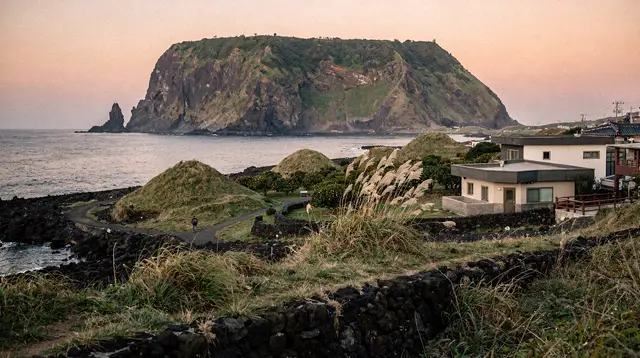
Gapado & Marado day trip guide
Can I visit both Gapado and Marado in one day?
Yes — both ferries depart from Moseulpo port in southwest Jeju, though they require separate crossings since the islands aren't connected to each other. A realistic single-day plan covers one island in the morning and the other in the afternoon, checking each ferry's schedule the day of your visit.
| Where | Moseulpo Port, southwest Jeju |
| Cost | Roughly ₩40,000-60,000/person for both islands, ferries+food |
| Time needed | Half-day for one island, full day for both |
| Getting there | Rental car recommended; limited public bus |
| Best time | Late spring for Gapado’s barley bloom |
Gapado and Marado are two small, quiet islands off Jeju’s southwestern coast, both reached by ferry from Moseulpo port, and both offering a distinctly calmer alternative to the more developed, more visited Udo. Gapado is known almost entirely for its barley fields, which turn a striking green-to-gold through spring and early summer; Marado, South Korea’s southernmost inhabited point, is dominated by a lighthouse and a scatter of restaurants that lean into the “southernmost” branding. Neither island is connected to the other by ferry, so visiting both in one day means two separate crossings from Moseulpo. Both islands reward travelers who’ve already experienced Udo and are looking for a quieter follow-up, or who simply prefer a slower, less commercially developed island-hopping experience from the start.
Getting to Moseulpo port
Moseulpo sits in southwest Jeju, near west Jeju and close to the town of Daejeong, roughly 50-60 minutes by car from Jeju City and somewhat closer from Seogwipo. There’s limited direct public bus service from Jeju City, making a rental car the practical way to reach the port independently, especially if trying to time a full day covering both islands.
Gapado: ferry, barley fields, and pace
Ferries to Gapado depart from Moseulpo on a roughly 15-minute crossing, with a more limited daily schedule than Udo’s — check current departure times before planning your day around a specific return sailing. Gapado is flat, small, and quiet: no crowds of tour buses, a handful of small restaurants near the dock, and a walkable loop of an hour or two on foot, with bikes also available to rent near the ferry landing for those who’d rather cover more ground. The island’s barley fields are its signature feature, particularly striking in the weeks before harvest when the barley turns from green to gold, timed with an annual barley festival on the island.
Because Gapado is so flat and open, it’s also one of the better spots on Jeju for an unobstructed view back toward Hallasan and Sanbangsan on the mainland — worth a slower look rather than a rushed walk-and-return.
Marado: lighthouse, “southernmost” branding, and realistic expectations
Marado is reachable by ferry from the same Moseulpo port, a separate crossing from the Gapado ferry. The island is dominated by a lighthouse and a handful of restaurants that lean heavily into the “southernmost” branding — a “southernmost restaurant,” a “southernmost café,” and similar. It’s walkable in under an hour end to end, and most visitors treat it as a symbolic stop — standing at Korea’s southernmost point — rather than a destination with deep sightseeing, which is a fair characterization. Go for the novelty and the lighthouse views, not expecting a full day’s worth of activities on the island itself.
How much time to allow for each island
Given Marado’s compact size, a visit there — including the ferry crossing, the walk to the lighthouse, and a meal at one of the “southernmost” establishments — typically fits into 2-3 hours door to door. Gapado, with its more spread-out barley fields and slower pace, benefits from a similar or slightly longer window, particularly during barley bloom season when lingering for photography adds meaningfully to the visit. Combined with the drive to and from Moseulpo, a single-island visit is a comfortable half-day commitment, while both islands together stretch into a fuller day.
Combining both islands in a single day
Since Gapado and Marado share a departure port but require separate ferry crossings, a realistic single-day plan means checking both islands’ ferry schedules in advance and sequencing your morning and afternoon around their departure times — there’s no single combined ticket or crossing that covers both. Given Marado’s smaller scope (under an hour to see) and Gapado’s slower, more scenic pace (an hour or two), most visitors find it comfortable to fit both into a single day if ferry timing cooperates, though this requires more schedule-watching than a single-island visit.
If schedules don’t align well on the day, prioritizing one island over cramming both in is the more relaxed approach — Gapado for barley-field scenery and a slower pace, Marado for the novelty of the southernmost point and a quick lighthouse visit.
Ferry logistics, honestly
Neither ferry can be booked with total certainty months in advance the way a flight can — schedules are published, but weather-driven cancellations happen often enough that experienced Jeju travelers treat any islet crossing as provisional until the morning of departure. This applies especially during typhoon season (late August-September) and winter storms. Bring cash for on-the-spot ticket purchases where online booking isn’t reliably available, and don’t schedule a tight connection between the two islands without slack in case one crossing runs late or is delayed.
Budget for a Gapado and Marado day
Ferry tickets from Moseulpo to each island run in a similar price range to Udo’s crossing, generally slightly less per ticket. Food on both islands — simple restaurants, cafés — runs comparable to or slightly above mainland Jeju prices, given the logistics of supplying small islands. Bike rental on Gapado, if you want to cover more ground than a walking loop allows, adds a modest amount on top. A day covering both islands, including ferries, a bike rental on Gapado, and meals, comes to a comparable range to a Udo day trip, generally in the ₩40,000-60,000 (US$30-45) per person range.
Photography on Gapado and Marado
Gapado’s barley fields, especially near peak bloom, offer some of the most distinctive agricultural landscape photography available on a Jeju day trip — wide shots capturing the fields’ sweep toward the coastline, with Hallasan sometimes visible in the distance on clear days, are the natural highlight. Marado’s photography centers more on the lighthouse and the dramatic sense of standing at land’s end, with coastal cliffs and open ocean views providing the main visual interest rather than any single dramatic landform. Both islands’ flat, open terrain means wind is a near-constant factor in outdoor photography — worth bracing for when shooting anything requiring a steady long exposure.
Best time of year to visit
Late spring, during Gapado’s barley bloom, is arguably the single best window to visit both islands together, combining Gapado’s most photogenic seasonal state with generally reliable ferry weather. Summer offers warm weather but carries typhoon risk in its later weeks; autumn is a dependable alternative with calm seas and comfortable temperatures, though without the barley bloom’s specific visual payoff. Winter visits are possible and considerably quieter, though wind exposure on both islands’ flat terrain is more pronounced, and ferry cancellations are somewhat more frequent.
What to pack
Wind is a constant on both crossings and across both islands’ flat, exposed terrain — a windbreaker is worth carrying regardless of season, and it matters even more here than on Udo given how little shelter either island offers. Sun protection is essential on Gapado’s open barley fields and Marado’s exposed lighthouse walk. Bring cash, since smaller vendors on both islands sometimes remain cash-preferred.
How these two islands compare to Udo
Visitors who’ve already done Udo and are deciding whether Gapado and Marado are worth the additional effort should recalibrate expectations: neither island offers Udo’s range of cafés, rental options, or well-worn tourist infrastructure. What they offer instead is a quieter, more understated experience — Gapado’s agricultural scenery and Marado’s symbolic “southernmost point” status — genuinely different in character from Udo’s more developed, more crowded appeal. Travelers specifically seeking solitude or a slower pace tend to find Gapado and Marado more rewarding on those terms, even though they lack Udo’s broader range of activities.
Where to stay if basing near Moseulpo
Most visitors day-trip to Gapado and Marado rather than overnighting, but if you want an early start or are combining the islands with other southwest Jeju sights, west Jeju towns near Moseulpo or nearby Daejeong offer practical bases within a short drive of the port.
Gapado’s barley festival
Gapado hosts an annual barley festival timed to the peak of the barley bloom, typically in the late spring window when the fields turn from green to a golden hue — an event that draws additional visitors specifically for the festival period, including food stalls, cultural performances, and photography opportunities centered on the fields themselves. Outside the festival window, the barley fields remain a scenic backdrop for a walk or cycle around the island, though without the added festival activity. If your trip timing happens to coincide with the festival, it’s worth checking current dates, since a barley-season visit adds a layer of local cultural experience beyond the usual quiet island walk.
Marado’s “southernmost” restaurants and cafés
Marado’s small commercial cluster leans heavily into its status as Korea’s southernmost inhabited point, with businesses branding themselves accordingly — a “southernmost restaurant,” “southernmost café,” and similar. These are largely simple, tourist-oriented establishments serving basic Korean fare and drinks rather than destination dining in their own right, but the novelty of eating at the “southernmost” version of a given business type is part of the appeal for many visitors, treated more as a memento of having been there than a serious culinary stop.
The lighthouse and Marado’s core landmark
Marado’s lighthouse, at the island’s edge, is the clear visual centerpiece of a Marado visit, marking Korea’s southernmost point and offering coastal views out toward the open ocean beyond. It’s a short, flat walk from the ferry landing, well within Marado’s under-an-hour full-island walking time, and functions as the natural endpoint for most visitors’ loop around the island before heading back to the ferry.
Cycling versus walking on Gapado
Gapado’s flat terrain makes bike rental a genuine option beyond walking, available near the ferry dock for visitors who want to cover the island’s loop more quickly or extend their exploration beyond the immediate area around the dock. Given the island’s small size, walking remains entirely practical for most visitors, and a bike adds convenience rather than being a necessity the way it functionally is for a full Udo perimeter loop — a reasonable optional upgrade rather than an essential rental.
An honest take
Gapado and Marado are quieter, more understated experiences than Udo, and travelers expecting Udo-level infrastructure — cafés, bike rental variety, a well-worn tourist loop — should recalibrate before visiting. Gapado’s barley fields are genuinely lovely in season but underwhelming outside the green-to-gold window; Marado’s appeal is largely symbolic rather than scenic. Both are worthwhile for travelers who specifically want a quieter island-hopping experience, but neither should be oversold as a must-do on the level of Seongsan Ilchulbong or Udo itself.
A quiet counterpoint to Jeju’s busier attractions
For travelers who’ve spent several days moving between Jeju’s more heavily visited sites — Seongsan Ilchulbong’s sunrise crowds, Manjanggul’s steady foot traffic, the queues at popular cafés and beaches — Gapado and Marado offer a genuine reset: minimal crowds, minimal commercial development, and a pace dictated entirely by the ferry schedule rather than by lines or timed-entry slots. This quality alone makes the pair worth considering even for travelers who don’t have a specific interest in barley fields or symbolic southernmost-point tourism, simply as a change of rhythm partway through a longer Jeju trip.
What to expect from the crossing itself
Neither the Gapado nor the Marado crossing feels like a major sea voyage — both are short, small-vessel hops rather than a large car-ferry experience, and seating is generally simple bench-style rather than assigned. Life jackets are provided and, on most operators, required for the duration of the crossing regardless of how calm conditions look. Both crossings run frequently enough in fair weather that arriving at the port without a reservation and simply buying a walk-up ticket for the next sailing is the normal approach, rather than needing to plan around a specific fixed departure time days in advance.
Traveling independently versus joining a tour
Gapado and Marado are straightforward enough to visit independently — buy a ferry ticket at Moseulpo, cross, walk or cycle the island, and return — without needing an organized tour to manage the logistics, unlike some of Jeju’s more complex multi-stop day trips. Because so few GYG tours cover these two islets specifically compared to the more heavily packaged Udo, independent travel is in practice the default and most common approach here, rather than an alternative to a well-established tour option. If you’d still like a hands-off day elsewhere on the island to balance a self-guided islet visit, a guided highlights day trip along the east course is a sensible companion. The private versus group day tours guide helps you decide which format suits you, and the ferries to the islets guide covers the crossings in broader terms.
Planning around the rest of your trip
Gapado and Marado slot best into a trip once you’ve settled the bigger decisions. The first-time Jeju planning guide and the how many days in Jeju guide help you judge whether a quiet islet day deserves a place in your schedule. Because the ferries are weather-dependent, it’s wise to read up on typhoon season before fixing the date, and to keep a flexible day in your plan. If you’re driving to the port, the car rental and IDP guide covers what you need, and the Udo island day trip guide is the natural comparison if you’re choosing between islets.
Making the most of a quieter island-hopping day
Travelers who prioritize a slower, less commercial pace over convenience and variety tend to come away from Gapado and Marado more satisfied than those expecting a scaled-down version of Udo. Approaching both islands with realistic, modest expectations — a scenic walk among barley fields, a symbolic stop at Korea’s southernmost point — rather than anticipating a packed day of activities is the surest way to enjoy what these two quieter islets genuinely offer.
Gapado versus Marado at a glance
| Gapado | Marado | |
|---|---|---|
| Signature feature | Barley fields | Lighthouse, southernmost point |
| Typical visit time | 1-2 hours | Under 1 hour |
| Best season | Late spring (barley bloom) | Any calm-weather season |
| Pace | Slower, more scenic | Quick, symbolic |
| Bike rental | Yes, near the dock | Not typically needed given size |
Combining with the rest of west Jeju
Since Moseulpo sits close to Daejeong and the west Jeju region generally, a Gapado or Marado morning pairs naturally with an afternoon exploring nearby Sanbangsan or the Yongmeori coastal cliffs, making the drive out to Moseulpo feel less like a single-purpose trip and more like one stop within a fuller west Jeju day. Travelers who’d rather not drive the rest of the day can pair the islet morning with a guided western Jeju outing built around UNESCO sites and sunset views, leaving the logistics to someone else. For a longer plan, the west Jeju day tour guide and the west Jeju itinerary show how the region fits together. See the Sanbangsan guide and Yongmeori coast guide for what else sits within easy reach of the same port.
Frequently asked questions about Gapado and Marado
Can Gapado and Marado be visited on the same day?
Yes, both depart from Moseulpo port, though they require separate ferry crossings since the islands aren’t connected to each other. Check both schedules in advance to plan a realistic sequence.
Which island is better to visit if I only have time for one?
Gapado, for its barley-field scenery and slower pace, if you want more to see. Marado, if the novelty of standing at Korea’s southernmost point matters more to you than scenery.
How long does it take to see Gapado?
An hour or two on foot for the full loop, or somewhat less by rental bike.
How long does it take to see Marado?
Under an hour end to end — it’s a small island best treated as a quick, symbolic stop rather than a half-day destination.
Is there much to eat on Gapado and Marado?
Both have a handful of small restaurants and cafés near the ferry landing, generally simple seafood or noodle options, priced comparably to or slightly above mainland Jeju.
How do I get to the Moseulpo ferry terminal?
By rental car (roughly 50-60 minutes from Jeju City) or organized tour; direct public bus service is limited, making a car the more reliable option.
Do ferries to Gapado and Marado run in winter?
Yes, though with more frequent weather-related cancellations than in spring or autumn — always check morning-of conditions before finalizing plans.
When is Gapado’s barley festival held?
Typically in late spring, timed to the peak of the barley bloom when the fields turn from green to gold — check current festival dates if you specifically want to time a visit around it.
Can I rent a bike on Gapado?
Yes, bike rental is available near the ferry dock, a convenient optional upgrade over walking given the island’s flat terrain, though walking remains entirely practical given Gapado’s small size.
What else can I combine with a Gapado or Marado day near Moseulpo?
Sanbangsan mountain and the Yongmeori coastal cliffs both sit within easy reach of Moseulpo, making it straightforward to build a fuller west Jeju day around the ferry crossing rather than treating it as a single-purpose trip.
Should I choose Gapado or Marado if I can only do one?
Gapado, for its barley-field scenery and slower pace, if you want more to see and are visiting in late spring. Marado, if the novelty of standing at Korea’s southernmost point matters more to you than scenery, or if your schedule only allows a very short stop.
Related guides

Ferry schedules to Jeju's islets
Ferry schedules for Udo, Gapado, and Marado — departure ports, crossing times, prices, and what to do when weather cancels a sailing.

Udo Island day trip guide
Udo Island day trip guide: ferry schedules from Seongsan, e-bike vs scooter rental, a suggested loop route, and how much the whole day realistically costs.

Ferries to Udo, Gapado and Marado
Ferry schedules, prices, and cancellation risk for the boats to Udo, Gapado, and Marado from Jeju Island.

Camellia Hill
Camellia Hill is a 6,000-tree camellia garden in west Jeju, at its best from November through March. Bloom timing, entry fees, and what else to see there.
Ready to book? Top tours for this guide
We earn a small commission if you book through GetYourGuide — at no extra cost to you. Every tour is hand-picked and verified.