
Seogwipo old town walking tour
What's in Seogwipo's old town worth a walking tour?
Seogwipo's compact old town centers on Lee Jung-seop Street, named for the Korean painter who lived there during the Korean War, alongside a small history museum, the Maeil Olle Market, and the old harbor area. A self-guided walk covering these takes about 2-3 hours and works well combined with sunset at the harbor.
Seogwipo’s old town is smaller and quieter than Jeju City’s downtown core, but it has its own distinct cultural layer worth an unhurried walk — centered on a Korean modernist painter’s wartime refuge, a genuinely local covered market, and an old harbor that still feels more like a working fishing port than a resort-town waterfront. None of it requires a car, a ticket, or advance planning beyond comfortable shoes and a rough sense of the route.
| Where | Seogwipo old town, centered on Lee Jung-seop Street |
| Cost | Free to walk; museum entry under ₩2,000 |
| Time needed | 2-3 hours, unhurried |
| Best time | Mid-afternoon into sunset at the harbor |
| Getting there | Walkable from central Seogwipo accommodation |
Lee Jung-seop Street and House
The walk’s cultural anchor is the small house where painter Lee Jung-seop lived with his family for roughly a year during the Korean War in the early 1950s, after fleeing fighting on the mainland. Lee is considered one of modern Korea’s most significant painters, known for expressive, often melancholic work depicting bulls, children, and family separation themes that drew directly on his own wartime displacement — including forced separation from his wife and children, who relocated to Japan during the war and whom he was never able to reunite with before his death in 1956.
The preserved house is modest, reflecting the genuine hardship of the family’s wartime circumstances rather than any romanticized version of an artist’s residence, and a small adjacent museum displays reproductions of his work along with biographical context. The surrounding street, now branded as a small arts district with galleries, cafes, and public art installations referencing his style, extends the site’s cultural footprint well beyond the house itself, though the newer commercial additions are a noticeably different register from the historical core.
Lee Jung-seop’s artistic legacy in more depth
Lee Jung-seop’s work is held in high regard within Korean art history partly for its emotional directness at a time when much Korean art was more formally conservative, and partly because his biography — wartime displacement, poverty, and a tragic personal life that included his final years marked by illness and isolation before his death in 1956 at just 40 — has become something of a symbol for the broader trauma the Korean War inflicted on ordinary families, including families separated across what became, after the war, an impassable border. His bull paintings in particular, often interpreted as expressing both vitality and suffering simultaneously, are among the most recognized images in modern Korean art, reproduced widely enough that Korean visitors frequently recognize them even without deep art history background.
The Seogwipo period represents a relatively rare stretch of stability in Lee’s difficult later life, and the preserved house — modest by any standard, reflecting genuine wartime hardship rather than an artist’s romanticized retreat — offers a tangible connection to that period specifically, distinct from his more turbulent years before and after. The surrounding street’s gallery and cafe additions, developed considerably later as Seogwipo leaned into the Lee Jung-seop connection as a cultural tourism asset, represent a different, more commercially developed layer worth recognizing as distinct from the historical core itself.
Maeil Olle Market
A short walk from Lee Jung-seop Street, the Maeil Olle Market is Seogwipo’s main covered traditional market — smaller and more locally oriented than Jeju City’s Dongmun Market, with produce and seafood stalls reflecting Seogwipo’s specific coastal and agricultural surroundings rather than island-wide sourcing. A night-market food-stall section extends the market’s hours into the evening, offering a more casual, standing-and-eating alternative to a sit-down dinner, popular with both locals and visitors staying nearby.
The market’s smaller scale compared to Dongmun makes it easier to browse without feeling rushed or crowded, though it also means a somewhat narrower selection — worth knowing if you’re comparing the two rather than visiting both.
Lee Jung-seop’s connection to Jeju’s wartime history
The wartime displacement that brought Lee Jung-seop to Seogwipo was part of a much larger movement of refugees to Jeju during the Korean War, when the island served as a relatively safe haven for civilians fleeing fighting on the mainland, even as Jeju itself was still recovering from the trauma of the 4.3 Incident that had only recently subsided. This overlap — an island absorbing mainland war refugees while still processing its own recent civilian tragedy — is a detail rarely foregrounded in standard tourism material about Lee Jung-seop’s Seogwipo period, but it adds useful context for visitors already engaging with Jeju’s 20th-century history elsewhere on this site, showing how the island’s wartime experience intersected with broader Korean historical currents beyond its own internal conflict.
The old harbor
Seogwipo’s old harbor area retains a working fishing-port character that contrasts with the more manicured resort infrastructure further along the coast toward Jungmun. Fishing boats still dock here, and the surrounding waterfront, while modernized with a promenade and some newer commercial development, hasn’t been fully converted into a purely tourist-facing space. It’s a reasonable spot to end a walking route, particularly timed for sunset, when the harbor’s working-boat silhouettes against the evening sky give a more grounded, less staged version of a “scenic coastal sunset” than some of Jeju’s more heavily marketed viewpoints.
Seasonal variations of the walk
The old town route works year-round, but its character shifts meaningfully with the seasons. Spring and autumn offer the most comfortable walking conditions and the clearest light for photography along the harbor and gallery street. Summer brings heat and humidity that make the covered sections of Maeil Olle Market a welcome respite, along with a livelier evening night-market atmosphere as visitors and locals alike wait out the day’s heat before venturing out. Winter, while cooler and windier than the mainland equivalent, remains mild enough by Korean standards to walk comfortably, and the reduced tourist crowds during this off-peak season give the old town a quieter, more genuinely local feel than the busier spring and summer months.
A suggested route and timing
A workable sequence starts at Lee Jung-seop Street in the mid-to-late afternoon, allowing 45-60 minutes for the house, small museum, and surrounding gallery street, followed by a 15-20 minute walk to Maeil Olle Market for an early dinner or snack browsing, and finishing with a walk to the old harbor timed for sunset — roughly 2-3 hours total at an unhurried pace, longer with a full sit-down meal factored in.
For a more structured version of essentially this same route with narrated historical context, Jeju: Seogwipo Old Town Walking Tour at Sunset covers similar ground with a guide, useful for visitors who want the historical and cultural background filled in rather than relying on posted signage, which is not always thorough in English.
Combining with Seogwipo’s art museums
Seogwipo’s old town connects naturally to the city’s broader art and museum offerings, given the Lee Jung-seop legacy’s influence on the area’s identity as an arts-adjacent district. Jeju: Art Museum Walking Tour in Seogwipo extends the walking-tour concept to cover additional gallery and museum stops beyond the old town core, a reasonable next step for visitors who found the Lee Jung-seop site particularly engaging and want more.
Extending the day
Visitors with more time can combine the old town walk with a visit to Yakcheonsa Temple near Jungmun, roughly 15-20 minutes away by car, or the broader Jungmun area culture walk, which covers a different cluster of cultural stops closer to the resort district. For visitors interested in Jeju’s wider museum landscape, the island’s museum roundup covers additional options both in Seogwipo and further afield.
Small galleries and shops along the arts street
Beyond the main Lee Jung-seop House itself, the surrounding streets host a rotating mix of small independent galleries showing contemporary Korean art, craft shops selling ceramics and textiles from local and mainland artisans, and cafes that lean into the neighborhood’s arts-district branding with rotating small exhibitions of their own on interior walls. Quality and curation vary considerably between venues, as is typical of an organically developed gallery district rather than a centrally curated art precinct, and browsing a few storefronts before committing significant time to any single gallery is a reasonable approach for visitors without a specific gallery already in mind.
Practical notes
The old town route is largely flat and walkable, with much of Lee Jung-seop Street pedestrianized or lightly trafficked, making it manageable for families with strollers or visitors who prefer not to drive for a short cultural outing. No admission fee applies to walking the street itself; the small Lee Jung-seop museum typically charges a nominal entry fee, usually under ₩2,000. The market and harbor areas are free to walk, with costs limited to whatever food or goods you choose to buy along the way.
Getting there
The old town core is within walking distance of much of central Seogwipo’s accommodation, and a short taxi ride from anywhere else in the city. Visitors based in Jeju City should budget 45-60 minutes for the drive south, making this a reasonable half-day add-on to a broader Seogwipo-focused itinerary rather than a standalone day trip from the north of the island.
How much the walk costs beyond entry
Aside from the museum’s nominal entry fee, the route’s cost is entirely up to you — a coffee, a market snack, or a full harbor-view dinner can range from a couple thousand won to a proper restaurant tab, making this one of the more budget-flexible half-days available in Seogwipo.
Rain and cold-weather notes
The old town route holds up reasonably well in light rain, since much of Lee Jung-seop Street and the Maeil Olle Market’s covered sections offer some shelter, though the harbor portion loses much of its appeal in poor weather or heavy wind. Winter visits remain comfortable by regional standards, though the harbor stretch can feel genuinely cold and exposed compared to the more sheltered market and gallery street — a warmer layer for the final harbor stretch is worth packing even if the earlier part of the walk feels mild.
A one-day Seogwipo culture itinerary beyond the old town
Visitors with a full day in Seogwipo, rather than just the old town walk, can reasonably combine this route with Cheonjiyeon Waterfall or Yakcheonsa Temple in the morning, saving the old town walk itself for the afternoon into sunset, when the light along the harbor and gallery street is at its best. The one day in Seogwipo guide lays out a fuller version of this kind of combined itinerary if you want a more structured plan for the whole day rather than just the walking route.
Photography along the route
The old town’s most rewarding photo subjects aren’t grand landscapes but small, human-scale details — the preserved simplicity of the Lee Jung-seop House, the gallery street’s public art referencing his bull paintings, the market’s produce stalls in late-afternoon light, and the harbor’s working fishing boats silhouetted at sunset. A standard walk-around lens handles the whole route well; there’s no need for specialized equipment the way a wide-angle might matter more at a cliff or coastal viewpoint elsewhere on the island.
Food stops along the route
Beyond the Maeil Olle Market’s night-food-stall section, the streets around Lee Jung-seop Street have a reasonable cluster of small cafes and restaurants, ranging from simple noodle shops to more design-conscious cafes that lean into the arts-district branding of the surrounding streets. None of it requires reservations for a small group, and portion sizes and prices skew toward casual, walk-in dining rather than a formal sit-down meal — consistent with the route’s overall unhurried, self-guided character. For a fuller picture of where to eat in the wider city, see the Seogwipo restaurants guide.
Frequently asked questions about the Seogwipo old town walk
How long does the Seogwipo old town walking route take?
About 2-3 hours at an unhurried pace, including time at the Lee Jung-seop House and Street of Art, the Maeil Olle Market, and the old harbor area; longer with meal stops.
Who was Lee Jung-seop and why does Seogwipo have a street named for him?
Lee Jung-seop was a prominent Korean modernist painter who took refuge in Seogwipo with his family during the Korean War in the early 1950s; the small house where they lived is preserved as a memorial, and the surrounding street is now dedicated to his legacy and local art.
Is the Maeil Olle Market different from Dongmun Market?
Yes — Maeil Olle Market is Seogwipo’s main covered market, smaller and more locally focused than Jeju City’s Dongmun Market, with a strong emphasis on Seogwipo-area produce and seafood, plus a lively night-market food-stall section.
Is this walking tour good at sunset?
Yes — timing the route to end at Seogwipo’s old harbor or the nearby coastal walkway for sunset is a natural and popular way to close out the walk.
Can this walk be done with children?
Yes, it’s flat, compact, and largely pedestrianized in its central sections, making it manageable with a stroller or young children, though the market’s crowds at peak times require some navigation.
Is a guided version of this walk available?
Yes, guided sunset walking tours covering similar ground are available and add narrated historical and cultural context that isn’t always evident from self-guided signage alone.
Related guides

Jungmun area culture walk
A half-day cultural route through the Jungmun resort area — Yakcheonsa Temple, coastal art stops, and cliffside walks beyond the resort strip itself.

Jeju Folk Village
A practical guide to Jeju Folk Village, the open-air museum in Pyoseon: reconstructed houses, admission, hours, and whether it's worth visiting.

Yakcheonsa Temple
Yakcheonsa is one of Asia's largest Buddhist temple halls, near Jungmun in Seogwipo — hours, etiquette, and how to combine it with a temple stay.
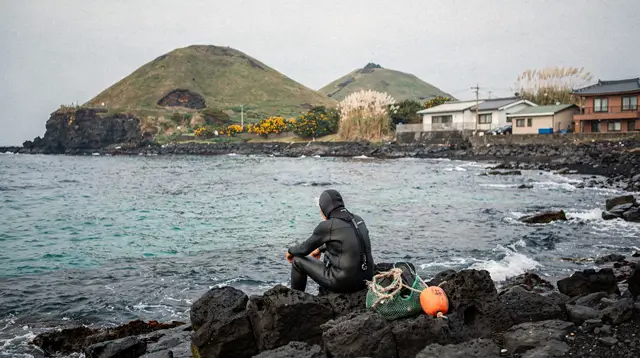
Haenyeo: Jeju's Sea Women
Who Jeju's haenyeo sea women are, where to see them dive, and how to experience this UNESCO-listed living tradition without turning it into a photo op.
Ready to book? Top tours for this guide
We earn a small commission if you book through GetYourGuide — at no extra cost to you. Every tour is hand-picked and verified.
Jeju East: Small Group Healing Tour w/Woman Divers Show
Jeju: Eastern UNESCO Sites Tour with Haenyeo Show
Jeju: Eastern UNESCO Join-in Tour (Seongsan, Haenyeo Show)

Jeju: 4.3 Incident History & Cultural Tour with a Guide
Jeju: 4.3 Incident History & Cultural Tour with a Guide (SW)