
Jeju dialect: a language apart
Is Jeju dialect really that different from standard Korean?
Yes — Jeju's traditional speech, sometimes called Jejueo, differs enough in vocabulary, grammar, and pronunciation that some linguists classify it as a separate language within the Koreanic family rather than a dialect of standard Korean, and UNESCO has listed it as critically endangered. Mutual intelligibility with mainland Korean speakers is limited, especially with older, fuller forms of the speech.
Most visitors to Jeju never realize that the island has its own distinct traditional speech, different enough from standard Korean that some linguists classify it as a separate language rather than a regional dialect. Called Jejueo by researchers, or simply “Jeju mal” (Jeju speech) locally, it developed in relative isolation from mainland Korean over centuries, shaped by the island’s geographic separation, distinct history, and — in more recent decades — the demographic and social upheaval of the 20th century.
| Status | UNESCO-listed critically endangered (2010) |
| Where to hear it | rural villages, older haenyeo divers |
| Tourism impact | none — all staff speak standard Korean |
| Best starting point | Haenyeo Museum, place-name etymology |
| Time needed | a curiosity worth an hour of reading, not a detour |
Why Jeju’s speech diverged so far from standard Korean
Jeju sits roughly 90 kilometers off Korea’s southern coast, and that distance, combined with the island’s relatively late and limited integration into mainland Korean political and administrative systems for much of its pre-modern history, allowed its spoken language to evolve along its own path. Vocabulary specific to the island’s volcanic terrain, agricultural practices distinct from mainland farming, and — most notably — the vocabulary of haenyeo diving culture, developed independently, producing words and expressions with no direct standard-Korean equivalent.
Grammatically, Jeju dialect retains verb endings, vowel sounds, and sentence structures that either don’t exist in standard Korean or have shifted meaningfully from historical forms preserved on the mainland. Some linguists argue Jejueo actually preserves older features of the Korean language family that have since disappeared from the mainland standard, making it linguistically significant beyond just its regional distinctiveness — a kind of living record of an earlier stage of Koreanic language development.
Example vocabulary and features
A few frequently cited examples give a concrete sense of the divergence. Jeju dialect retains an “aeae” vowel sound (often transliterated as a symbol resembling standard Korean’s “a” written with an additional mark) that disappeared from standard Korean centuries ago but survives in Jeju speech — a detail linguists point to as evidence the dialect preserves genuinely archaic features rather than simply representing a modern regional accent. Everyday vocabulary also differs substantially: common words for basic concepts like “what,” “where,” and various kinship terms take different forms in Jeju speech than their standard Korean equivalents, to a degree that goes well beyond the milder regional vocabulary variation found between, say, Seoul and Busan dialects of standard Korean.
Verb ending systems, which carry significant grammatical and social meaning in Korean generally (indicating politeness level, tense, and sentence type), follow different patterns in Jeju dialect, contributing significantly to the difficulty mainland Korean speakers have understanding fluent Jeju speech in real time, even when individual vocabulary items might be guessable from context.
A separate language or a dialect? The debate
Within Korea, official and educational framing generally treats Jeju speech as a regional dialect (bang-eon) of Korean, consistent with a broader Korean linguistic and cultural tradition of treating the nation’s language as fundamentally unified despite regional variation. A number of international linguists, however, classify Jejueo as a distinct language within the Koreanic language family — not a dialect of Korean, but a closely related sibling language — based on the scale of grammatical divergence and limited mutual intelligibility with standard Korean speakers, particularly for older, fuller forms of the speech rather than a lightly accented version of standard Korean.
This classification debate isn’t merely academic; UNESCO’s 2010 designation of Jejueo as critically endangered used language-level criteria, a significant marker that treats its potential loss as more consequential than the disappearance of a regional accent or vocabulary set would typically be considered.
Place names as living fossils of the dialect
Even for visitors who never hear the dialect spoken, its influence surfaces constantly in Jeju’s place names, many of which derive from dialect terms rather than standard Korean vocabulary. Descriptive elements common in Jeju village and landmark names — referring to terrain features, water sources, or historical land uses — often reflect older dialect forms that would not be immediately transparent to a standard-Korean speaker without local knowledge, similar to how many English place names retain elements of older or regional dialects no longer in everyday use. This layer of linguistic history embedded in the map itself is one of the more accessible ways the dialect’s legacy persists in daily life, encountered by every visitor reading a road sign or destination name, even without any direct exposure to spoken Jejueo.
Why the dialect is disappearing
Several overlapping forces have driven Jeju dialect’s decline over the past century. Standard-Korean-only education policy, in place for decades across the country, actively discouraged dialect use in schools nationwide, a pattern that hit Jeju’s linguistically distinct speech harder than milder regional dialects on the mainland. Population shifts — younger residents leaving for education and work on the mainland, and mainland Koreans relocating to Jeju as the island’s tourism economy grew — diluted the concentration of native dialect speakers within the local population.
Perhaps most significantly, the mass civilian deaths and displacement of the 4.3 Incident between 1948 and 1954 disrupted exactly the rural, mid-mountain village communities where the dialect was most fully preserved, killing or displacing tens of thousands of people from the communities that would otherwise have passed the fullest, most traditional forms of the speech to subsequent generations. The dialect’s decline and the island’s most traumatic historical event are, in this sense, directly connected — one more reason understanding 4.3 matters for understanding several other threads of Jeju’s contemporary cultural landscape.
Comparison to other endangered regional languages
Jejueo’s situation has parallels with endangered regional and minority languages elsewhere, in that its decline reflects a common global pattern: a historically distinct spoken tradition losing ground to a politically and economically dominant standard language through generations of centralized education policy, urban migration, and shifting economic incentives that favor fluency in the broader national language over a regionally confined one. UNESCO’s endangered-language framework has documented thousands of similar cases worldwide, and Jejueo’s inclusion places Jeju’s cultural heritage within that much larger, ongoing global pattern of linguistic homogenization — a useful frame for visitors familiar with similar dynamics affecting minority or regional languages in their own countries.
Where the dialect survives today
Fluent traditional speakers today are concentrated among older residents, generally in their 70s and beyond, particularly in rural villages away from Jeju City and the tourism-heavy coastal resort areas. Haenyeo divers, many of whom are themselves elderly, retain dialect-specific vocabulary tied to diving conditions, sea terrain, and equipment that has no standard-Korean equivalent — a linguistic layer embedded directly within the UNESCO-recognized diving tradition itself. Younger Jeju residents typically speak standard Korean as their primary language, sometimes with some dialect vocabulary or intonation patterns absorbed from grandparents, but rarely with full traditional grammatical competence.
Visitors are extremely unlikely to encounter dialect in any tourism-facing context — hotel staff, restaurant workers, and tour guides across the island communicate in standard Korean (and often English), regardless of their own family background with the dialect.
Preservation efforts
Jeju’s provincial government funds dialect documentation and education initiatives, including efforts to introduce dialect vocabulary and awareness into local school curricula, alongside academic linguistic research projects recording remaining fluent speakers before the generation that holds the fullest traditional forms of the speech passes on. UNESCO’s endangered-language listing has raised international academic and cultural attention, though translating that attention into a meaningful reversal of the decline remains, by most accounts, an uphill effort given the demographic realities involved.
Resources for curious visitors
Visitors with a genuine interest in the dialect beyond a passing curiosity have a few practical avenues, though none are aimed specifically at tourists. Academic linguistic papers on Jejueo, some available in English through university repositories, cover its grammar and phonology in technical detail. The Jeju provincial government’s cultural heritage division publishes some general-audience material on the dialect as part of broader cultural preservation communications, occasionally translated into English or summarized in tourism-adjacent cultural content.
Local cultural centers and, occasionally, the Haenyeo Museum itself can point interested visitors toward current documentation projects or community initiatives, though language learning in any structured sense isn’t something set up for short-term visitors given how few speakers remain and how concentrated they are among elderly residents in specific villages.
Why this matters for visitors beyond curiosity
Jeju dialect connects directly to several other cultural threads covered elsewhere on this site. The distinct vocabulary around dol hareubang and older place names across the island often derives from dialect terms rather than standard Korean, and the broader sense that Jeju is culturally “a place apart” from mainland Korea — a framing this site uses in describing the island’s positioning — has real linguistic grounding in the dialect’s genuine divergence, not just tourism marketing language. Understanding that Jeju’s cultural distinctiveness extends down to the level of language, not just food, architecture, and folk practices, gives useful context for engaging with the rest of the island’s heritage more thoughtfully.
Where dialect vocabulary clusters
Rather than isolated words, dialect divergence clusters most heavily around a few domains tied to island life: terrain and geology (words for volcanic cones, lava rock formations, and specific coastal features), diving and sea conditions (the haenyeo-specific vocabulary referenced above), and kinship and honorific terms, where verb endings and address forms differ enough from standard Korean to affect basic conversation, not just isolated nouns. The most visible everyday example for visitors is dol hareubang itself — “hareubang” is dialect for grandfather, distinct from the standard Korean “harabeoji,” and it’s a word every visitor to Jeju ends up using without necessarily realizing it’s dialect rather than standard Korean.
Hearing dialect-adjacent culture on a haenyeo experience
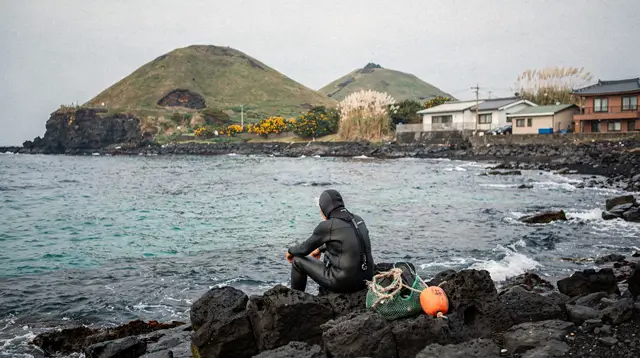
Since fluent dialect speakers are concentrated among older haenyeo, a guided haenyeo culture experience is one of the more genuine ways a visitor might encounter dialect-inflected speech firsthand, alongside the diving tradition itself. It’s not a language lesson, but the cultural context around the divers’ vocabulary and storytelling gives a more textured sense of the dialect’s living context than reading about it alone.
Jeju haenyeo culture experience with seafood tastingA few common visitor misconceptions
A handful of assumptions trip up curious visitors reading about Jeju dialect for the first time. It’s not simply a heavier regional accent the way some visitors assume — the grammatical and lexical divergence goes well beyond pronunciation. It’s also not something you’ll casually overhear in Jeju City cafes or tourist areas, since virtually all tourism-facing staff use standard Korean regardless of their own family background. And it isn’t taught in any structured short-term visitor program, so arriving hoping for even a basic phrasebook-level lesson will likely disappoint — the more realistic goal is understanding the dialect’s cultural significance rather than learning to speak it.
Reading the island’s names as you travel
The most practical way to put this guide to use is to keep your ear and eye open as you move around. Names on signs, bus stops and maps often carry dialect forms, so a drive along the coast or a day on the island bus network becomes a small exercise in reading. The same goes for the Olle trail routes, where village and shoreline names are posted along the way, and for the cones you meet on an oreum hike, since “oreum” is itself an island word for a volcanic cone.
Towns and districts reward the same curiosity. Villages such as Hado and Gujwa on the eastern shore are closely tied to the diving tradition, and Seongsan sits within a landscape whose place names reflect the terrain. Walking through them with a little background makes the labels on a map feel less arbitrary.
Pairing the dialect with a day out
Language is easiest to appreciate alongside the sites it describes. The UNESCO sites day tour guide shows how to string together the island’s recognised places, and many of the stories you hear along the way, from sea-women to stone guardians, rest on words that only exist in Jeju speech. If you prefer not to drive, a guided day lets you ask the guide about local terms as they come up, and the private versus group tours comparison helps you choose a format that leaves room for those questions.
For a ready-made route through the south of the island, a day tour of the southern UNESCO-recognised sites gives plenty of occasions to hear how island names and stories fit together. Those who want to dig into the culture further can also read the folk village guide, which shows traditional island life in a setting where older vocabulary still makes sense.
Frequently asked questions about Jeju dialect
Is Jeju dialect a language or a dialect of Korean?
Linguistic classification is debated — Korean linguistic tradition generally treats it as a regional dialect, while a number of international linguists classify Jejueo as a distinct language within the Koreanic language family, given its significant grammatical and lexical divergence from standard Korean.
Why is Jeju dialect endangered?
UNESCO listed it as critically endangered in 2010, reflecting a shrinking base of older, mostly elderly fluent speakers, decades of standard-Korean-only education policy, and the 20th-century upheavals — particularly the 4.3 Incident — that disrupted the communities where the dialect was most concentrated.
Can I hear Jeju dialect spoken as a visitor?
It’s most likely among older residents in rural villages and among haenyeo divers, who use dialect-specific diving and sea-related vocabulary; most younger Jeju residents and virtually all tourism-industry staff speak standard Korean.
Are there efforts to preserve Jeju dialect?
Yes — Jeju provincial government programs, academic linguistic documentation projects, and community initiatives including dialect education for children aim to slow the decline, alongside UNESCO’s endangered-language listing raising international awareness.
What are some example differences between Jeju dialect and standard Korean?
Jeju dialect uses distinct vocabulary for everyday words, different verb endings and honorific structures, and vowel sounds not present in standard Korean, along with specialized terms tied to diving, farming, and volcanic terrain that have no standard-Korean equivalent.
Does the Haenyeo Museum discuss the dialect?
Indirectly, yes — some exhibits reference dialect-specific diving terminology used by haenyeo, though the museum’s focus is the diving tradition itself rather than a dedicated linguistic exhibition.
Related guides
Haenyeo: Jeju's Sea Women
Who Jeju's haenyeo sea women are, where to see them dive, and how to experience this UNESCO-listed living tradition without turning it into a photo op.

The Jeju 4.3 incident: history explained
What the Jeju 4.3 Incident was, why it still matters, and how to visit the Jeju 4.3 Peace Park and related sites respectfully and with proper context.

Jeju's best museums: a 100+ roundup
Jeju has over 100 museums, from serious art institutions to novelty theme collections — a practical guide to which ones actually deserve your time.

K-drama filming locations in Jeju
Where popular K-dramas filmed on Jeju, from When Life Gives You Tangerines to older classics — practical visiting info for each real-world location.
Ready to book? Top tours for this guide
We earn a small commission if you book through GetYourGuide — at no extra cost to you. Every tour is hand-picked and verified.
Jeju East: Small Group Healing Tour w/Woman Divers Show
Jeju: Eastern UNESCO Sites Tour with Haenyeo Show
Jeju: Eastern UNESCO Join-in Tour (Seongsan, Haenyeo Show)
Jeju: 4.3 Incident History & Cultural Tour with a Guide
Jeju: 4.3 Incident History & Cultural Tour with a Guide (SW)