
Jeju abalone and seafood: what to eat and where
What is Jeju's signature seafood dish?
Jeonbok-juk, a thick porridge made with abalone and its liver, cooked in sesame oil, is Jeju's most distinctive seafood dish. A bowl costs ₩15,000-20,000 (about US$11-15) at a specialist restaurant, more at resort-area menus.
Jeju’s coastal waters, and the haenyeo divers who have worked them for generations, are the backbone of the island’s seafood identity. Abalone in particular carries a cultural weight beyond its price tag — it’s the dish most closely associated with the haenyeo tradition, and it’s worth understanding before you order.
| Signature dish | Jeonbok-juk (abalone porridge), around ₩15,000-20,000 |
| Where | Seongsan for abalone specialists; coastal towns islandwide |
| Cost for two | Around ₩50,000-90,000 for a fuller seafood meal |
| Best avoided | Restaurants directly at scenic-viewpoint parking lots |
| Booking | Not usually needed except peak-season Seongsan lunches |
Jeonbok-juk: the signature dish
Jeonbok-juk is a thick rice porridge cooked with sliced abalone meat and, distinctively, the abalone’s liver, which turns the porridge a pale green-grey and contributes most of its deeper flavor beyond the abalone meat itself. It’s finished with a generous amount of sesame oil, giving it a glossy texture and nutty aroma that’s fairly different from plain Korean rice porridge (juk) served elsewhere for illness or recovery.
A bowl costs ₩15,000-20,000 (about US$11-15) at a dedicated seafood or porridge restaurant, which is reasonable relative to how much abalone realistically goes into a single serving — expect a modest amount of sliced abalone rather than a whole animal’s worth of meat, since porridge is a way to make a smaller quantity of an expensive ingredient go further and taste concentrated rather than a display of abundance.
Abalone beyond the porridge
Whole or sliced abalone shows up prepared several other ways: grilled in the shell over charcoal (jeonbok-gui), raw as sashimi (jeonbok-hoe) with a chewy, almost crunchy texture very different from the porridge, and braised in soy-based sauce (jeonbok-jorim) as a side dish or banchan at some restaurants. Grilled and raw preparations run considerably higher than porridge — ₩30,000-60,000 depending on size and how many pieces are included — since these dishes are priced by the abalone itself rather than as an ingredient stretched across a bowl of rice.
Seongsan, on Jeju’s east side near Seongsan Ilchulbong, has several restaurants built specifically around abalone dishes, reflecting the area’s historical haenyeo diving grounds. Myeongjin Jeonbok, a long-running restaurant in the area specializing in abalone doenjang-jjigae (soybean paste stew with abalone), is one of the more consistently recommended options for trying abalone in a stew format rather than porridge or sashimi.
The haenyeo connection
Haenyeo — free-diving women who harvest abalone, conch, sea urchin, and seaweed without oxygen tanks, diving repeatedly to depths of several meters and holding their breath for a minute or more per dive — are recognized by UNESCO as an Intangible Cultural Heritage practice, and Jeju treats the tradition as central to its identity. The honest caveat worth knowing: not all seafood sold as “haenyeo-caught” in restaurants can be verified as such, and a meaningful share of the abalone supply chain now includes farmed abalone or seafood from conventional fishing boats rather than free-diving harvest. This doesn’t make the seafood lower quality, but it does mean the “caught by haenyeo this morning” framing on some tourist menus should be taken as marketing rather than a guaranteed fact.
For a more direct, verifiable connection to the tradition, a haenyeo culture experience with a seafood tasting component gives you both context — often from a retired or active haenyeo herself, or a guide with direct family connection to the practice — and a meal where the seafood provenance is actually explained rather than assumed:
Haenyeo culture experience with seafood tastingThis kind of tasting experience is a reasonable way to understand the diving tradition and the food it produces together, rather than treating them as separate topics — worth building into an east-side day that also covers the East Jeju coastal attractions.
Small haenyeo seafood huts
Beyond formal restaurants, small haenyeo-run seafood stalls — plastic tables and chairs set up directly by the coast, often with a tank or cooler of the day’s catch — operate in several coastal areas, particularly around Seongsan and near Hamdeok. These are less polished than a sit-down restaurant and menus are rarely in English, but they offer the most direct version of “seafood caught that morning, prepared simply” available on the island, usually raw sliced abalone or conch with a chili-vinegar dipping sauce, priced by weight and negotiated somewhat informally. Expect to pay a similar or slightly lower rate than a restaurant for comparable abalone, with the tradeoff being a much more basic dining setup — plastic stools, no menu translation, and cash-only in many cases.
How haenyeo diving actually works
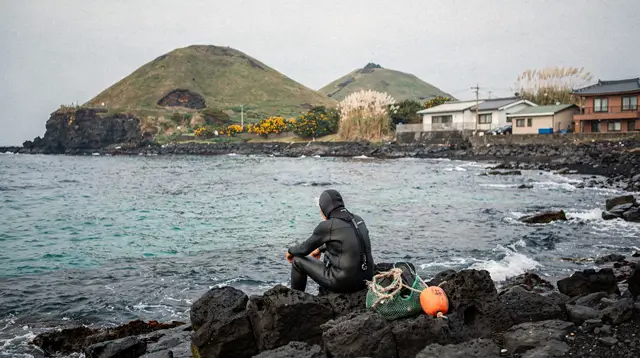
Haenyeo dive without oxygen tanks or modern breathing equipment, relying on trained breath-holding, a weighted belt, and a floating buoy (taewak) that marks their position and carries a net bag for the day’s catch. A working dive session typically runs several hours, with divers surfacing periodically to breathe — often with a distinctive whistling exhale (sumbisori) that’s become a recognizable part of the practice — before descending again. Traditional wetsuits (once cotton, now neoprene) offer some insulation, but Jeju’s coastal water is genuinely cold outside of summer, and the physical toll of the work over a career is well documented; many active haenyeo today are in their 60s, 70s, or older, having done this work for decades.
The East Jeju coast, particularly around Seongsan, Hado, and Sehwa, has some of the highest concentrations of active haenyeo communities remaining, and small haenyeo museums or interpretive centers in the area explain the practice, its economics (divers are typically organized into local cooperatives with defined diving grounds and shared income arrangements), and its decline in more depth than a restaurant meal alone can convey.
If the diving side of the story interests you as much as the food, the haenyeo culture guide and the haenyeo museum guide go deeper into how the tradition works and where to see it explained. The blog piece haenyeo explained is a shorter read, and the fishing villages of Hado and Sehwa are natural places to combine a seafood stop with a look at the working coast.
Grading and pricing abalone
Abalone size and grade materially affect price — a small abalone (a few centimeters across) used in porridge or as a garnish costs far less per piece than a large abalone (10cm or more) served whole, grilled or raw, which restaurants price individually rather than by weight in many cases. Menus that list abalone dishes by size grade (small/medium/large, or a specific centimeter measurement) are being more transparent than ones that simply list “abalone” with a single price, since the latter leaves room for a restaurant to serve a smaller animal than a customer might expect at that price point. When in doubt, ask to see the size of the abalone before it’s prepared — a reasonable and common request at seafood restaurants.
Abalone dishes at a glance
| Dish | Preparation | Typical price |
|---|---|---|
| Jeonbok-juk | Porridge with sliced abalone and liver | ₩15,000-20,000/bowl |
| Jeonbok-gui | Grilled in the shell | ₩30,000-60,000, by size |
| Jeonbok-hoe | Raw, sliced | ₩30,000-60,000, by size |
| Jeonbok-jorim | Braised in soy sauce, as a side | Usually included with a set, not sold alone |
Porridge remains the most accessible entry point precisely because it stretches a small quantity of abalone across a full bowl; grilled and raw preparations are priced closer to the ingredient’s real market cost.
Pairing seafood with local drinks
Soju and Korean-style beer are the default pairings at most seafood restaurants, but Jeju’s own makgeolli (a milky, lightly fizzy rice wine), sometimes made with local ingredients like hallabong citrus in a modern twist, is worth trying alongside a seafood platter if it’s on the menu — its slight sweetness and low alcohol content complement raw seafood’s brininess well. Restaurants specializing in abalone and other shellfish often carry a house or regional makgeolli specifically for this pairing, distinct from the mass-market versions available at any convenience store.
Haenyeo diving sustainability and quotas
Haenyeo cooperatives operate under informal and, increasingly, formal harvest limits meant to prevent overfishing of the abalone, conch, and sea urchin populations they depend on — a self-regulating practice that predates modern fisheries management and has drawn academic interest as a working example of community-managed marine resources. Diving grounds are typically divided among cooperative members, with restrictions on diving days, minimum harvest sizes, and seasonal closures for certain species, particularly during spawning periods. This matters for visitors mainly as context: the seafood on your plate sits within a genuinely old system of resource management, not an unregulated free-for-all, even where restaurant sourcing itself is hard to verify dish by dish.
Other seafood worth trying
Sea urchin (seong-ge) is harvested locally and appears both as a standalone dish and mixed into bibimbap, where its briny, custardy roe is folded through warm rice with vegetables — a distinctly Jeju take on a dish found across Korea. Conch (sora), grilled or raw, is another haenyeo-harvested staple, chewier than abalone with a milder flavor, and generally cheaper. Mixed raw seafood platters (modumhoe) combining several types of fish and shellfish are widely available at coastal restaurants and markets, priced by the platter and often shareable for two or three people.
Warning signs of a tourist-trap seafood restaurant
A few patterns repeat at Jeju’s more overpriced coastal seafood restaurants. Menus without visible pricing, or with pricing only given verbally by staff, make it hard to know the bill in advance and are worth avoiding in favor of a restaurant with a posted menu. Restaurants that steer solo diners or couples toward a large “set course” priced per table rather than allowing individual dish selection often end up costing more than ordering the same items à la carte would. And a restaurant positioned directly at a scenic viewpoint parking lot, with no other seafood restaurants nearby for comparison, has less competitive pressure to keep prices reasonable than one in a town with several similar options within walking distance — the latter is generally the safer bet.
None of this means every restaurant near a viewpoint is a trap, but it’s a pattern worth watching for, particularly around Seongsan Ilchulbong and other high-traffic sightseeing stops where a captive audience of day-trippers passes through without time to comparison-shop.
Prices and honest expectations
A realistic seafood meal for two — say, a modumhoe platter plus one abalone dish and rice — runs ₩50,000-90,000 (about US$37-67) at a mid-range coastal restaurant, more at resort-area establishments in Seogwipo’s Jungmun district where prices for the same quality of seafood can run 30-50% higher than equivalent restaurants a short drive away. Jeonbok-juk alone, as a lighter single-person meal, is one of the more affordable ways to try abalone specifically without committing to a full seafood spread.
As with black pork, restaurants directly adjacent to major sightseeing points tend to price for tourist footfall rather than local competition — a seafood restaurant a few streets back from a scenic overlook, or in a town rather than at a headline attraction, is usually both cheaper and no less fresh, since Jeju’s coastal supply chains serve the whole island rather than concentrating quality near tourist stops.
Reservations and timing
Most abalone and seafood restaurants don’t require reservations for lunch, though popular spots in Seongsan can fill up around midday when tour groups and independent travelers overlap, particularly on weekends and during the busier spring and autumn travel seasons. Arriving before noon or after 1:30 p.m. generally avoids the worst of the crush. Dinner is typically calmer at seafood-specific restaurants, since more of Jeju’s evening dining traffic goes toward black pork BBQ rather than seafood, making it a reasonable choice if you want a quieter table without booking ahead.
Markets as an alternative
Jeju’s seafood markets and the seafood sections of Dongmun Market offer a cheaper, more self-directed way to try abalone and other seafood — buy raw seafood at market rates and have it prepared on the spot for a service fee, a common arrangement at Korean seafood markets nationwide, or take home vacuum-packed items if your accommodation has a kitchen. It requires more initiative than sitting down at a restaurant but generally costs less for equivalent freshness.
Seafood sits well alongside the island’s other signature meal: the Jeju black pork BBQ guide covers the dinner side, and the food lovers itinerary strings both together over several days. For drinks to go with the meal, see the soju and makgeolli guide.
Buying abalone to take home
Vacuum-packed and canned abalone products, along with dried abalone, are sold widely at Jeju’s airport, duty-free shops, and specialty seafood retailers as souvenirs, and travel considerably better than fresh seafood for anyone flying home rather than driving. Dried abalone in particular has a long shelf life and is a traditional gift item in Korean food culture, though it commands a high price relative to its size — expect ₩30,000-80,000 for a small packaged set depending on quantity and grade. Fresh, unprocessed abalone is not a realistic take-home item for most international travelers given both customs restrictions on fresh seafood in many countries and the obvious spoilage risk, so treat any restaurant or market abalone meal as something to enjoy on the island rather than plan to bring home.
A day built around seafood
A reasonable seafood-focused day on Jeju’s east side might start with a morning haenyeo culture experience and seafood tasting, continue with an early afternoon at a Seongsan abalone restaurant for jeonbok-juk or a stew, and finish with sunset over Seongsan Ilchulbong before a lighter seafood dinner back toward Jeju City. This kind of day naturally works better with a rental car, given the driving distances between coastal seafood towns and the scattered nature of the best small restaurants, most of which are not centrally located near major hotels.
If you would rather not drive, a guided day can cover the same coast: an east-coast day tour that includes a haenyeo diving show pairs the heritage sights with the tradition behind the seafood, and you can add a seafood lunch of your own afterwards. For the sunrise end of the same area, see the Seongsan Ilchulbong sunrise guide, and for a full route through the region the East Jeju itinerary shows how the stops fit together. Our East Jeju day tour guide compares the ways to cover it.
Etiquette and ordering tips
Most seafood restaurants expect orders per dish to be shared across the table rather than individually plated per person, standard Korean dining practice — a single abalone dish, a seafood platter, and a soup or stew is a normal order for two to three people rather than one dish per person. Side dishes (banchan) are complimentary and often refillable; it’s normal to ask for more of a specific banchan without ordering another full dish. See the Jeju food etiquette guide for broader table-manners context, including tipping norms, which differ meaningfully from Western expectations.
Seasonal notes
Abalone and most shellfish are available year-round in Jeju given the temperate ocean conditions, though sea urchin has a stronger seasonal peak in late spring through early summer, when roe quality and quantity are at their best. Winter months bring rougher seas that can occasionally limit haenyeo diving days, which in practice has little visible effect on restaurant supply given farmed abalone and stored stock, but may reduce availability at the small direct-sale coastal huts on any given day.
Reading a Korean seafood menu without fluent Korean
Even with English translations, Jeju seafood menus can be confusing on a first visit. A few terms to recognize: 회 (hoe) means raw fish or seafood; 구이 (gui) means grilled; 죽 (juk) means porridge; 찜 or 조림 (jjim/jorim) means steamed or braised. Abalone itself is 전복 (jeonbok), conch is 소라 (sora), and sea urchin is 성게 (seong-ge). Menus that list a price per 100g or per person rather than a flat dish price are common for premium items like abalone and larger fish, and staff will usually confirm the total cost before preparing the dish if asked — a reasonable and expected question, not an awkward one.
What a haenyeo seafood tasting experience actually includes
For visitors weighing whether the guided tasting experience is worth the cost over a self-directed restaurant meal, it typically combines three elements: a short explanation of haenyeo diving history and technique, often from someone with direct family or community connection to the practice; a demonstration or viewing of diving equipment (the taewak buoy, weighted belt, traditional versus modern wetsuits); and a seafood tasting where the specific catch and its sourcing are explained rather than left to a restaurant menu’s assumptions. This context is the main value-add over an independent meal — the food itself is comparable to what’s available at a good seafood restaurant, but the narrative and provenance are far clearer.
Regional differences within Jeju
Seafood quality and specialty vary meaningfully by coast. The east side, particularly Seongsan, Hado, and Sehwa, has the strongest concentration of active haenyeo communities and abalone-focused restaurants, reflecting the area’s historically favorable diving grounds. The south coast around Seogwipo leans more toward a broader mix of fish alongside shellfish, with Jungmun’s resort-district restaurants generally pricier for comparable quality. The west coast has fewer dedicated abalone specialists but solid general seafood options around Hallim and Aewol. If abalone specifically is the priority, building a day around the east coast gives the widest and most historically grounded selection.
How it compares to mainland Korean seafood
Coastal cities on the Korean mainland — Busan, Sokcho, Tongyeong — all have strong seafood traditions of their own, and a visitor who has already eaten well in one of those cities might reasonably ask what makes Jeju’s version distinct. The honest answer is mostly the haenyeo connection and abalone’s prominence specifically, rather than a fundamentally different range of fish and shellfish; much of what’s available (conch, raw fish platters, sea urchin) overlaps with mainland coastal cuisine. What Jeju adds is the cultural weight of the diving tradition and jeonbok-juk as a signature preparation less commonly found elsewhere, making it worth prioritizing abalone specifically during a Jeju visit even if you’ve eaten seafood extensively on the mainland.
Frequently asked questions about Jeju abalone and seafood
Is jeonbok-juk suitable for a light lunch?
Yes, it’s a common lunch order precisely because it’s filling but not heavy, and a single bowl is a full portion for one person.
Can vegetarians find alternatives at seafood restaurants?
Limited options — most seafood restaurants are built around their specialty and don’t offer strong vegetarian mains, though rice, kimchi, and vegetable banchan are always available as sides.
Is abalone considered a luxury food in Korea?
Yes, generally — it commands premium prices nationwide, and Jeju’s status as a major abalone-producing region doesn’t make it especially cheap, though it is somewhat more accessible here than in inland Korean cities.
What does abalone taste like?
Firm, slightly chewy, with a mild oceanic flavor closer to a very fresh clam or scallop than to fish; the liver used in jeonbok-juk adds a deeper, slightly bitter-savory note that’s distinct from the meat itself.
Do I need to book the haenyeo seafood tasting experience in advance?
Yes, small-group cultural experiences like this typically have limited daily capacity and are worth booking a few days ahead, especially in peak season.
Are haenyeo divers still active today?
Yes, though in smaller numbers and generally older on average than in past decades, since the profession has become less common among younger generations — a decline that’s part of why the tradition earned UNESCO recognition as heritage worth preserving.
Is sea urchin bibimbap available year-round?
It’s sold year-round at most restaurants that offer it, but quality and roe volume peak in late spring through early summer; a bowl ordered in that window is likely to be noticeably better than one ordered in late autumn or winter, when restaurants may rely more on frozen or lower-yield stock.
What’s a fair price for a mixed raw seafood platter (modumhoe) for two?
Expect ₩60,000-100,000 depending on the mix and quantity of fish and shellfish included, with coastal town restaurants generally cheaper than resort-district equivalents in Jungmun or near major hotels.
Related guides

Jeju black pork BBQ: what it is and where to eat it
Jeju black pork explained — the real heukdwaeji breed, how it's grilled and served, honest price ranges, and which streets to trust over tourist-trap

Best restaurants in Seogwipo: an honest guide
Seogwipo's restaurant scene explained — Maeil Olle Market, Jungmun resort pricing versus town restaurants, and where locals actually eat.

Jeju seafood markets: how to buy and eat fresh catch
How Jeju's seafood markets work — buying raw seafood and having it prepared on the spot, honest prices, and which markets are worth visiting.

Eating at Dongmun Market: a food-focused guide
Dongmun Market's food scene explained — what to eat, honest prices, the night market food street, and how to avoid the priciest tourist stalls.
Ready to book? Top tours for this guide
We earn a small commission if you book through GetYourGuide — at no extra cost to you. Every tour is hand-picked and verified.
Jeju: Haenyeo Culture Experience with Seafood Tasting

Jeju: Small Group South Cherry Blossom Tour & Tangerine Cafe
Jeju: Small Group Tour w/Pink Muhly & Tangerine Picking
Jeju: Hotel Pickup East Snow, Camellia, Tangerine Picking
Jeju: Small Group Tour w/ Camellia & Tangerine Picking