
Jeju seafood markets: how to buy and eat fresh catch
How does buying seafood at a Jeju market actually work?
You select raw seafood by weight from a market stall, then either the same vendor or a nearby restaurant prepares it (sliced raw or grilled) for a separate service fee — a common two-step arrangement at Korean seafood markets, distinct from ordering directly off a restaurant menu.
Buying seafood at a Jeju market and having it prepared on the spot is one of the better value, more hands-on ways to eat well on the island — but the process works differently from ordering off a restaurant menu, and knowing how it’s structured before you go avoids confusion and overpaying.
| Where | Dongmun Market (Jeju City), Seogwipo Maeil Olle Market |
| Cost | Seafood by weight + ₩5,000-15,000/person preparation fee; ₩40,000-70,000 for two |
| Time needed | 45 min-1.5 hrs including a 10-20 min prep wait |
| Best for groups | Preparation fees favor splitting a purchase across 2-3 people |
| Best time | Morning for the freshest, widest selection |
How the buy-then-prepare system works
At Korean seafood markets generally, including Jeju’s, the standard arrangement separates the seafood purchase from its preparation into two steps: you select and pay for raw seafood by weight at one stall, then either that same vendor or an adjacent restaurant-style counter prepares it for you — sliced raw for sashimi-style eating, or grilled, depending on what you’ve bought and what you want. This two-step system means the total cost of a meal is the seafood price plus a separate preparation fee, rather than a single all-inclusive menu price the way a standard restaurant works. It can feel unfamiliar on a first visit, but market staff are generally used to walking visitors through the process, and pointing at what you want combined with basic gestures for quantity works reasonably well even without shared language.
What to buy
Abalone, conch, sea urchin, and a range of fresh fish are the standard seafood market offerings on Jeju, consistent with what’s covered in more culinary depth in the abalone and seafood guide. For a first-time visitor unfamiliar with pricing or quality signals, abalone and conch are relatively forgiving choices — visually easy to assess freshness (an abalone should show some movement or firm attachment to its shell if genuinely live) and standard enough that most vendors handle them confidently for both slicing and grilling preparations.
Prices and the preparation fee
Raw seafood itself is priced by weight, varying considerably by type — abalone commands a premium per kilo compared to more common fish. The preparation fee for slicing or grilling runs roughly ₩5,000-15,000 per person depending on the complexity of preparation and how many separate dishes are made from your purchase (a common practice is preparing part of a catch raw and part grilled or in a soup, from the same purchase). Altogether, a seafood meal for two assembled this way — a reasonable quantity of abalone or fish plus preparation — runs roughly ₩40,000-70,000 (about US$30-52), generally somewhat cheaper than an equivalent quantity and variety ordered directly from a full-service seafood restaurant, though the gap narrows once the preparation fee is factored in.
Where to do this on Jeju
Dongmun Market in Jeju City has the largest, most varied seafood section on the island and is the most straightforward place for a first-time visitor to try this buy-then-prepare process, given the volume of both vendors and other customers doing the same thing, which makes the overall system easier to observe and follow. Seogwipo Maeil Olle Market, covered in the Seogwipo restaurants guide, offers a comparable but calmer alternative in the south, useful if you’re based there rather than making a special trip north.
A guided version of this experience
For visitors who’d rather have the market and its seafood-buying process explained by a guide than navigate it independently on a first visit, a culinary tour through Dongmun Market covers this alongside other market food categories:
Taste of Jeju: a culinary journey through the traditional marketThis is a reasonable way to build confidence with the market’s layout and buying process before returning independently later in your trip if you want to repeat the experience without a guide.
Buying to cook independently
If your accommodation has kitchen access, buying raw seafood to prepare yourself is a straightforward and often cheaper alternative to the on-site preparation service — just confirm with the vendor whether the seafood needs immediate cooking or can hold for a few hours, since fresh seafood doesn’t store well without proper refrigeration, and market vendors generally don’t provide extended cold storage or ice packaging as standard unless specifically requested.
Freshness and how to judge it
Live tanks or clearly refrigerated display cases, high customer turnover, and a vendor willing to answer questions about when the catch arrived are all reasonable signals of a trustworthy seafood stall. Avoid stalls with seafood sitting unrefrigerated in direct sunlight or with visibly discolored or dried-out product, the same basic food-safety judgment that applies to any seafood market anywhere in the world. Korean food safety standards are generally strong, and outright unsafe seafood is uncommon at established markets, but ordinary common-sense freshness checks remain worthwhile.
Seasonal variation at seafood markets
Jeju’s seafood markets shift their offerings somewhat with the seasons, though the shift is generally less dramatic than for the island’s agricultural products since much of the coastal catch is available year-round. Sea urchin sees its strongest quality peak in late spring through early summer, and some vendors highlight seasonal specialty items — particular fish varieties at their peak, or seasonal shellfish — with signage during their best windows. Winter can occasionally see reduced haenyeo diving activity during rough seas, though this has limited visible effect on overall market supply given the broader mix of commercial fishing and farmed product that supplements direct diving harvests. For a visitor without a strong seasonal preference, seafood markets remain a reliable, worthwhile stop in any season on Jeju.
First-timer walkthrough, step by step
For a visitor doing this for the first time, a straightforward approach: walk the seafood section first without buying anything, comparing a few stalls for what’s on display, pricing (often posted per 100g or per kilo), and vendor friendliness. Once you’ve settled on a stall, point to what you want and use hand gestures or a translation app to specify quantity — starting with a smaller amount than you think you need is a reasonable strategy for a first attempt, since you can always order more once you’ve confirmed you’re happy with the vendor and process. After paying for the raw seafood, ask about preparation options and the associated fee before committing, so there are no surprises on the final bill. Most stalls have some adjacent seating, however basic, where you can eat once everything’s prepared.
Etiquette and expectations
Bargaining is possible but modest at Korean seafood markets — small discounts for larger purchases are sometimes available if you ask politely, but aggressive haggling isn’t the local norm and can come across poorly. It’s reasonable to ask to see or weigh seafood before committing to a purchase, and vendors generally expect and accommodate this. Once you’ve selected preparation, expect a short wait — 10-20 minutes is typical — while the seafood is cleaned and prepared, often at a small seating area adjacent to the stall rather than a formal restaurant dining room.
Combining market seafood with other Jeju food
A seafood market visit pairs naturally with the rest of a market food crawl — citrus sweets, black pork skewers, and general street food are all available in the same space, as covered in the Jeju street food guide. For a fuller sit-down version of Jeju’s seafood tradition beyond the market format, the abalone and seafood guide covers dedicated restaurants specializing in dishes like jeonbok-juk that aren’t typically part of the market buy-and-prepare system.
Comparing markets to haenyeo direct-sale huts
Beyond the formal markets, small haenyeo-operated seafood stalls along the coast (covered in more detail in the abalone and seafood guide) offer a similar buy-and-eat-on-the-spot arrangement in a much more informal setting, typically plastic tables directly by the water rather than a covered market stall.
The tradeoff between the two is fairly clear: markets like Dongmun offer more variety, more consistent hours, and an easier first-time experience given the higher volume of vendors and other customers to observe, while the small coastal huts offer a more direct connection to the haenyeo diving tradition specifically, at the cost of less predictable hours, availability tied to weather and diving conditions, and no formal signage or pricing structure. Visitors with time for only one seafood-buying experience during their trip should generally default to a market for reliability, while those with more flexible time and a specific interest in the haenyeo tradition might prioritize seeking out a coastal hut instead or in addition.
Group versus solo visits
Buying and preparing market seafood works more efficiently as a shared group activity than a solo one, since preparation fees and reasonable seafood quantities are generally structured around multiple diners splitting a purchase — a solo traveler can still do this, but may find the per-person economics less favorable than splitting a larger seafood purchase and preparation fee across two or three people. Solo travelers on a budget might reasonably default to the seafood stalls within a broader street-food graze (smaller, individually priced portions) rather than the full buy-and-prepare experience, reserving the latter for when traveling with company.
Language phrases worth knowing before you go
A handful of simple phrases smooth out the buying process considerably even without fluent Korean: asking “how much” (eolmayeyo), specifying “raw” (hoe) versus “grilled” (gui) for preparation style, and basic numbers for quantity. Pointing combined with a translation app covers the rest reliably, and vendors at high-traffic stalls in Dongmun Market in particular are generally patient and experienced with visitors working through the process for the first time. None of this is essential — the system works fine with gestures alone — but it does tend to speed up the interaction and occasionally helps with a friendlier price on a larger purchase.
Markets versus haenyeo huts at a glance
| Market (Dongmun/Seogwipo) | Haenyeo coastal hut | |
|---|---|---|
| Variety | Widest, most vendors | Limited to that day’s catch |
| Hours | Consistent, predictable | Weather- and diving-dependent |
| Atmosphere | Covered stalls, higher volume | Informal, plastic tables by the water |
| Best for | First-timers, reliability | A more direct haenyeo connection |
Bringing market seafood back to your accommodation
For visitors staying somewhere with kitchen access who’d rather cook a purchase themselves than pay the on-site preparation fee, it’s worth asking the vendor for a double-bagged, ice-packed portion specifically for transport, since standard market packaging isn’t built for anything beyond a short walk. If your accommodation is more than 30-45 minutes away, treat that as the practical limit for safely transporting unrefrigerated seafood, and lean toward the on-site preparation option instead if your stay is further out — a seafood purchase that sits too long without cooling loses both safety margin and quality.
Learning more about the haenyeo behind the catch
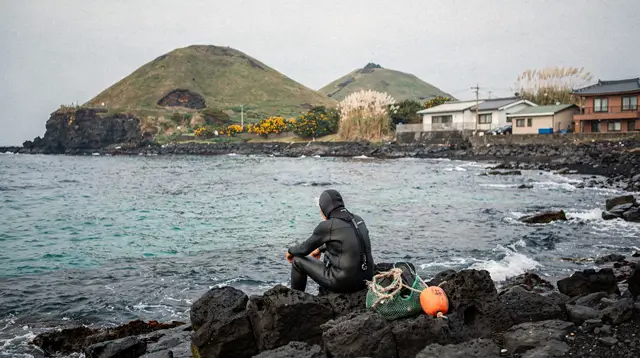
Much of the prized shellfish on a Jeju stall traces back to the island’s sea-women, and understanding who they are makes the meal more meaningful. The haenyeo culture guide explains the tradition, and the haenyeo museum guide is a good rainy-day complement. If you’d rather taste the catch alongside that story, a session that pairs the culture with a seafood tasting, such as a haenyeo culture experience with a seafood tasting, covers both in one outing.
Fitting a market visit into your day
A seafood stop works best as a late-morning anchor rather than a full-day plan. In Jeju City it sits comfortably beside the cultural side of Dongmun Market and the rest of Jeju City; in the south, pair it with the Seogwipo walking tour. Food-focused travelers building a longer trip will find market meals slot naturally into the food lovers itinerary.
Drinks, payment and table manners
Raw fish is traditionally enjoyed with a drink, and the soju and makgeolli guide covers what to order alongside it. For small stall purchases it helps to read up on money and currency on Jeju beforehand, and the food etiquette and tipping guide explains how to behave at shared tables and what is expected when you pay.
Frequently asked questions about Jeju seafood markets
Is market seafood safer or less safe than restaurant seafood?
Neither inherently — both operate under similar Korean food safety standards, and the usual freshness indicators (turnover, refrigeration, vendor confidence) apply equally to judging quality at either.
Can I request a specific cooking style when buying market seafood?
Yes, most vendors offer both raw and grilled preparation, and some can do a simple stew or soup with part of your purchase if asked — communicate your preference clearly, using a translation app if needed.
Is there a minimum purchase amount at seafood market stalls?
Generally no strict minimum, though very small purchases may not justify the preparation service in practice, since the fee is often charged per person or per preparation rather than scaling down proportionally for tiny quantities.
What happens if I buy more seafood than I can eat?
Ask the vendor about packaging the remainder to take away; most are accustomed to this request, though be mindful that seafood needs refrigeration soon after, which matters if you don’t have immediate access to a fridge.
Do seafood market stalls take reservations?
No, this is a walk-up, first-come system rather than a reservation-based restaurant model, consistent with how traditional markets generally operate.
Is it better value to buy seafood as a group rather than solo?
Yes, generally — preparation fees and reasonable purchase quantities favor splitting a purchase across two or more people, making the buy-and-prepare experience more cost-efficient for groups than solo travelers.
What time of day is best for buying fresh seafood at the market?
Morning tends to offer the freshest selection and the widest range of catch, before the day’s most popular items sell out; afternoon visits still work but with a somewhat narrower selection at the busiest stalls.
Related guides

Eating at Dongmun Market: a food-focused guide
Dongmun Market's food scene explained — what to eat, honest prices, the night market food street, and how to avoid the priciest tourist stalls.

Jeju abalone and seafood: what to eat and where
Jeju's abalone and seafood tradition explained — jeonbok-juk, haenyeo-caught seafood, and where to eat it without overpaying at tourist restaurants.

Jeju street food: a practical eating guide
Jeju's street food scene explained — what's actually local versus generic Korean street food, honest prices, and the best places to graze.

Hallabong and Jeju citrus: what to know before buying
Hallabong and Jeju's citrus varieties explained — season, real prices, where to buy quality fruit, and how to avoid overpriced tourist-shop tangerines.
Ready to book? Top tours for this guide
We earn a small commission if you book through GetYourGuide — at no extra cost to you. Every tour is hand-picked and verified.
Jeju: Haenyeo Culture Experience with Seafood Tasting
Jeju: Small Group South Cherry Blossom Tour & Tangerine Cafe
Jeju: Small Group Tour w/Pink Muhly & Tangerine Picking
Jeju: Hotel Pickup East Snow, Camellia, Tangerine Picking
Jeju: Small Group Tour w/ Camellia & Tangerine Picking
